

Report on Kilauea (United States) — 24 December-30 December 2025
Smithsonian Institution / US Geological Survey
Weekly Volcanic Activity Report, 24 December-30 December 2025
Managing Editor: Sally Sennert.
Please cite this report as:
Global Volcanism Program, 2025. Report on Kilauea (United States) (Sennert, S, ed.). Weekly Volcanic Activity Report, 24 December-30 December 2025. Smithsonian Institution and US Geological Survey.
Kilauea
United States
19.421°N, 155.287°W; summit elev. 1222 m
All times are local (unless otherwise noted)
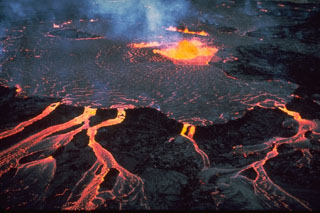
The Hawaiian Volcano Observatory (HVO) reported that the eruption within Kilauea’s Kaluapele summit caldera, characterized by episodic fountaining, incandescence, and intermittent spatter from craters along the SW margin of Halema’uma’u Crater, continued at variable levels during 23-30 December. Lava began to overflow the S vent at around 1841 on 23 December. The overflows intensified and by 2020 there were sustained lava fountains at both the N and S vents. Lava fountains rapidly grew taller and by 2130 the S vent fountain was 425 m tall and the N vent fountain was 275 m tall. At the N vent the fountain rose from the “right hand” part of the vent, or the W part of the vent based on the south-looking V1 webcam. The fountain was as tall as 280 m. A small fountain emerged at 2045 from the “left hand” part of the vent, the E side, and rose 30-60 m. Three fountains in total were active. The highest instantaneous effusion rate was 800 cubic meters per second at about 2100, just before the S and N vent fountains reached their maximum heights. The N vent stopped erupting at approximately 0200 on 24 December and the S vent stopped erupting around 0213. Fountaining lasted for 5.9 hours in total and produced an estimated 10 million cubic meters of lava. The combined average eruption rate was over 190 cubic meters per second from the fountains. Lava flows from the fountains covered about 60-70 percent of the floor of Halema’uma’u Crater. During 24-25 December lava flows moved along on the crater floor, notably an ‘a’a flow near the eruptive vents and a pahoehoe flow on the E crater floor, fed by lava draining from higher elevations to the W. The ‘a’a flow continued to move slowly through 29 December, though by then it no longer had any visible incandescence. Incandescence at the S vent was mostly persistent and only occasional at the N vent. The Volcano Alert Level remained at Watch (the third level on a four-level scale) and the Aviation Color Code remained at Orange (the third color on a four-color scale).
Geological Summary. Kilauea overlaps the E flank of the massive Mauna Loa shield volcano in the island of Hawaii. Eruptions are prominent in Polynesian legends; written documentation since 1820 records frequent summit and flank lava flow eruptions interspersed with periods of long-term lava lake activity at Halemaumau crater in the summit caldera until 1924. The 3 x 5 km caldera was formed in several stages about 1,500 years ago and during the 18th century; eruptions have also originated from the lengthy East and Southwest rift zones, which extend to the ocean in both directions. About 90% of the surface of the basaltic shield volcano is formed of lava flows less than about 1,100 years old; 70% of the surface is younger than 600 years. The long-term eruption from the East rift zone between 1983 and 2018 produced lava flows covering more than 100 km2, destroyed hundreds of houses, and added new coastline.
Source: US Geological Survey Hawaiian Volcano Observatory (HVO)
