

Report on Etna (Italy) — 1 January-7 January 2026
Smithsonian Institution / US Geological Survey
Weekly Volcanic Activity Report, 1 January-7 January 2026
Managing Editor: Sally Sennert.
Please cite this report as:
Global Volcanism Program, 2026. Report on Etna (Italy) (Sennert, S, ed.). Weekly Volcanic Activity Report, 1 January-7 January 2026. Smithsonian Institution and US Geological Survey.
Etna
Italy
37.748°N, 14.999°E; summit elev. 3357 m
All times are local (unless otherwise noted)
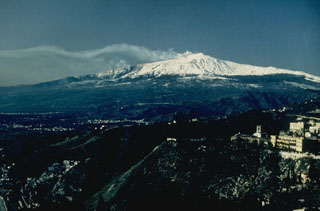
The Sezione di Catania - Osservatorio Etneo (INGV) reported that eruptive activity at Etna’s summit craters continued during 29 December 2025-4 January 2026, characterized by explosive activity (mainly at Voragine Crater) and advancing lava flows in the Valle del Bove. Visual observations were often hindered by weather conditions. On 29 December explosive activity at the BN-2 vent at Bocca Nuova Crater and from the vent on the E flank of the Voragine Crater produced ash emissions that rapidly dispersed near the summit. The NE Crater (Northeast Crater) produced sporadic ash emissions and flashes of incandescence visible at night. Beginning on 30 December summit activity was concentrated at Voragine Crater with Strombolian activity and minor ash emissions. Beginning at around 1730 on 1 January, as the weather conditions cleared, lava flows were visible within the Valle del Bove in webcam images. Satellite images and field observations conducted by INGV scientists revealed that at least two vents had opened just upslope of Mount Simone at about 2,050-2,100 m elevation. Intense spattering activity had built hornitos around the vents. By 1900 the lava flow field consisted of several branches, with the longest branch reaching an area just S of Rocca Musarra, around 1,570 m elevation. On 2 January the most advanced lava flow had reached 1,420 m elevation and was about 2.8 km long. During the next day, on 3 January, INGV scientists observed the flow field and launched drones. They noted that the longest branch had advanced 330 m since the previous day, reaching 1,380 m elevation, and had a total length of 3.14 km. The most active part of the flow field was between 1,800 m and 1,700 m elevation; this area consisted of several active branches, some newer flows overlapped older flows. The flow field area was an estimated 550,000 square meters. Lava flows were active on 4 January, though the longest flow was stationary and cooling.
Geological Summary. Mount Etna, towering above Catania on the island of Sicily, has one of the world's longest documented records of volcanism, dating back to 1500 BCE. Historical lava flows of basaltic composition cover much of the surface of this massive volcano, whose edifice is the highest and most voluminous in Italy. The Mongibello stratovolcano, truncated by several small calderas, was constructed during the late Pleistocene and Holocene over an older shield volcano. The most prominent morphological feature of Etna is the Valle del Bove, a 5 x 10 km caldera open to the east. Two styles of eruptive activity typically occur, sometimes simultaneously. Persistent explosive eruptions, sometimes with minor lava emissions, take place from one or more summit craters. Flank vents, typically with higher effusion rates, are less frequently active and originate from fissures that open progressively downward from near the summit (usually accompanied by Strombolian eruptions at the upper end). Cinder cones are commonly constructed over the vents of lower-flank lava flows. Lava flows extend to the foot of the volcano on all sides and have reached the sea over a broad area on the SE flank.
