

Report on Mayon (Philippines) — 1 January-7 January 2026
Smithsonian Institution / US Geological Survey
Weekly Volcanic Activity Report, 1 January-7 January 2026
Managing Editor: Sally Sennert.
Please cite this report as:
Global Volcanism Program, 2026. Report on Mayon (Philippines) (Sennert, S, ed.). Weekly Volcanic Activity Report, 1 January-7 January 2026. Smithsonian Institution and US Geological Survey.
Mayon
Philippines
13.257°N, 123.685°E; summit elev. 2462 m
All times are local (unless otherwise noted)
The Philippine Institute of Volcanology and Seismology (PHIVOLCS) reported that escalating numbers of rockfalls preceded the extrusion of new lava at Mayon. Beginning in November 2025 rockfalls from the summit lava dome became more frequent based on visual and seismic observations. A total of 599 rockfalls were recorded during November-December, averaging 21 events per day. Photos of the summit dome on 8 and 10 December revealed that dark lava spines had been recently extruded. On 31 December a total of 47 rockfalls were recorded, the highest number recorded in a single day in 2025. Ground deformation had been anomalous for the previous 18 months, notably at the E and NE flanks; inflation at the W and SW flanks began to be detected in May 2025. At 0600 on 1 January 2026 the Alert Level was raised to 2 (on a 0-5 scale); the public was warned to stay out of the 6-km-radius Permanent Danger Zone (PDZ) and pilots were advised to avoid flying close to the summit.
Sulfur dioxide emissions remained at background levels, averaging 288 tonnes per day (t/d) on 2 January and 702 t/d on 5 January. The seismic network continued to detect a high number of rockfalls from the unstable summit dome; a total of 346 rockfalls were recorded during 1-6 January as well as four volcanic earthquakes. The rockfalls lasted 1-5 minutes and descended the S flank less than 1 km. The volume of the rockfalls increased on 5 January and incandescence at the summit was seen at night, indicting the extrusion of new lava at the summit. Beginning at 1226 on 6 January a collapse of new material from the summit generated a three-minute-long pyroclastic density current (PDC) that traveled less than 2 km down the Bonga drainage on the SE flank. At 1320 the Alert Level was raised to 3. The Albay Provincial Information Office reported that the governor ordered the evacuation of residents living within the PDZ. Activity continued to increase through the day; in total there were 131 rockfalls and five PDCs detected on 6 January . By 0600 on 7 January a total of 3,476 people (952 families) had moved to 13 evacuation shelters, and an additional 39 people (12 families) were staying with friends or relatives, according to a report from the Disaster Response Operations Monitoring and Information Center (DROMIC). Collapses at the summit dome continued on 7 January; a total of 16 discrete PDC events were recorded during 1226-1630, generating grayish to brownish ash clouds that rose 200 m and drifted ENE. According to the Tokyo VAAC ash plumes during 1458-1928 on 7 January rose 2.4-3 km (8,000-10,000 ft) a.s.l., or as high as 580 m above the summit, and drifted NW and ENE.
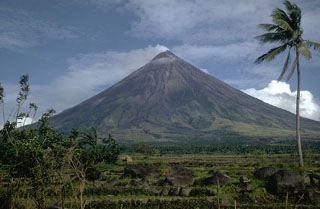
Geological Summary. Symmetrical Mayon, which rises above the Albay Gulf NW of Legazpi City, is the most active volcano of the Philippines. The steep upper slopes are capped by a small summit crater. Recorded eruptions since 1616 CE range from Strombolian to basaltic Plinian, with cyclical activity beginning with basaltic eruptions, followed by longer periods of andesitic lava flows. Eruptions occur predominately from the central conduit and have also produced lava flows that travel far down the flanks. Pyroclastic density currents and mudflows have commonly swept down many of the approximately 40 ravines that radiate from the summit and have often damaged populated lowland areas. A violent eruption in 1814 killed more than 1,200 people and devastated several towns.
Sources: Philippine Institute of Volcanology and Seismology (PHIVOLCS), Disaster Response Operations Monitoring and Information Center (DROMIC), Tokyo Volcanic Ash Advisory Center (VAAC), Albay Provincial Information Office
