

Report on Masaya (Nicaragua) — 1 January-7 January 2026
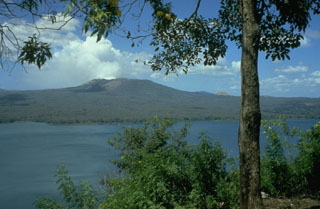
Smithsonian Institution / US Geological Survey
Weekly Volcanic Activity Report, 1 January-7 January 2026
Managing Editor: Sally Sennert.
Please cite this report as:
Global Volcanism Program, 2026. Report on Masaya (Nicaragua) (Sennert, S, ed.). Weekly Volcanic Activity Report, 1 January-7 January 2026. Smithsonian Institution and US Geological Survey.
Masaya
Nicaragua
11.9844°N, 86.1688°W; summit elev. 594 m
All times are local (unless otherwise noted)
The Washington Volcanic Ash Advisory Center (VAAC) reported that at 0750 on 2 January a diffuse ash plume from Masaya was visible in satellite and webcam images rising to 1.2 km (4,000 ft) a.s.l. and drifting less than 20 km SW.
Geological Summary. Masaya volcano in Nicaragua has erupted frequently since the time of the Spanish Conquistadors, when an active lava lake prompted attempts to extract the volcano's molten "gold" until it was found to be basalt rock upon cooling. It lies within the massive Pleistocene Las Sierras caldera and is itself a broad, 6 x 11 km basaltic caldera with steep-sided walls up to 300 m high. The caldera is filled on its NW end by more than a dozen vents that erupted along a circular, 4-km-diameter fracture system. The Nindirí and Masaya cones, the source of observed eruptions, were constructed at the southern end of the fracture system and contain multiple summit craters, including the currently active Santiago crater. A major basaltic Plinian tephra erupted from Masaya about 6,500 years ago. Recent lava flows cover much of the caldera floor and there is a lake at the far eastern end. A lava flow from the 1670 eruption overtopped the north caldera rim. Periods of long-term vigorous gas emission at roughly quarter-century intervals have caused health hazards and crop damage.
