
Smithsonian Institution / US Geological Survey
Weekly Volcanic Activity Report, 12 March-18 March 2026
Managing Editor: Sally Sennert
Please cite this report as:
Global Volcanism Program, 2026. Report on Akan (Japan) (Sennert, S, ed.). Weekly Volcanic Activity Report, 12 March-18 March 2026. Smithsonian Institution and US Geological Survey. https://volcano.si.edu/showreport.cfm?gvpvar=GVP.WVAR20260312-285070
The Japan Meteorological Agency (JMA) reported continuing eruptive activity at Akan (also known as Meakan-dake, which means Meakan Peak) of the Akan volcanic complex during 9-15 March. During a field visit on 9 March scientists measured an average of 300 tons per day of sulfur dioxide emissions, the same as the last measurement on 18 February. Weather clouds obscured webcam views for most of the week, starting during the evening of 11 March. At around 0831 on 13 March a small-amplitude, short-duration volcanic tremor was recorded along with a very slight tilt change; eruptive activity could not be visually confirmed. Weather conditions allowed for clearer webcam views around noon on 15 March. Black deposits, likely volcanic ash, were visible on the snow near Ponmachineshiri Crater’s 96-1 vent; an eruptive event occurred sometime during 11-15 March. The Alert Level remained at 2 (the second lowest level on a 5-level scale) and the public was warned to exercise caution within 500 m of Ponmachineshiri Crater.
Source: Japan Meteorological Agency (JMA)
Geological Summary. Akan is a 13 x 24 km caldera located immediately SW of Kussharo caldera in eastern Hokkaido. The elongated, irregular outline of the caldera rim reflects its incremental formation during major explosive eruptions from the early to mid-Pleistocene. There are four post-caldera stratovolcanoes, three at the SW end of the caldera and the other on the NE side. Conical Oakandake was frequently active during the Holocene. The 1-km-wide Nakamachineshiri crater of Meakandake was formed during a major pumice-and-scoria eruption about 13,500 years ago. The Meakandake group, composed of nine overlapping cones E of Lake Akan, has produced mild phreatic eruptions since the beginning of the 19th century. The main cone of Meakandake proper has a triple crater at its summit. Although recorded eruptions at Meakandake have consisted of minor phreatic explosions, four major magmatic eruptions with pyroclastic flows have also occurred during the Holocene.


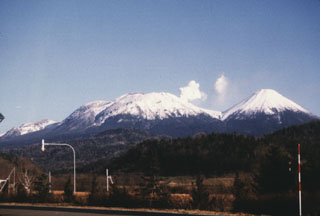 Akan
Akan