
Smithsonian Institution
Bulletin of the Global Volcanism Network, vol. 18, no. 1 (January 1993)
Managing Editor: Lindsay McClelland
Dieng Volcanic Complex (Indonesia) Hot mud fountains and steam emissions; poisonous gas
Please cite this report as:
Global Volcanism Program, 1993. Report on Dieng Volcanic Complex (Indonesia) (McClelland, L, ed.). Bulletin of the Global Volcanism Network, 18:1. Smithsonian Institution. https://doi.org/10.5479/si.GVP.BGVN199301-263200
Hot mud began fountaining from a new vent (near the Pandawa Lima Temples) area at 0001 on 23 January. The fountaining was heard by residents of a nearby village (Bale Kambang). The hot mud, which emerged from a 5-m-diameter hole, had a temperature of 93°C and reached heights of 2-15 m. Hot mud and steam emissions were continuing on 8 February, with fountaining to 1 m height. The area within 25 m of the hole has been covered with mud. Gas measurements taken on 8 February detected 15 ppm HCN and 12 ppm H2S. Shallow volcanic earthquakes were recorded in January at rates of 3-20/day, but were decreasing prior to the 23 January activity. Seismicity has continued since then.
Information Contacts: W. Tjetjep, VSI.
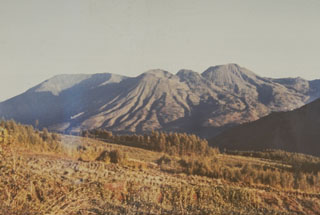
Geological Summary. The Dieng plateau in the highlands of central Java is renowned both for the variety of its volcanic scenery and as a sacred area housing Java's oldest Hindu temples, dating back to the 9th century CE. The Dieng Volcanic Complex consists of multiple stratovolcanoes and more than 20 small Pleistocene-to-Holocene craters and cones over a 6 x 14 km area. Prahu stratovolcano was truncated by a large Pleistocene caldera, which was subsequently filled by a series of cones, lava domes, and craters, many containing lakes. Lava flows cover much of the plateau, but observed activity has been restricted to minor phreatic eruptions. Gas emissions are a hazard at several craters and have caused fatalities. There are abundant thermal features and high heat flow across the area.


 Dieng Volcanic Complex