
Smithsonian Institution
Scientific Event Alert Network Bulletin, vol. 11, no. 11 (November 1986)
Managing Editor: Lindsay McClelland
Ulawun (Papua New Guinea) Low levels of seismicity and steam emission
Please cite this report as:
Global Volcanism Program, 1986. Report on Ulawun (Papua New Guinea) (McClelland, L, ed.). Scientific Event Alert Network Bulletin, 11:11. Smithsonian Institution. https://doi.org/10.5479/si.GVP.SEAN198611-252120
"Activity remained at non-eruptive levels throughout November. Seismicity was at a very low level and dry tilt measurements indicated no significant tilt between 18 and 21 November. The only reported activity was weak vapour emission from the summit."
Information Contacts: B. Talai and P. Lowenstein, RVO.
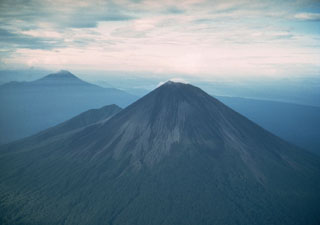
Geological Summary. The symmetrical basaltic-to-andesitic Ulawun stratovolcano is the highest volcano of the Bismarck arc, and one of Papua New Guinea's most frequently active. The volcano, also known as the Father, rises above the N coast of the island of New Britain across a low saddle NE of Bamus volcano, the South Son. The upper 1,000 m is unvegetated. A prominent E-W escarpment on the south may be the result of large-scale slumping. Satellitic cones occupy the NW and E flanks. A steep-walled valley cuts the NW side, and a flank lava-flow complex lies to the south of this valley. Historical eruptions date back to the beginning of the 18th century. Twentieth-century eruptions were mildly explosive until 1967, but after 1970 several larger eruptions produced lava flows and basaltic pyroclastic flows, greatly modifying the summit crater.


 Ulawun