
Smithsonian Institution / US Geological Survey
Weekly Volcanic Activity Report, 26 July-1 August 2023
Managing Editor: Kadie Bennis
Please cite this report as:
Global Volcanism Program, 2023. Report on Ulawun (Papua New Guinea) (Bennis, K L, ed.). Weekly Volcanic Activity Report, 26 July-1 August 2023. Smithsonian Institution and US Geological Survey. https://volcano.si.edu/showreport.cfm?gvpvar=GVP.WVAR20230726-252120
RVO reported that occasional ash emissions at Ulawun occurred during 25-26 July and drifted SE. Moderate seismicity was variable and was dominated by volcanic tremors. RSAM values ranged between 380 and 800. The Alert Level was raised to Stage 2 (the second highest on the four-level scale) on 27 July.
Source: Rabaul Volcano Observatory (RVO)
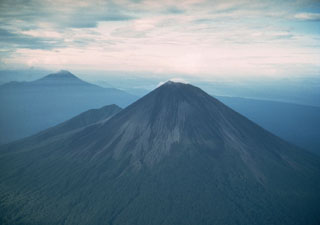
Geological Summary. The symmetrical basaltic-to-andesitic Ulawun stratovolcano is the highest volcano of the Bismarck arc, and one of Papua New Guinea's most frequently active. The volcano, also known as the Father, rises above the N coast of the island of New Britain across a low saddle NE of Bamus volcano, the South Son. The upper 1,000 m is unvegetated. A prominent E-W escarpment on the south may be the result of large-scale slumping. Satellitic cones occupy the NW and E flanks. A steep-walled valley cuts the NW side, and a flank lava-flow complex lies to the south of this valley. Historical eruptions date back to the beginning of the 18th century. Twentieth-century eruptions were mildly explosive until 1967, but after 1970 several larger eruptions produced lava flows and basaltic pyroclastic flows, greatly modifying the summit crater.


 Ulawun