
Smithsonian Institution / US Geological Survey
Weekly Volcanic Activity Report, 20 August-26 August 2025
Managing Editor: Sally Sennert
Please cite this report as:
Global Volcanism Program, 2025. Report on Ulawun (Papua New Guinea) (Sennert, S, ed.). Weekly Volcanic Activity Report, 20 August-26 August 2025. Smithsonian Institution and US Geological Survey. https://volcano.si.edu/showreport.cfm?gvpvar=GVP.WVAR20250820-252120
The Rabaul Volcano Observatory (RVO) reported that activity at Ulawun was low during 1-20 August. Summit emissions occasionally observed during periods of clearer weather were characterized as white with variable densities; weather clouds obscured views of the summit on most days. There were reports of brief periods of minor summit incandescence observed from the Bakada and Likuranga areas to the NE, but those observations were unconfirmed. Seismicity was dominated by small low- and high-frequency volcanic earthquakes, with low-frequency earthquakes being the dominant signal. Occasionally periods of low-level volcanic tremors were recorded by the seismic network, lasting between one hour and several hours. The Alert Level remained at Stage 1 (the lowest level of a four-stage scale).
Source: Rabaul Volcano Observatory (RVO)
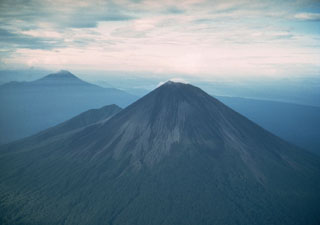
Geological Summary. The symmetrical basaltic-to-andesitic Ulawun stratovolcano is the highest volcano of the Bismarck arc, and one of Papua New Guinea's most frequently active. The volcano, also known as the Father, rises above the N coast of the island of New Britain across a low saddle NE of Bamus volcano, the South Son. The upper 1,000 m is unvegetated. A prominent E-W escarpment on the south may be the result of large-scale slumping. Satellitic cones occupy the NW and E flanks. A steep-walled valley cuts the NW side, and a flank lava-flow complex lies to the south of this valley. Historical eruptions date back to the beginning of the 18th century. Twentieth-century eruptions were mildly explosive until 1967, but after 1970 several larger eruptions produced lava flows and basaltic pyroclastic flows, greatly modifying the summit crater.


 Ulawun