

Report on Ambrym (Vanuatu) — 19 January-25 January 2022
Smithsonian Institution / US Geological Survey
Weekly Volcanic Activity Report, 19 January-25 January 2022
Managing Editor: Sally Sennert.
Please cite this report as:
Global Volcanism Program, 2022. Report on Ambrym (Vanuatu) (Sennert, S, ed.). Weekly Volcanic Activity Report, 19 January-25 January 2022. Smithsonian Institution and US Geological Survey.
Ambrym
Vanuatu
16.25°S, 168.12°E; summit elev. 1334 m
All times are local (unless otherwise noted)
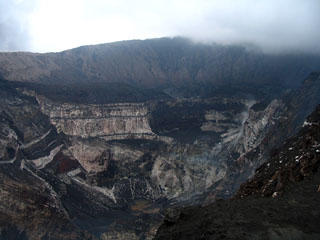
On 25 January the Vanuatu Meteorology and Geo-Hazards Department (VMGD) raised the Alert Level for Ambrym to 2 (on a scale of 0-5) due to a significant increase in activity beginning at around 0400. Steam emissions rose from Marum Crater, and at 0515 a steam, gas, and ash plume rose from Benbow Crater. Satellite data recorded increased sulfur dioxide emissions from Benbow, and residents of Ambrym and surrounding islands reported seeing incandescence from crater overnight. VMGD warned the public to stay outside of the Permanent Danger Zone A defined as a 1-km radius around Benbow Crater and a 2-km radius around Marum Crater, and additionally to stay 500 m away from the ground cracks created by the December 2018 eruption.
Geological Summary. Ambrym is a large basaltic volcano with a 12-km-wide caldera formed during a major Plinian eruption with dacitic pyroclastic flows about 1,900 years ago. A thick, almost exclusively pyroclastic sequence, initially dacitic then basaltic, overlies lava flows of a pre-caldera shield volcano. Post-caldera eruptions, primarily from Marum and Benbow cones, have partially filled the caldera floor and produced lava flows that ponded on the floor or overflowed through gaps in the caldera rim. Post-caldera eruptions have also formed a series of scoria cones and maars along a fissure system oriented ENE-WSW. Eruptions have been frequently reported since 1774, though mostly limited to extra-caldera eruptions that would have affected local populations. Since 1950 observations of eruptive activity from cones within the caldera or from flank vents have occurred almost yearly.
Source: Vanuatu Meteorology and Geohazards Department (VMGD)
