

Report on Ioto (Japan) — 3 September-9 September 2025
Smithsonian Institution / US Geological Survey
Weekly Volcanic Activity Report, 3 September-9 September 2025
Managing Editor: Sally Sennert.
Please cite this report as:
Global Volcanism Program, 2025. Report on Ioto (Japan) (Sennert, S, ed.). Weekly Volcanic Activity Report, 3 September-9 September 2025. Smithsonian Institution and US Geological Survey.
Ioto
Japan
24.751°N, 141.289°E; summit elev. 169 m
All times are local (unless otherwise noted)
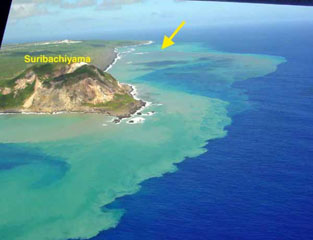
The Japan Meteorological Agency (JMA) reported that an eruption at Ioto (Iwo-jima) began at around 1914 on 1 September from a submarine vent off the W coast of the island. An eruption plume rose about 1 km above the surface of the water and had darker- and lighter-colored components. The eruption was ongoing at least through the next day; a webcam image captured at 0730 on 2 September showed a Surtseyan ejection of dark material above the water’s surface and a white steam-and-gas plume drifting downwind. The Japan Coast Guard reported bubbling water around the vents on 14 August, and JMA noted that both seismicity and inflation increased on 30 August. The last eruption occurred in February.
Geological Summary. Ioto, in the Volcano Islands of Japan, lies within a 9-km-wide submarine caldera. The volcano is also known as Ogasawara-Iojima to distinguish it from several other "Sulfur Island" volcanoes in Japan. The triangular, low-elevation, 8-km-long island narrows toward its SW tip and has produced trachyandesitic and trachytic rocks that are more alkalic than those of other volcanoes in this arc. The island has undergone uplift for at least the past 700 years, accompanying resurgent doming of the caldera; a shoreline landed upon by Captain Cook's surveying crew in 1779 is now 40 m above sea level. The Motoyama plateau on the NE half of the island consists of submarine tuffs overlain by coral deposits and forms the island's high point. Many fumaroles are oriented along a NE-SW zone cutting through Motoyama. Numerous recorded phreatic eruptions, many from vents on the W and NW sides of the island, have accompanied the uplift.
Sources: Japan Meteorological Agency (JMA), Japan Coast Guard
