

Report on Whakaari/White Island (New Zealand) — 12 November-18 November 2025
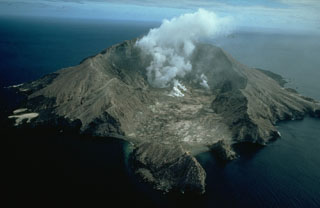
Smithsonian Institution / US Geological Survey
Weekly Volcanic Activity Report, 12 November-18 November 2025
Managing Editor: Sally Sennert.
Please cite this report as:
Global Volcanism Program, 2025. Report on Whakaari/White Island (New Zealand) (Sennert, S, ed.). Weekly Volcanic Activity Report, 12 November-18 November 2025. Smithsonian Institution and US Geological Survey.
Whakaari/White Island
New Zealand
37.52°S, 177.18°E; summit elev. 294 m
All times are local (unless otherwise noted)
GeoNet reported that eruptive activity at Whakaari/White Island continued on 14 November. At about 1130 a steam-and-gas plume was visible from the Bay of Plenty coast, in Whakatane and Te Kaha webcam images, rising to around 3 km a.s.l. Webcam and satellite images indicated that the ash content was low. According to the Wellington VAAC gas-and-steam plumes containing ash rose to 1.2 km (4,000 ft) a.s.l. and drifted SW on 17 November based on pilot observations and satellite images. The Volcanic Alert Level remained at 3 (on a scale of 0-5) and the Aviation Color Code remained at Orange (the second highest level on a four-color scale).
Geological Summary. The uninhabited Whakaari/White Island is the 2 x 2.4 km emergent summit of a 16 x 18 km submarine volcano in the Bay of Plenty about 50 km offshore of North Island. The island consists of two overlapping andesitic-to-dacitic stratovolcanoes. The SE side of the crater is open at sea level, with the recent activity centered about 1 km from the shore close to the rear crater wall. Volckner Rocks, sea stacks that are remnants of a lava dome, lie 5 km NW. Descriptions of volcanism since 1826 have included intermittent moderate phreatic, phreatomagmatic, and Strombolian eruptions; activity there also forms a prominent part of Maori legends. The formation of many new vents during the 19th and 20th centuries caused rapid changes in crater floor topography. Collapse of the crater wall in 1914 produced a debris avalanche that buried buildings and workers at a sulfur-mining project. Explosive activity in December 2019 took place while tourists were present, resulting in many fatalities. The official government name Whakaari/White Island is a combination of the full Maori name of Te Puia o Whakaari ("The Dramatic Volcano") and White Island (referencing the constant steam plume) given by Captain James Cook in 1769.
Sources: GeoNet, Wellington Volcanic Ash Advisory Center (VAAC)
