

Report on Taal (Philippines) — 12 November-18 November 2025
Smithsonian Institution / US Geological Survey
Weekly Volcanic Activity Report, 12 November-18 November 2025
Managing Editor: Sally Sennert.
Please cite this report as:
Global Volcanism Program, 2025. Report on Taal (Philippines) (Sennert, S, ed.). Weekly Volcanic Activity Report, 12 November-18 November 2025. Smithsonian Institution and US Geological Survey.
Taal
Philippines
14.0106°N, 120.9975°E; summit elev. 311 m
All times are local (unless otherwise noted)
The Philippine Institute of Volcanology and Seismology (PHIVOLCS) reported eruptive activity at Taal during 12-18 November. The seismic network recorded 10-20 daily volcanic earthquakes along with periods of volcanic tremor on 12 and 16 November. One minor phreatic event occurred on 12 November and lasted for three minutes; voluminous emissions rose 2.8 km above the crater rim and drifted NE. Daily gas-and-steam emissions with variable densities rose 400-900 m above the crater rim and drifted SW during the rest of the week. Sulfur dioxide emissions decreased during the week, averaging 1,095 tonnes per day (t/d) on 12 November, 339 t/d on 14 November, and 72 t/d on 17 November. The Alert Level remained at 1 (on a scale of 0-5); PHIVOLCS reminded the public that the entire Taal Volcano Island (TVI) was a Permanent Danger Zone (PDZ) and recommended that the Main Crater and areas along the Daang Kastila fissure should remain prohibited. Pilots were warned to avoid flying over TVI.
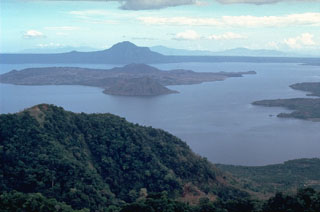
Geological Summary. Taal is one of the most active volcanoes in the Philippines and has produced some powerful eruptions. The 15 x 20 km Talisay (Taal) caldera is largely filled by Lake Taal, whose 267 km2 surface lies only 3 m above sea level. The maximum depth of the lake is 160 m, with several submerged eruptive centers. The 5-km-wide Volcano Island in north-central Lake Taal is the location of all observed eruptions. The island is composed of coalescing small stratovolcanoes, tuff rings, and scoria cones. Powerful pyroclastic flows and surges have caused many fatalities.
Source: Philippine Institute of Volcanology and Seismology (PHIVOLCS)
