

Report on Ahyi (United States) — 12 November-18 November 2025
Smithsonian Institution / US Geological Survey
Weekly Volcanic Activity Report, 12 November-18 November 2025
Managing Editor: Sally Sennert.
Please cite this report as:
Global Volcanism Program, 2025. Report on Ahyi (United States) (Sennert, S, ed.). Weekly Volcanic Activity Report, 12 November-18 November 2025. Smithsonian Institution and US Geological Survey.
Ahyi
United States
20.437°N, 145.03°E; summit elev. -50 m
All times are local (unless otherwise noted)
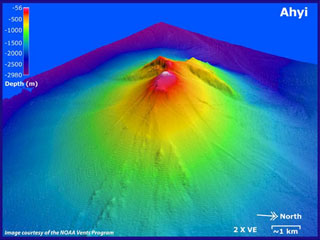
The US Geological Survey reported that signs of unrest at Ahyi Seamount were observed during the previous few weeks. Plumes of discolored water drifting up to 1.6 km away from the volcano were observed in satellite images on 20, 21, 26, and 28 October and on 5 November. No high-resolution satellite data were available during 6-14 November. One signal coming from the direction of Ahyi was identified in data from underwater pressure sensors near Wake Island (about 2,270 km E of Ahyi) and may have been related to activity. The Aviation Color Code remained at Yellow (the second lowest level on a four-color scale) and the Volcano Alert Level remained at Advisory (the second lowest level on a four-level scale).
Geological Summary. Ahyi seamount is a large conical submarine volcano ~18 km SE of the island of Farallon de Pajaros in the northern Marianas. Water discoloration has been observed there, and in 1979 the crew of a fishing boat felt shocks over the summit area, followed by upwelling of sulfur-bearing water. On 24-25 April 2001 an explosive eruption was detected seismically by a station on Rangiroa Atoll, Tuamotu Archipelago. The event was well constrained (+/- 15 km) at a location near the southern base of Ahyi. An eruption in April-May 2014 was detected by NOAA divers, hydroacoustic sensors, and seismic stations.
Source: US Geological Survey
