

Report on Planchon-Peteroa (Chile) — 12 November-18 November 2025
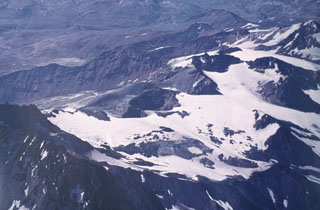
Smithsonian Institution / US Geological Survey
Weekly Volcanic Activity Report, 12 November-18 November 2025
Managing Editor: Sally Sennert.
Please cite this report as:
Global Volcanism Program, 2025. Report on Planchon-Peteroa (Chile) (Sennert, S, ed.). Weekly Volcanic Activity Report, 12 November-18 November 2025. Smithsonian Institution and US Geological Survey.
Planchon-Peteroa
Chile
35.223°S, 70.568°W; summit elev. 3977 m
All times are local (unless otherwise noted)
According to the Buenos Aires VAAC steam-and-gas plumes with diffuse ash content at Planchón-Peteroa rose 4.3-4.6 km (14,000-15,000 ft) a.s.l. and drifted SE during 11-13 November. The Servicio Nacional de Geología y Minería (SERNAGEOMIN) also reported that emissions were visible on 13 November. Specifically, a gas-and-ash plume rose 2 km above the crater rim and drifted NE at 0956 according to the Servicio Geológico Minero Argentino (SEGEMAR); the emissions continued at least through 1010. The Alert Level remained at Yellow (the middle level on a three-color scale). The Sistema y Servicio Nacional de Prevención y Repuesta Ante Desastres (SENAPRED) stated that the communities of Molina (66 WNW), Curicó (68 km NW), Romeral (75 km NW), and Teno (68 km NW) continued to be under a “Preventive Early Warning” (since 18 July 2025) and that a security perimeter 4 km from the craters was in effect.
Geological Summary. Planchón-Peteroa is an elongated complex volcano along the Chile-Argentina border with several overlapping calderas. Activity began in the Pleistocene with construction of the basaltic andesite to dacitic Volcán Azufre, followed by formation of the basaltic and basaltic andesite Volcán Planchón, 6 km N. About 11,500 years ago much of Azufre and part of Planchón collapsed, forming the massive Río Teno debris avalanche, which traveled 95 km to reach Chile's Central Valley. Subsequently, Volcán Planchón II was formed. The youngest volcano, andesitic and basaltic andesite Volcán Peteroa, consists of scattered vents between Azufre and Planchón, and and contains a small steaming crater lake. Reported eruptions from the complex have been dominantly explosive, although lava flows were emplaced in 1837 and 1937.
Sources: Servicio Nacional de Geología y Minería (SERNAGEOMIN), Buenos Aires Volcanic Ash Advisory Center (VAAC), Sistema y Servicio Nacional de Prevención y Repuesta Ante Desastres (SENAPRED), Servicio Geológico Minero Argentino (SEGEMAR)
