

Report on Talang (Indonesia) — 10 December-16 December 2025
Smithsonian Institution / US Geological Survey
Weekly Volcanic Activity Report, 10 December-16 December 2025
Managing Editor: Sally Sennert.
Please cite this report as:
Global Volcanism Program, 2025. Report on Talang (Indonesia) (Sennert, S, ed.). Weekly Volcanic Activity Report, 10 December-16 December 2025. Smithsonian Institution and US Geological Survey.
Talang
Indonesia
0.979°S, 100.681°E; summit elev. 2575 m
All times are local (unless otherwise noted)
The Pusat Vulkanologi dan Mitigasi Bencana Geologi (PVMBG) reported increased seismicity at Talang starting in September 2024, and seismicity indicative of magma movement in December 2025. The seismic network recorded swarms of deep volcanic (VT) earthquakes on 8 April, on 25 July, on 23 September, and on 9 October 2025. Specifically, the 23 September swarm was more clustered beneath the crater area and located at shallower depths compared to the 8 April and 25 July swarms. During 1-9 December seismicity was characterized by 101 VT earthquakes, two felt earthquakes ranging I-III on the Modified Mercalli Intensity scale (MMI), and 14 deep tectonic earthquakes. A tectonic earthquake (M 4.7) at 0248 on 10 December was located about 222 km N; this was followed over about the next six hours by 227 VT earthquakes. At 1000 the Alert Level was raised to 2 (on a scale of 1-4) and visitors and tourists were warned to stay away 2 km from both South Crater and Main Crater. PVMBG noted that Talang, mainly consisting of the Talang Jantan cone and Talang Betina cone about 1 km W, was located along the central zone of the active Great Sumatran Fault and influenced by tectonic activity.
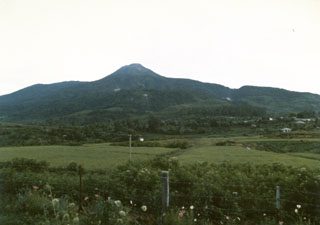
Geological Summary. Talang is part of a large volcanic edifice just NW of Dibawah Lake. An older volcanic peak, Pasar Arbaao, is ~1.5 km W. The steep-sided Talang cone exhibits fumarolic activity but has no crater; it appears to have grown within a larger caldera. Recorded eruptions have mostly involved small-to-moderate explosive activity, first documented in the 19th century, that originated from a series of small craters in a valley on the NE flank.
Source: Pusat Vulkanologi dan Mitigasi Bencana Geologi (PVMBG, also known as CVGHM)
