

Report on Shishaldin (United States) — 10 December-16 December 2025
Smithsonian Institution / US Geological Survey
Weekly Volcanic Activity Report, 10 December-16 December 2025
Managing Editor: Sally Sennert.
Please cite this report as:
Global Volcanism Program, 2025. Report on Shishaldin (United States) (Sennert, S, ed.). Weekly Volcanic Activity Report, 10 December-16 December 2025. Smithsonian Institution and US Geological Survey.
Shishaldin
United States
54.756°N, 163.97°W; summit elev. 2857 m
All times are local (unless otherwise noted)
The Alaska Volcano Observatory (AVO) reported that on 13 December strong winds in the vicinity of Shishaldin dispersed unconsolidated ash up to 2.7 km (9,000 ft) a.s.l. to the SSW. This phenomenon was not the result of recent volcanic activity and occurs during times of strong winds and dry snow-free conditions. The Anchorage Volcanic Ash Advisory Center and AVO reported that plumes of unconsolidated ash were visible in satellite images the next day, rising to the same altitude. Lower-level plumes of unconsolidated ash were also visible the week before, on 6 December, rising to 1.2 km (4,000 ft) a.s.l. The Volcano Alert Level remained at Advisory (the second lowest level on a four-level scale) and the Aviation Color Code remained at Yellow (the second lowest level on a four-color scale).
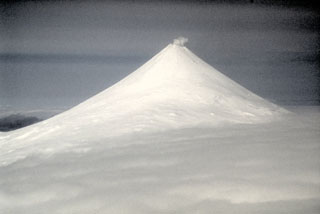
Geological Summary. The symmetrical glacier-covered Shishaldin in the Aleutian Islands is the westernmost of three large stratovolcanoes in the eastern half of Unimak Island. The Aleuts named the volcano Sisquk, meaning "mountain which points the way when I am lost." Constructed atop an older glacially dissected edifice, it is largely basaltic in composition. Remnants of an older edifice are exposed on the W and NE sides at 1,500-1,800 m elevation. There are over two dozen pyroclastic cones on its NW flank, which is covered by massive aa lava flows. Frequent explosive activity, primarily consisting of Strombolian ash eruptions from the small summit crater, but sometimes producing lava flows, has been recorded since the 18th century. A steam plume often rises from the summit crater.
Sources: US Geological Survey Alaska Volcano Observatory (AVO), Anchorage Volcanic Ash Advisory Center (VAAC)
