

Report on Lewotobi (Indonesia) — 8 January-14 January 2026
Smithsonian Institution / US Geological Survey
Weekly Volcanic Activity Report, 8 January-14 January 2026
Managing Editor: Sally Sennert.
Please cite this report as:
Global Volcanism Program, 2026. Report on Lewotobi (Indonesia) (Sennert, S, ed.). Weekly Volcanic Activity Report, 8 January-14 January 2026. Smithsonian Institution and US Geological Survey.
Lewotobi
Indonesia
8.542°S, 122.775°E; summit elev. 1703 m
All times are local (unless otherwise noted)
According to the Kementerian Energi dan Sumber Daya Mineral (ESDM), the Badan Nacional Penanggulangan Bencana (BNPB), and news reports, seismic activity at Lewotobi Laki-laki began to increase during 23-24 December 2025, with notable increases in the number of deep volcanic earthquakes on 31 December. ESDM noted that deformation data from the Global Navigation Satellite System (GNSS) and tiltmeter data indicated significant inflation starting at around the same time as the increased seismicity that intensified during the last few days of the year. The seismicity and inflation were indicators that magma was moving. The Pusat Vulkanologi dan Mitigasi Bencana Geologi (PVMBG) raised the Alert Level to 4 (the highest level on a scale of 1-4) at 1800 on 1 January and warned the public to stay 6 km away from the center of Laki-laki and 7 km in an area clockwise from NW to NE. News agencies reported that seismicity remained at high levels during 2-3 January and deformation data showed inflationary trends. On 9 January PVMBG lowered the Alert Level to 3 and the public was warned to stay 6 km away from the center of Laki-laki.
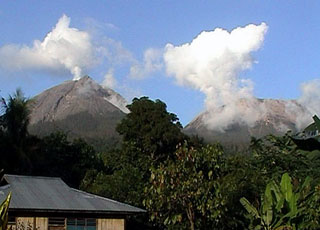
Geological Summary. The Lewotobi edifice in eastern Flores Island is composed of the two adjacent Lewotobi Laki-laki and Lewotobi Perempuan stratovolcanoes (the "husband and wife"). Their summits are less than 2 km apart along a NW-SE line. The conical Laki-laki to the NW has been frequently active during the 19th and 20th centuries, while the taller and broader Perempuan has had observed eruptions in 1921 and 1935. Small lava domes have grown during the 20th century in both of the summit craters, which are open to the north. A prominent cone, Iliwokar, occurs on the E flank of Perampuan.
Sources: Pusat Vulkanologi dan Mitigasi Bencana Geologi (PVMBG, also known as CVGHM), Badan Nacional Penanggulangan Bencana (BNPB), Tempo (Indonesia), Kementerian Energi dan Sumber Daya Mineral (ESDM), TVRI news
