
| Country | United States |
| Volcanic Region | Aleutian Ridge Volcanic Arc |
| Landform | Volc Type | Composite | Stratovolcano |
| Last Known Eruption | Pleistocene |
| Coordinates | 54.765°N, 163.723°W |
| Elevation | 2,446 m (8,025 ft) |
| Volcano Number | 311370 |
 Google Earth Placemark with Features Google Earth Placemark with Features
| |
 Cite Volcano Profile Cite Volcano Profile
| |
The Global Volcanism Program has no Weekly Volcanic Activity Reports available for Isanotski Peaks.
The Global Volcanism Program has no Bulletin Reports available for Isanotski Peaks.
The Global Volcanism Program has no Weekly Reports available for Isanotski Peaks.
The Global Volcanism Program has no Bulletin Reports available for Isanotski Peaks.
|
|
||||||||||||||||||||||||||
There is data available for 0 confirmed eruptive period.
[ 1845 Jul 2 ± 182 days ] Discredited Eruption
[ 1831 Mar 16 ± 15 days - 1831 May 6 ± 1 days ] Discredited Eruption
[ 1830 Nov 16 ± 15 days ] Discredited Eruption
[ 1825 Mar 10 ] Discredited Eruption
[ 1795 ] Discredited Eruption
This compilation of synonyms and subsidiary features may not be comprehensive. Features are organized into four major categories: Cones, Craters, Domes, and Thermal Features. Synonyms of features appear indented below the primary name. In some cases additional feature type, elevation, or location details are provided.
Synonyms |
| Issanakski | Sannak | Isannach | Ragged Jack | Isannachotski |
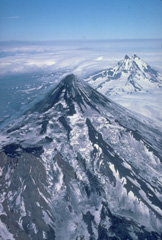 Despite its extensive glacial cover, Shishaldin volcano maintains its symmetrical profile because of frequent eruptions. Aa lava flows, erupted from summit and satellitic vents, spread over the NW flank, the location of more than 2 dozen pyroclastic cones. The dominantly basaltic volcano is the highest peak in the Aleutian Islands. The rugged, dissected Isanotski volcano rises to the east behind Shishaldin.
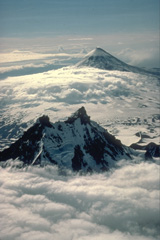 The effects of differential erosion are dramatically seen in this aerial view of two Alaskan volcanoes. Isanotski volcano in the foreground, sometimes referred to as "Ragged Jack," has been extensively dissected by glaciers that have excavated steep walls separated by narrow ridges. The symmetrical Shishaldin volcano in the background is sometimes referred to as the Mount Fuji of the Aleutians. In contrast to Isanotski, Shishaldin is one of Alaska's most active volcanoes. Frequent eruptions maintain the young, constructional profile of the volcano.
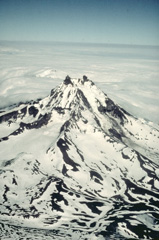 Isanotski volcano, sometimes referred to as "Ragged Jack," has been extensively dissected by glaciers. Although historical eruptions in the 18th and 19th centuries have been attributed to Isanotski, these reports from an infrequently visited region with notoriously poor weather must be considered somewhat suspect.
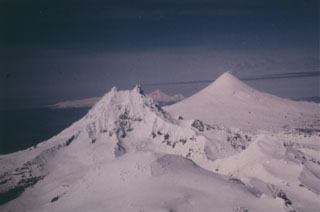 Three volcanoes are constructed along an E-W trend on the eastern half of Unimak Island. Roundtop in the foreground is glacially eroded and has Holocene pyroclastic flow deposits and a group of lava domes to the south. Isanotski is in the background and Shishaldin is in the midground.
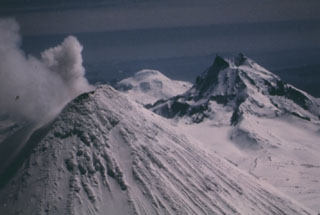 Unimak Island has three volcanoes constructed along an E-W line. Shishaldin is in the foreground and is the highest of the three in this 1987 photo. Isanotski is to the right and Roundtop is in the far distance.
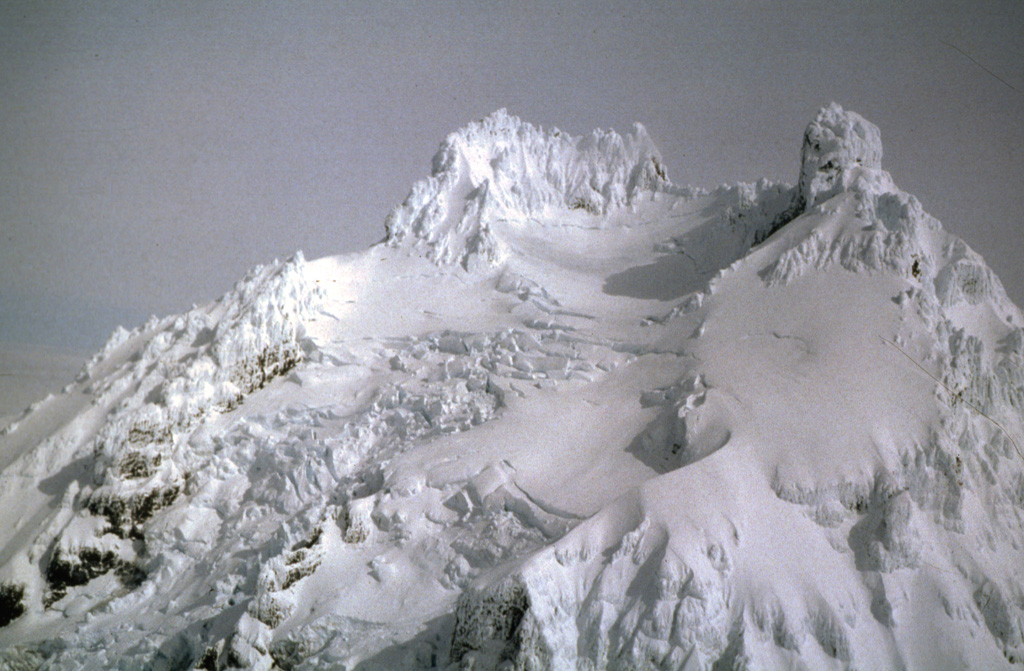
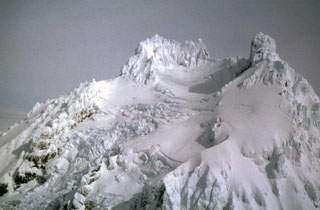 Glaciers descend the upper flanks of Isanotski between the summit pinnacles. Locally known as Ragged Jack, this is at the center of an E-W-trending group of three volcanoes on Unimak Island.
 There are no samples for Isanotski Peaks in the Smithsonian's NMNH Department of Mineral Sciences Rock and Ore collection.
| Alaska Volcano Observatory (Link to Isanotski Peaks) | The Alaska Volcano Observatory (AVO) is a joint program of the U.S. Geological Survey (USGS), the Geophysical Institute of the University of Alaska Fairbanks (UAFGI), and the State of Alaska Division of Geological and Geophysical Surveys (ADGGS). AVO was formed in 1988, and uses federal, state, and university resources to monitor and study Alaska's hazardous volcanoes, to predict and record eruptive activity, and to mitigate volcanic hazards to life and property. |
| Copernicus Browser | The Copernicus Browser replaced the Sentinel Hub Playground browser in 2023, to provide access to Earth observation archives from the Copernicus Data Space Ecosystem, the main distribution platform for data from the EU Copernicus missions. |
|
WOVOdat
Single Volcano View Temporal Evolution of Unrest Side by Side Volcanoes |
WOVOdat is a database of volcanic unrest; instrumentally and visually recorded changes in seismicity, ground deformation, gas emission, and other parameters from their normal baselines. It is sponsored by the World Organization of Volcano Observatories (WOVO) and presently hosted at the Earth Observatory of Singapore.
GVMID Data on Volcano Monitoring Infrastructure The Global Volcano Monitoring Infrastructure Database GVMID, is aimed at documenting and improving capabilities of volcano monitoring from the ground and space. GVMID should provide a snapshot and baseline view of the techniques and instrumentation that are in place at various volcanoes, which can be use by volcano observatories as reference to setup new monitoring system or improving networks at a specific volcano. These data will allow identification of what monitoring gaps exist, which can be then targeted by remote sensing infrastructure and future instrument deployments. |
| EarthScope Consortium SAGE seismic stations/networks | EarthScope Consortium operates the NSF Geodetic Facility for the Advancement of Geoscience (GAGE) and NSF Seismological Facility for the Advancement of Geoscience (SAGE). The linked map shows the location of seismic stations from all available networks (permanent or temporary) within a radius of 0.18° (about 20 km at mid-latitudes) from the given location of Isanotski Peaks. Users can customize a variety of filters and options in the left panel. Note that if there are no stations are known the map will default to show the entire world with a "No data matched request" error notice. |
| Large Eruptions of Isanotski Peaks | Information about large Quaternary eruptions (VEI >= 4) is cataloged in the Large Magnitude Explosive Volcanic Eruptions (LaMEVE) database of the Volcano Global Risk Identification and Analysis Project (VOGRIPA). |
| EarthChem | EarthChem develops and maintains databases, software, and services that support the preservation, discovery, access and analysis of geochemical data, and facilitate their integration with the broad array of other available earth science parameters. EarthChem is operated by a joint team of disciplinary scientists, data scientists, data managers and information technology developers who are part of the NSF-funded data facility Integrated Earth Data Applications (IEDA). IEDA is a collaborative effort of EarthChem and the Marine Geoscience Data System (MGDS). |

