
Smithsonian Institution / US Geological Survey
Weekly Volcanic Activity Report, 21 September-27 September 2011
Managing Editor: Sally Sennert
Please cite this report as:
Global Volcanism Program, 2011. Report on Kīlauea (United States) (Sennert, S, ed.). Weekly Volcanic Activity Report, 21 September-27 September 2011. Smithsonian Institution and US Geological Survey. https://volcano.si.edu/showreport.cfm?gvpvar=GVP.WVAR20110921-332010
During 21-27 September, HVO reported that the lava lake circulated and periodically rose and fell in the deep pit within Kīlauea's Halemaʻumaʻu crater. Almost daily measurements indicated that the gas plume from the vent continued to deposit variable amounts of ash and occasionally fresh spatter nearby.
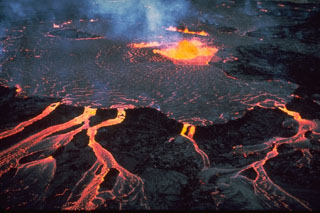
At the E rift zone, lava in the W lava lake in Puʻu ʻŌʻō Crater fed a series of lava flows that traveled down the W flank of Puʻu ʻŌʻō during 20-21 September. At about 0225 on 21 September activity in the crater and overflows to the W suddenly decreased, as lava broke through the upper E flank of Puʻu ʻŌʻō, bypassing the crater. The new fissure fed a channelized 'a'a lava flow that advanced rapidly downslope 2.5 km SE. A second flow to the W of the first began the next day. In addition, a small pad of lava actively refilled the bottom of the drained E lava lake and small flows were barely active at the W edge of Puʻu ʻŌʻō Crater. The channelized 'a'a lava flow reached 3.7 km long on 23 September and then stalled within the Kahauale'a Natural Area Reserve. Most of the active lava spread S and W of Pu'u Halulu (1.3 km NE of Puʻu ʻŌʻō) during 23-27 September. Minor lava activity resumed within Puʻu ʻŌʻō Crater with short lava flows issuing from the base of the E wall on 25 September and from the W wall base during 25-26 September. The crater floor of Puʻu ʻŌʻō slowly subsided. Lava activity resumed within the E lake on 26 September. The floor of the crater continued to subside during 26-27 September, opening up cracks in the N crater floor.
Source: US Geological Survey Hawaiian Volcano Observatory (HVO)
Geological Summary. Kīlauea overlaps the E flank of the massive Mauna Loa shield volcano in the Island of Hawaiʻi. Eruptions are prominent in Polynesian legends; written documentation since 1820 records frequent summit and flank lava flow eruptions interspersed with periods of long-term lava lake activity at Halemaʻumaʻu crater in the summit caldera until 1924. The 3 x 5 km caldera was formed in several stages about 1,500 years ago and during the 18th century; eruptions have also originated from the lengthy East and Southwest rift zones, which extend to the ocean in both directions. About 90% of the surface of the basaltic shield volcano is formed of lava flows less than about 1,100 years old; 70% of the surface is younger than 600 years. The long-term eruption from the East Rift Zone between 1983 and 2018 produced lava flows covering more than 100 km2, destroyed hundreds of houses, and added new coastline.


 Kīlauea