
Due to the US Government shutdown, the Smithsonian is temporarily closed. The Global Volcanism Program website will remain available but will not be monitored or updated. Status updates will be available on the Smithsonian homepage.
Logo link to homepage

Image GVP-04429

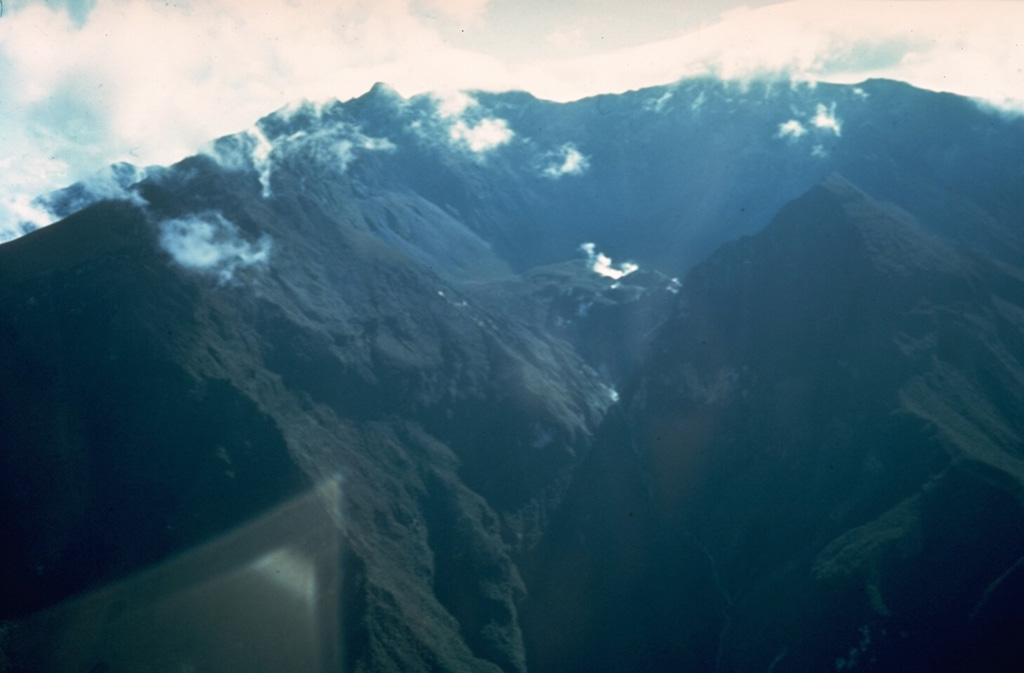
Fumaroles rise above a small crater (right center) at the base of the headwall of the 6-km-wide summit caldera of Guagua Pichincha volcano.  The breached caldera seen here from the east was formed about 50,000 years ago.  Subsequent late-Pleistocene and Holocene eruptions from the central vent in the breached caldera consisted of explosive activity with pyroclastic flows that accompanied periodic growth and destruction of a lava dome.   Photo by Minard Hall, 1975 (Escuela Politécnica Nacional, Quito).

Fumaroles rise above a small crater (right center) at the base of the headwall of the 6-km-wide summit caldera of Guagua Pichincha volcano. The breached caldera seen here from the east was formed about 50,000 years ago. Subsequent late-Pleistocene and Holocene eruptions from the central vent in the breached caldera consisted of explosive activity with pyroclastic flows that accompanied periodic growth and destruction of a lava dome.

Photo by Minard Hall, 1975 (Escuela Politécnica Nacional, Quito).

Creative Commons Icon This image is made available under the Creative Commons BY-NC 4.0 license terms.

Guagua Pichincha