

Report on Rincon de la Vieja (Costa Rica) — February 1992
Bulletin of the Global Volcanism Network, vol. 17, no. 2 (February 1992)
Managing Editor: Lindsay McClelland.
Rincon de la Vieja (Costa Rica) Gas emission and sporadic phreatic eruptions
Please cite this report as:
Global Volcanism Program, 1992. Report on Rincon de la Vieja (Costa Rica) (McClelland, L., ed.). Bulletin of the Global Volcanism Network, 17:2. Smithsonian Institution. https://doi.org/10.5479/si.GVP.BGVN199202-345020
Rincon de la Vieja
Costa Rica
10.83°N, 85.324°W; summit elev. 1916 m
All times are local (unless otherwise noted)
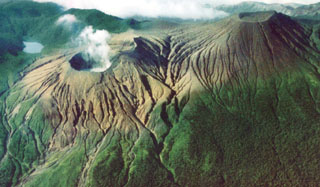
Gas emission has continued over the last several months, punctuated by sporadic phreatic eruptions. Fumarolic activity was concentrated on the active crater's E wall, producing a plume that occasionally reached 500 m height, smelling of sulfur, and irritating eyes and skin. The crater lake was gray, with yellow areas over bubbling points. Concentric and radial fissures, to 1 m wide and to >4 m deep, were found on the upper E, N, and NW flanks. The fissures were probably formed by partial collapse of the crater walls, especially on the E and NW flanks. Seven low-frequency earthquakes were recorded during February, down from a peak of 30 recorded 8 May 1991, associated with a large phreatic eruption. Abnormal seismicity was reported for several months after 8 May.
Geological Summary. Rincón de la Vieja, the largest volcano in NW Costa Rica, is a remote volcanic complex in the Guanacaste Range. The volcano consists of an elongated, arcuate NW-SE-trending ridge constructed within the 15-km-wide early Pleistocene Guachipelín caldera, whose rim is exposed on the south side. Sometimes known as the "Colossus of Guanacaste," it has an estimated volume of 130 km3 and contains at least nine major eruptive centers. Activity has migrated to the SE, where the youngest-looking craters are located. The twin cone of Santa María volcano, the highest peak of the complex, is located at the eastern end of a smaller, 5-km-wide caldera and has a 500-m-wide crater. A Plinian eruption producing the 0.25 km3 Río Blanca tephra about 3,500 years ago was the last major magmatic eruption. All subsequent eruptions, including numerous historical eruptions possibly dating back to the 16th century, have been from the prominent active crater containing a 500-m-wide acid lake located ENE of Von Seebach crater.
Information Contacts: E. Fernández, J. Barquero, V. Barboza, and R. Van der Laat, OVSICORI.
