
Smithsonian Institution / US Geological Survey
Weekly Volcanic Activity Report, 9 August-15 August 2017
Managing Editor: Sally Sennert
Please cite this report as:
Global Volcanism Program, 2017. Report on Bogoslof (United States) (Sennert, S, ed.). Weekly Volcanic Activity Report, 9 August-15 August 2017. Smithsonian Institution and US Geological Survey. https://volcano.si.edu/showreport.cfm?gvpvar=GVP.WVAR20170809-311300
AVO reported that on 9 August seismic and infrasound data suggested low-level eruptive activity at Bogoslof; weakly elevated surface temperatures and a minor steam emission were identified in satellite images. No significant activity was observed in cloudy satellite images, and no activity was detected in seismic, infrasound, or lightning data during 10-13 August. Two short pulses of tremor were detected (at 0853, lasting five minutes, and at 0913, lasting three minutes) in seismic data; seismicity returned to baseline levels afterwards. A sequence of seismic events began at 0000 on 15 August; no activity was observed in infrasound, lightning, or satellite data. The Aviation Color Code remained at Orange and the Volcano Alert Level remained at Watch.
Source: US Geological Survey Alaska Volcano Observatory (AVO)
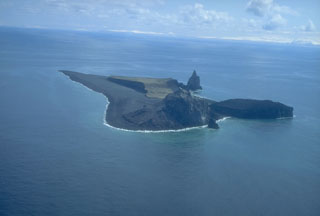
Geological Summary. Bogoslof is the emergent summit of a submarine volcano that lies 40 km N of the main Aleutian arc. It rises 1,500 m above the Bering Sea floor. Repeated construction and destruction of lava domes at different locations during historical time has greatly modified the appearance of this "Jack-in-the-Box" volcano and has introduced a confusing nomenclature applied during frequent visits by exploring expeditions. The present triangular-shaped, 0.75 x 2 km island consists of remnants of lava domes emplaced from 1796 to 1992. Castle Rock (Old Bogoslof) is a steep-sided pinnacle that is a remnant of a spine from the 1796 eruption. The small Fire Island (New Bogoslof), about 600 m NW of Bogoslof Island, is a remnant of a lava dome formed in 1883.


 Bogoslof