

Report on Ibu (Indonesia) — 17 October-23 October 2018
Smithsonian Institution / US Geological Survey
Weekly Volcanic Activity Report, 17 October-23 October 2018
Managing Editor: Sally Sennert.
Please cite this report as:
Global Volcanism Program, 2018. Report on Ibu (Indonesia) (Sennert, S, ed.). Weekly Volcanic Activity Report, 17 October-23 October 2018. Smithsonian Institution and US Geological Survey.
Ibu
Indonesia
1.488°N, 127.63°E; summit elev. 1325 m
All times are local (unless otherwise noted)
PVMBG reported that at 1223 on 19 October an event at Ibu generated an ash plume that rose 400 m above the crater rim and drifted E. Another event at 1809 on 22 October generated an ash plume that rose 400 m above the crater rim and drifted N. On both days seismic signals indicated explosions and rock avalanches. The Alert Level remained at 2 (on a scale of 1-4), and the public was warned to stay at least 2 km away from the active crater, and 3.5 km away on the N side.
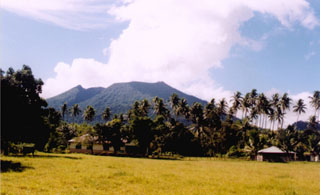
Geological Summary. The truncated summit of Gunung Ibu stratovolcano along the NW coast of Halmahera Island has large nested summit craters. The inner crater, 1 km wide and 400 m deep, has contained several small crater lakes. The 1.2-km-wide outer crater is breached on the N, creating a steep-walled valley. A large cone grew ENE of the summit, and a smaller one to the WSW has fed a lava flow down the W flank. A group of maars is located below the N and W flanks. The first observed and recorded eruption was a small explosion from the summit crater in 1911. Eruptive activity began again in December 1998, producing a lava dome that eventually covered much of the floor of the inner summit crater along with ongoing explosive ash emissions.
Source: Pusat Vulkanologi dan Mitigasi Bencana Geologi (PVMBG, also known as CVGHM)
