

Report on Bezymianny (Russia) — 28 October-3 November 2020
Smithsonian Institution / US Geological Survey
Weekly Volcanic Activity Report, 28 October-3 November 2020
Managing Editor: Sally Sennert.
Please cite this report as:
Global Volcanism Program, 2020. Report on Bezymianny (Russia) (Sennert, S, ed.). Weekly Volcanic Activity Report, 28 October-3 November 2020. Smithsonian Institution and US Geological Survey.
Bezymianny
Russia
55.972°N, 160.595°E; summit elev. 2882 m
All times are local (unless otherwise noted)
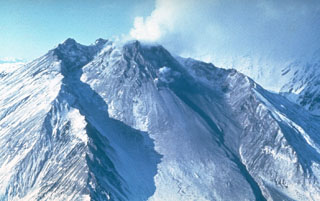
KVERT reported that a thermal anomaly over Bezymianny was identified in satellite images during 22-24 and 27-29 October. The N part of the lava dome was active and possibly advanced. The Aviation Color Code remained at Yellow (the second lowest level on a four-color scale).
Geological Summary. The modern Bezymianny, much smaller than its massive neighbors Kamen and Kliuchevskoi on the Kamchatka Peninsula, was formed about 4,700 years ago over a late-Pleistocene lava-dome complex and an edifice built about 11,000-7,000 years ago. Three periods of intensified activity have occurred during the past 3,000 years. The latest period, which was preceded by a 1,000-year quiescence, began with the dramatic 1955-56 eruption. This eruption, similar to that of St. Helens in 1980, produced a large open crater that was formed by collapse of the summit and an associated lateral blast. Subsequent episodic but ongoing lava-dome growth, accompanied by intermittent explosive activity and pyroclastic flows, has largely filled the 1956 crater.