

Report on Karthala (Union of the Comoros) — 31 August-6 September 2022
Smithsonian Institution / US Geological Survey
Weekly Volcanic Activity Report, 31 August-6 September 2022
Managing Editor: Sally Sennert.
Please cite this report as:
Global Volcanism Program, 2022. Report on Karthala (Union of the Comoros) (Sennert, S, ed.). Weekly Volcanic Activity Report, 31 August-6 September 2022. Smithsonian Institution and US Geological Survey.
Karthala
Union of the Comoros
11.7658°S, 43.3639°E; summit elev. 2350 m
All times are local (unless otherwise noted)
According to the Direction Générale de la Sécurité Civile – Comores, the Observatoire Volcanologique du Karthala (OVK) reported that a significant increase in the number of small earthquakes beneath Karthala’s W flank began to be detected on 15 July. The abnormal activity persisted, so on 16 August the Alert Level was raised to Yellow (the second lowest level on a four-level scale) and residents were asked to limit activities on and around the volcano. On 5 September OVK recommended that the Alert Level remain at Yellow.
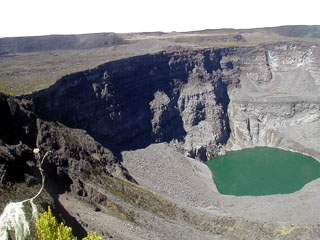
Geological Summary. The southernmost and largest of the two shield volcanoes forming Grand Comore Island (also known as Ngazidja Island), Karthala has two overlapping 3-4 km summit calderas generated by repeated collapse. Elongated rift zones extend NNW and SE from the summit of the basaltic shield, which has an asymmetrical profile that is steeper to the S. The lower SE rift zone forms the Massif du Badjini, a peninsula at the SE tip of the island. More than twenty eruptions have been recorded since the 19th century from the summit caldera and vents on the N and S flanks, producing many lava flows that reached the sea on both sides of the island. An 1860 CE lava flow from the summit caldera traveled ~13 km to the NW, reaching the W coast to the N of the capital city of Moroni.
