

Report on Lokon-Empung (Indonesia) — 29 January-4 February 2025
Smithsonian Institution / US Geological Survey
Weekly Volcanic Activity Report, 29 January-4 February 2025
Managing Editor: Sally Sennert.
Please cite this report as:
Global Volcanism Program, 2025. Report on Lokon-Empung (Indonesia) (Sennert, S, ed.). Weekly Volcanic Activity Report, 29 January-4 February 2025. Smithsonian Institution and US Geological Survey.
Lokon-Empung
Indonesia
1.3644°N, 124.7992°E; summit elev. 1580 m
All times are local (unless otherwise noted)
The Pusat Vulkanologi dan Mitigasi Bencana Geologi (PVMBG) reported that seismicity at Lokon-Empung decreased during January. The number of shallow volcanic earthquakes gradually decreased from 102 daily events on 2 January, to 15 daily events on 15 January, to 1-5 daily events during 20-29 January. White emissions rose as high as 10 m above the summit. The Alert Level was lowered to 2 (on a scale of 1-4) at 0600 on 31 January and the public was warned to stay 1.5 km away from the crater.
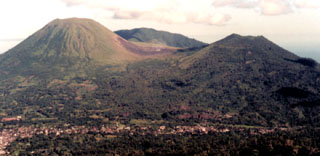
Geological Summary. The Lokong-Empung volcanic complex, rising above the plain of Tondano in North Sulawesi, includes four peaks and an active crater. Lokon, the highest peak, has a flat craterless top. The morphologically younger Empung cone 2 km NE has a 400-m-wide, 150-m-deep crater that erupted last in the 18th century. A ridge extending 3 km WNW from Lokon includes the Tatawiran and Tetempangan peaks. All eruptions since 1829 have originated from Tompaluan, a 150 x 250 m crater in the saddle between Lokon and Empung. These eruptions have primarily produced small-to-moderate ash plumes that sometimes damaged croplands and houses, but lava-dome growth and pyroclastic flows have also occurred.
Source: Pusat Vulkanologi dan Mitigasi Bencana Geologi (PVMBG, also known as CVGHM)
