

Report on Dukono (Indonesia) — 28 May-3 June 2025
Smithsonian Institution / US Geological Survey
Weekly Volcanic Activity Report, 28 May-3 June 2025
Managing Editor: Sally Sennert.
Please cite this report as:
Global Volcanism Program, 2025. Report on Dukono (Indonesia) (Sennert, S, ed.). Weekly Volcanic Activity Report, 28 May-3 June 2025. Smithsonian Institution and US Geological Survey.
Dukono
Indonesia
1.6992°N, 127.8783°E; summit elev. 1273 m
All times are local (unless otherwise noted)
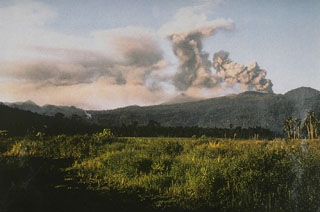
The Pusat Vulkanologi dan Mitigasi Bencana Geologi (PVMBG) reported that eruptive activity at Dukono continued during 28 May-3 June. Daily white-and-gray or white, gray, and black gas-and-ash plumes rose 900-1,900 m above the summit and drifted NW, W, and S. The emissions were described as ongoing through the week. Residents 10-11 km away felt vibrations from the activity on 29 May and occasional banging sounds were heard at the same distances during 29-30 May. Faint rumbling was heard at the observation post, 11 km N, during 31 May-1 June. The Alert Level remained at Level 2 (on a scale of 1-4) and the public was warned to stay 4 km away from the Malupang Warirang Crater.
Geological Summary. The Dukono complex in northern Halmahera is on an edifice with a broad, low profile containing multiple peaks and overlapping craters. Almost continuous explosive eruptions, sometimes accompanied by lava flows, have occurred since 1933. During a major eruption in 1550 CE, a lava flow filled in the strait between Halmahera and the Gunung Mamuya cone, 10 km NE. Malupang Wariang, 1 km SW of the summit crater complex, contains a 700 x 570 m crater that has also had reported eruptions.
Source: Pusat Vulkanologi dan Mitigasi Bencana Geologi (PVMBG, also known as CVGHM)
