
The Global Volcanism Program has no activity reports available for Kronotsky.
The Global Volcanism Program has no Weekly Reports available for Kronotsky.
The Global Volcanism Program has no Bulletin Reports available for Kronotsky.
|
|
||||||||||||||||||||||||||
There is data available for 2 confirmed eruptive periods.
[ 2025 Oct 3 - 2015 Oct 4 ] Discredited Eruption
A large plume visible in satellite imagery developed from a point source at the location of the summit. Although a VONA was issued by KVERT for potential ash from a phreatic eruption, later observations found no evidence of volcanic activity, so this was likely a meteorological event. The plume consisted largely of water vapor, spread NE-SW along the volcanic front as well as expanding downwind SE with the prevailing weather pattern, and rapidly dissipated.
[ 1922 Nov 16 ± 15 days - 1923 Feb 15 ± 14 days ] Discredited Eruption
Although the phrase "weak phreatic eruptions" was used, evaluation of the full context over 34 years and no obvious source location for magmatic surface eruptions, indicates that the reported activity was more likely small fumarolic/hydrothermal explosions, possibly including rockfalls. Fedotov and Masurenkov (1991) described the activity as follows: "Weak phreatic eruptions were recorded in November, 1922, and in February, 1923 [Novograblenov, 1932; Vlodavets, Piip, 1957; Gavrilov, 1944; Guschenko, 1957]. Repeated fumarolic activities were observed for the first time in 1928 [Guschenko, 1957]; then on 13 June, 1941, growing activity produced a gas column almost 600 m high [Gavrilov, 1941]. In August, 1956, we registered weak fumarolic manifestations in one of the ravenes while surveying the area of the crater fumarolic field. The observed eruptions and fumarolic activity were limited to a single site: a fumarolic field at an elevation of 3150 m on the southern slope of the volcano." The CAVW summary by Vlodavets and Piip (1959, referencing the same sources) noted that "Blackish smoke was observed on the southern slope in 1922, and flames, accompanied by rumbling on the summit in 1923."
[ 0050 BCE (?) ] Discredited Eruption
Ponomareva and Braitseva (1991, p. 62) included the following statement: "Only one Holocene tephra deposit can be associated with uncertainty with Kronotsky Volcano. It is a medium-grained volcanic sand which has a maximum thickness of 10 cm in the northeast of the area. Its age is about 2000 years. As regards the cinder cones at the southwestern foot of Kronotsky, they had a poor effect on the extreme northeast of the study area (2-3 eruptions in Holocene time)." | No Kronotsky tephra marker layer is included in Zelenin et al. (2020, table 1), but they do list a 2,138 ± 80 cal BP for tephra from Gamchen (27 km NE), citing O.A. Braitseva (oral communication). Gorbach et al. (2024, 2025) makes no mention of this eruption during their review and description of older eruptions identified from N-flank deposits.
3350 BCE ± 100 years Confirmed Eruption (Explosive / Effusive) VEI: 2
| Episode 1 | Eruption (Explosive / Effusive) | ||||||||||||||||||||||||||||||||||
|---|---|---|---|---|---|---|---|---|---|---|---|---|---|---|---|---|---|---|---|---|---|---|---|---|---|---|---|---|---|---|---|---|---|---|
| 3350 BCE ± 100 years - Unknown | Evidence from Correlation: Tephrochronology | |||||||||||||||||||||||||||||||||
| A tephra horizon found in one section by Gorbach et al. (2024) was "...represented by stratified black medium-grained ash with an admixture of lapilli up to 0.5 cm." This ash was directly above the marker tephra for a Shiveluch eruption from ~5,500 BP, so they proposed an age of ~5,200-5,400 BP. | ||||||||||||||||||||||||||||||||||
|
List of 5 Events for Episode 1
|
||||||||||||||||||||||||||||||||||
4050 BCE Confirmed Eruption (Explosive / Effusive) VEI: 3
| Episode 1 | Eruption (Explosive / Effusive) | ||||||||||||||||||||||||||||||||||
|---|---|---|---|---|---|---|---|---|---|---|---|---|---|---|---|---|---|---|---|---|---|---|---|---|---|---|---|---|---|---|---|---|---|---|
| 4050 BCE - Unknown | Evidence from Correlation: Tephrochronology | |||||||||||||||||||||||||||||||||
| Soil-pyroclastic sections studied by Gorbach et al. (2024) showed a horizon from one eruption in three sections based on stratigraphy and volcanic glass compositions. The horizon thickness was 20-30 cm thick, with 2-cm lapilli in two sections and 0.501 cm at a more distant section. In all three sections the horizon was between known marker tephras from Sheveluch (~5,500 BP) and Avachinsky (~6,300). They concluded that "the precise stratigraphic position of the scoria horizon allows us to date its eruption to approximately 6000 years ago." | ||||||||||||||||||||||||||||||||||
|
List of 5 Events for Episode 1
|
||||||||||||||||||||||||||||||||||
This compilation of synonyms and subsidiary features may not be comprehensive. Features are organized into four major categories: Cones, Craters, Domes, and Thermal Features. Synonyms of features appear indented below the primary name. In some cases additional feature type, elevation, or location details are provided.
Synonyms |
| Kronotzkaia Sopka | Kronotzky | Kronozky |
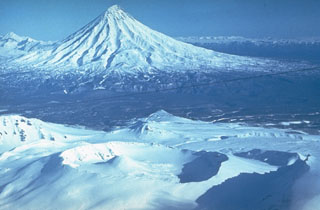 Kronotsky is seen here to the NE of the broad summit of Krasheninnikov in the foreground. The slopes of the largely Pleistocene Kronotsky contain deep erosional valleys and had weak phreatic eruptions during the 20th century. Krasheninnikov has been active throughout the Holocene.
 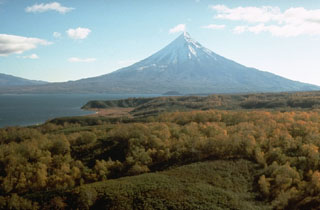 Kronotsky is seen here beyond Lake Kronotskoye, Kamchatka's largest lake. The lake formed during the late-Pleistocene to early Holocene when a series of voluminous lava flows erupted from the south flank of Kronotsky, damming the Listvenichnaya River. The SE and SW flanks contain scoria cones, and weak phreatic eruptions took place during the 20th century.
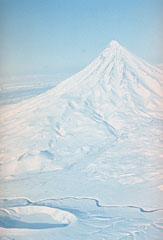 Kronotsky rises NE of the Kronotsky River, shown across the bottom of the photo. A small cone above the river to the right is one of several on the SW flank. The crater to the lower right is a lake-filled maar that formed at the northern end of a rift zone extending 8 km NNE from Krasheninnikov. The maar erupted along the NE flank of a large Pleistocene caldera inside which Krasheninnikov formed.
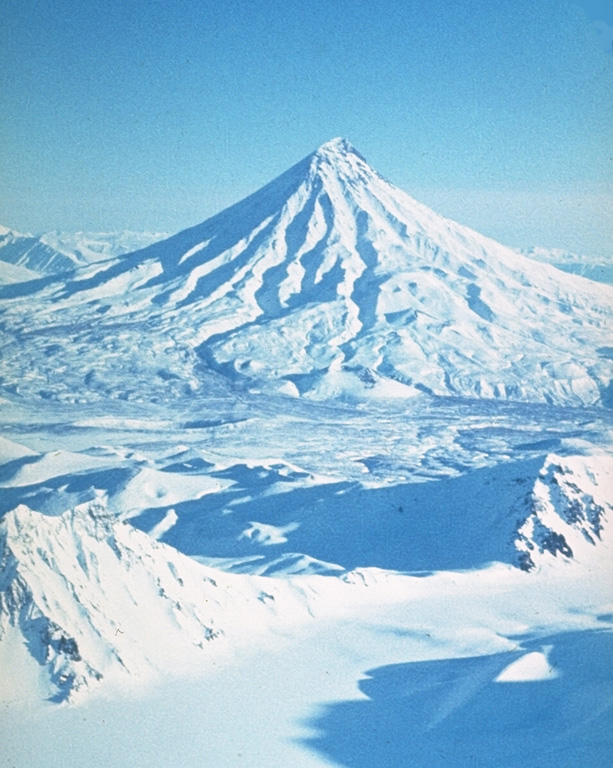
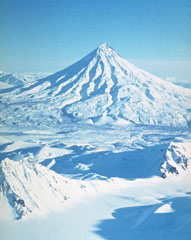 Kronotsky stratovolcano Is located between the Pacific Ocean and Lake Kronotsky, Kamchatka's largest lake. The flanks are dissected by radial valleys up to 200 m deep. Weak phreatic eruptions took place during the 20th century. Kronotsky is seen here from the SW with the caldera rim of neighboring Krasheninnikov volcano in the foreground.
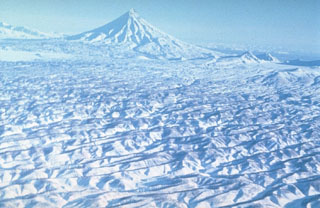 Kronotsky, seen here from the SW, towers above extensively eroded pyroclastic flow deposits. These voluminous deposits were produced by Pleistocene explosive eruptions that resulted in formation of the Uzon and Krasheninnikov calderas. The initial caldera-forming eruption at Uzon dates back to the mid-Pleistocene. A younger caldera formed about 39,000 years ago and was followed shortly by formation of the Krasheninnikov caldera.
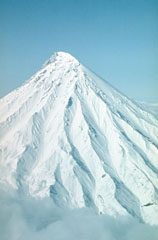 The flanks of Kronotsky contain radial erosional valleys up to 200 m deep. The summit, seen here from the north, consists of a basaltic andesite lava extrusion. The conical, sharp-peaked volcano is one of the most distinctive in Kamchatka.
There are no samples for Kronotsky in the Smithsonian's NMNH Department of Mineral Sciences Rock and Ore collection.
| Copernicus Browser | The Copernicus Browser replaced the Sentinel Hub Playground browser in 2023, to provide access to Earth observation archives from the Copernicus Data Space Ecosystem, the main distribution platform for data from the EU Copernicus missions. |
| MIROVA | Middle InfraRed Observation of Volcanic Activity (MIROVA) is a near real time volcanic hot-spot detection system based on the analysis of MODIS (Moderate Resolution Imaging Spectroradiometer) data. In particular, MIROVA uses the Middle InfraRed Radiation (MIR), measured over target volcanoes, in order to detect, locate and measure the heat radiation sourced from volcanic activity. |
| MODVOLC Thermal Alerts | Using infrared satellite Moderate Resolution Imaging Spectroradiometer (MODIS) data, scientists at the Hawai'i Institute of Geophysics and Planetology, University of Hawai'i, developed an automated system called MODVOLC to map thermal hot-spots in near real time. For each MODIS image, the algorithm automatically scans each 1 km pixel within it to check for high-temperature hot-spots. When one is found the date, time, location, and intensity are recorded. MODIS looks at every square km of the Earth every 48 hours, once during the day and once during the night, and the presence of two MODIS sensors in space allows at least four hot-spot observations every two days. Each day updated global maps are compiled to display the locations of all hot spots detected in the previous 24 hours. There is a drop-down list with volcano names which allow users to 'zoom-in' and examine the distribution of hot-spots at a variety of spatial scales. |
|
WOVOdat
Single Volcano View Temporal Evolution of Unrest Side by Side Volcanoes |
WOVOdat is a database of volcanic unrest; instrumentally and visually recorded changes in seismicity, ground deformation, gas emission, and other parameters from their normal baselines. It is sponsored by the World Organization of Volcano Observatories (WOVO) and presently hosted at the Earth Observatory of Singapore.
GVMID Data on Volcano Monitoring Infrastructure The Global Volcano Monitoring Infrastructure Database GVMID, is aimed at documenting and improving capabilities of volcano monitoring from the ground and space. GVMID should provide a snapshot and baseline view of the techniques and instrumentation that are in place at various volcanoes, which can be use by volcano observatories as reference to setup new monitoring system or improving networks at a specific volcano. These data will allow identification of what monitoring gaps exist, which can be then targeted by remote sensing infrastructure and future instrument deployments. |
| Volcanic Hazard Maps | The IAVCEI Commission on Volcanic Hazards and Risk has a Volcanic Hazard Maps database designed to serve as a resource for hazard mappers (or other interested parties) to explore how common issues in hazard map development have been addressed at different volcanoes, in different countries, for different hazards, and for different intended audiences. In addition to the comprehensive, searchable Volcanic Hazard Maps Database, this website contains information about diversity of volcanic hazard maps, illustrated using examples from the database. This site is for educational purposes related to volcanic hazard maps. Hazard maps found on this website should not be used for emergency purposes. For the most recent, official hazard map for a particular volcano, please seek out the proper institutional authorities on the matter. |
| IRIS seismic stations/networks | Incorporated Research Institutions for Seismology (IRIS) Data Services map showing the location of seismic stations from all available networks (permanent or temporary) within a radius of 0.18° (about 20 km at mid-latitudes) from the given location of Kronotsky. Users can customize a variety of filters and options in the left panel. Note that if there are no stations are known the map will default to show the entire world with a "No data matched request" error notice. |
| UNAVCO GPS/GNSS stations | Geodetic Data Services map from UNAVCO showing the location of GPS/GNSS stations from all available networks (permanent or temporary) within a radius of 20 km from the given location of Kronotsky. Users can customize the data search based on station or network names, location, and time window. Requires Adobe Flash Player. |
| DECADE Data | The DECADE portal, still in the developmental stage, serves as an example of the proposed interoperability between The Smithsonian Institution's Global Volcanism Program, the Mapping Gas Emissions (MaGa) Database, and the EarthChem Geochemical Portal. The Deep Earth Carbon Degassing (DECADE) initiative seeks to use new and established technologies to determine accurate global fluxes of volcanic CO2 to the atmosphere, but installing CO2 monitoring networks on 20 of the world's 150 most actively degassing volcanoes. The group uses related laboratory-based studies (direct gas sampling and analysis, melt inclusions) to provide new data for direct degassing of deep earth carbon to the atmosphere. |
| Large Eruptions of Kronotsky | Information about large Quaternary eruptions (VEI >= 4) is cataloged in the Large Magnitude Explosive Volcanic Eruptions (LaMEVE) database of the Volcano Global Risk Identification and Analysis Project (VOGRIPA). |
| EarthChem | EarthChem develops and maintains databases, software, and services that support the preservation, discovery, access and analysis of geochemical data, and facilitate their integration with the broad array of other available earth science parameters. EarthChem is operated by a joint team of disciplinary scientists, data scientists, data managers and information technology developers who are part of the NSF-funded data facility Integrated Earth Data Applications (IEDA). IEDA is a collaborative effort of EarthChem and the Marine Geoscience Data System (MGDS). |


