
| Country | Chile |
| Volcanic Region | Central Andean Volcanic Arc |
| Landform | Volc Type | Composite | Stratovolcano |
| Last Known Eruption | Unknown - Evidence Uncertain |
| Coordinates | 23.58°S, 67.7°W |
| Elevation | 5,778 m (18,957 ft) |
| Volcano Number | 355098 |
 Google Earth Placemark with Features Google Earth Placemark with Features
| |
 Cite Volcano Profile Cite Volcano Profile
| |
The Global Volcanism Program has no Weekly Volcanic Activity Reports available for Chiliques.
Cite this Report
Signs of awakening despite recent dormancy
On 12 April 2002, NASA's Jet Propulsion Laboratory reported that new images taken by the Advanced Spaceborne Thermal Emission and Reflection Radiometer (Aster) on NASA's Terra satellite showed signs of activity at Chiliques. This volcano was previously considered to be dormant; however, on 6 January, a nighttime thermal infrared image from Aster showed a hot spot in the summit crater, as well as several others along the upper flanks, indicating new volcanic activity (figure 1). Examination of an earlier nighttime thermal infrared image from 24 May 2000 showed no such hot spots.
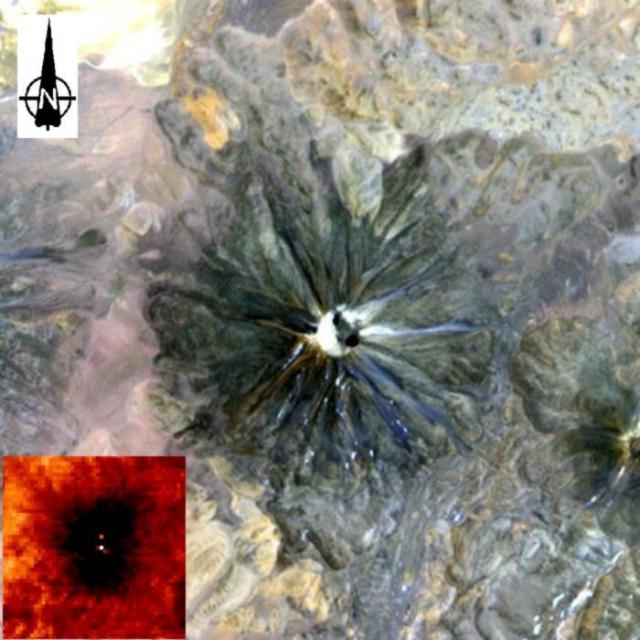 |
Figure 1. Aster images of Chiliques. The larger view is a daytime image acquired on 19 November 2000, created by displaying ASTER bands 1, 2, and 3. The inset is a nighttime thermal infrared image of Chiliques on 6 January 2002. Both images cover an area of 7.5 x 7.5 km and are centered at 23.6°S latitude, 67.6°W longitude. Courtesy Michael Abrams, NASA's Jet Propulsion Laboratory. |
General Reference. de Silva, S.L., and Francis, P.W., 1991, Volcanoes of the Central Andes: Berlin: Springer-Verlag, 216 p.
Information Contacts: Michael Abrams, Jet Propulsion Laboratory, California Institute of Technology, National Aeronautics and Space Administration, Pasadena, CA 91109 (URL: http://www.jpl.nasa.gov/).
The Global Volcanism Program has no Weekly Reports available for Chiliques.
Reports are organized chronologically and indexed below by Month/Year (Publication Volume:Number), and include a one-line summary. Click on the index link or scroll down to read the reports.
06/2002 (BGVN 27:06) Signs of awakening despite recent dormancy
Information is preliminary and subject to change. All times are local (unless otherwise noted)
Cite this Report
Signs of awakening despite recent dormancy
On 12 April 2002, NASA's Jet Propulsion Laboratory reported that new images taken by the Advanced Spaceborne Thermal Emission and Reflection Radiometer (Aster) on NASA's Terra satellite showed signs of activity at Chiliques. This volcano was previously considered to be dormant; however, on 6 January, a nighttime thermal infrared image from Aster showed a hot spot in the summit crater, as well as several others along the upper flanks, indicating new volcanic activity (figure 1). Examination of an earlier nighttime thermal infrared image from 24 May 2000 showed no such hot spots.
|
Figure 1. Aster images of Chiliques. The larger view is a daytime image acquired on 19 November 2000, created by displaying ASTER bands 1, 2, and 3. The inset is a nighttime thermal infrared image of Chiliques on 6 January 2002. Both images cover an area of 7.5 x 7.5 km and are centered at 23.6°S latitude, 67.6°W longitude. Courtesy Michael Abrams, NASA's Jet Propulsion Laboratory. |
General Reference. de Silva, S.L., and Francis, P.W., 1991, Volcanoes of the Central Andes: Berlin: Springer-Verlag, 216 p.
Information Contacts: Michael Abrams, Jet Propulsion Laboratory, California Institute of Technology, National Aeronautics and Space Administration, Pasadena, CA 91109 (URL: http://www.jpl.nasa.gov/).
|
|
||||||||||||||||||||||||||
The Global Volcanism Program is not aware of any Holocene eruptions from Chiliques. If this volcano has had large eruptions (VEI >= 4) prior to 12,000 years ago, information might be found on the Chiliques page in the LaMEVE (Large Magnitude Explosive Volcanic Eruptions) database, a part of the Volcano Global Risk Identification and Analysis Project (VOGRIPA).
The Global Volcanism Program has no synonyms or subfeatures listed for Chiliques.
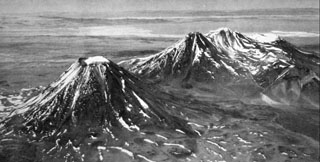 Volcán Chiliques, the conical peak at the left, is a structurally simple stratovolcano located immediately south of Laguna Lejía. A 500-m-wide snow-capped crater truncates the summit and contains a small lake. The volcano was constructed over a base of dacitic lava domes and andesitic lava flows. Youthful lava flows radially descended from the summit as far as 5 km to the NW. The volcanic complex at the right is the Pleistocene Volcán Lejía, which was constructed within a 3.5-km-wide caldera.
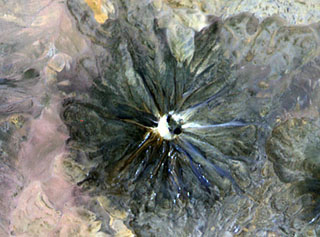 An ASTER satellite image from NASA in November 2000 looks down onto the summit crater of Chilques volcano. Radial gullies descend the flank of the volcano. Nighttime thermal infrared images on April 12, 2002 revealed hot spots in the summit crater and along the upper flanks, marking the first observations of historical activity at the volcano.
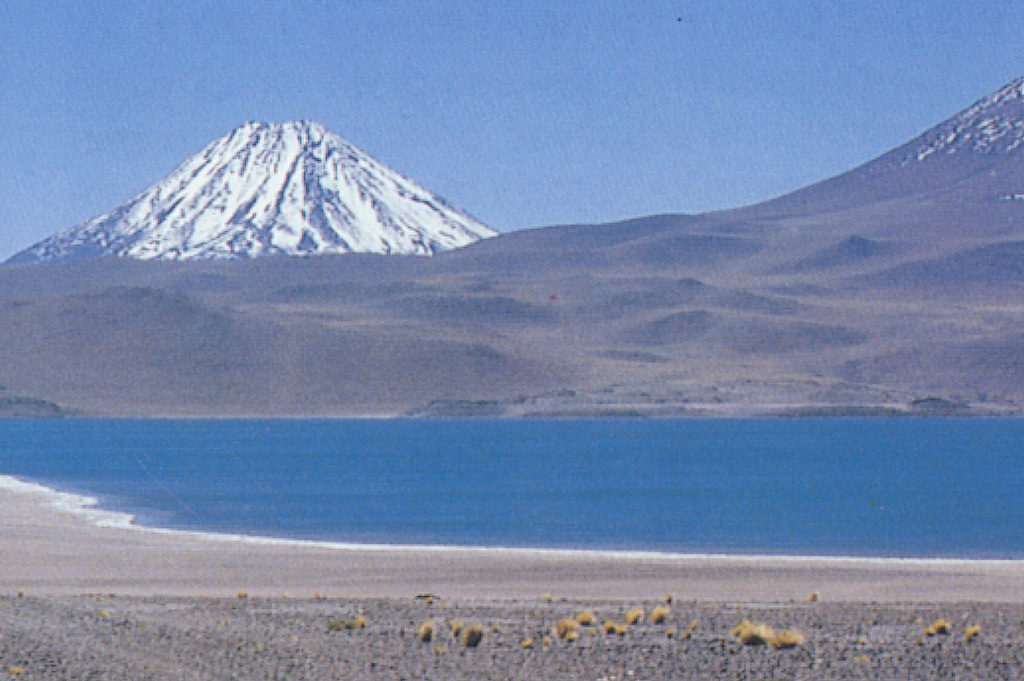
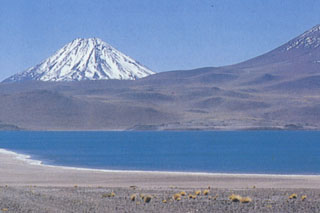 Snow-capped Volcán Chiliques is a conical stratovolcano located NNE of Laguna Miscanti (foreground). The 5778-m-high summit of the volcano contains a 500-m-wide crater. Several youthful lava flows, some of which are considered to be of Holocene age descend its flanks. Chiliques had previously been considered to be dormant; however, in 2002 a NASA nighttime thermal infrared satellite image showed low-level hot spots in the summit crater and upper flanks.
 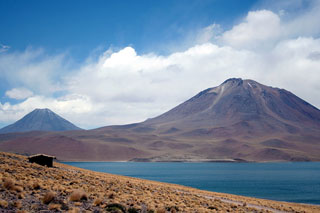 Conical Volcán Chiliques (left) and Volcan Miscanti (right) rise to the NE above Laguna Miscanti. The 5778-m-high summit of Chiliques contains a 500-m-wide crater, and some youthful lava flows may be of Holocene age. This volcano had previously been considered to be dormant; however, in 2002 a NASA nighttime thermal infrared ASTER satellite image showed low-level hot spots in the summit crater and upper flanks. Miscanti volcano is of probable late-Pleistocene age.
 There are no samples for Chiliques in the Smithsonian's NMNH Department of Mineral Sciences Rock and Ore collection.
| Copernicus Browser | The Copernicus Browser replaced the Sentinel Hub Playground browser in 2023, to provide access to Earth observation archives from the Copernicus Data Space Ecosystem, the main distribution platform for data from the EU Copernicus missions. |
| MIROVA | Middle InfraRed Observation of Volcanic Activity (MIROVA) is a near real time volcanic hot-spot detection system based on the analysis of MODIS (Moderate Resolution Imaging Spectroradiometer) data. In particular, MIROVA uses the Middle InfraRed Radiation (MIR), measured over target volcanoes, in order to detect, locate and measure the heat radiation sourced from volcanic activity. |
| MODVOLC Thermal Alerts | Using infrared satellite Moderate Resolution Imaging Spectroradiometer (MODIS) data, scientists at the Hawai'i Institute of Geophysics and Planetology, University of Hawai'i, developed an automated system called MODVOLC to map thermal hot-spots in near real time. For each MODIS image, the algorithm automatically scans each 1 km pixel within it to check for high-temperature hot-spots. When one is found the date, time, location, and intensity are recorded. MODIS looks at every square km of the Earth every 48 hours, once during the day and once during the night, and the presence of two MODIS sensors in space allows at least four hot-spot observations every two days. Each day updated global maps are compiled to display the locations of all hot spots detected in the previous 24 hours. There is a drop-down list with volcano names which allow users to 'zoom-in' and examine the distribution of hot-spots at a variety of spatial scales. |
|
WOVOdat
Single Volcano View Temporal Evolution of Unrest Side by Side Volcanoes |
WOVOdat is a database of volcanic unrest; instrumentally and visually recorded changes in seismicity, ground deformation, gas emission, and other parameters from their normal baselines. It is sponsored by the World Organization of Volcano Observatories (WOVO) and presently hosted at the Earth Observatory of Singapore.
GVMID Data on Volcano Monitoring Infrastructure The Global Volcano Monitoring Infrastructure Database GVMID, is aimed at documenting and improving capabilities of volcano monitoring from the ground and space. GVMID should provide a snapshot and baseline view of the techniques and instrumentation that are in place at various volcanoes, which can be use by volcano observatories as reference to setup new monitoring system or improving networks at a specific volcano. These data will allow identification of what monitoring gaps exist, which can be then targeted by remote sensing infrastructure and future instrument deployments. |
| Volcanic Hazard Maps | The IAVCEI Commission on Volcanic Hazards and Risk has a Volcanic Hazard Maps database designed to serve as a resource for hazard mappers (or other interested parties) to explore how common issues in hazard map development have been addressed at different volcanoes, in different countries, for different hazards, and for different intended audiences. In addition to the comprehensive, searchable Volcanic Hazard Maps Database, this website contains information about diversity of volcanic hazard maps, illustrated using examples from the database. This site is for educational purposes related to volcanic hazard maps. Hazard maps found on this website should not be used for emergency purposes. For the most recent, official hazard map for a particular volcano, please seek out the proper institutional authorities on the matter. |
| EarthScope Consortium SAGE seismic stations/networks | EarthScope Consortium operates the NSF Geodetic Facility for the Advancement of Geoscience (GAGE) and NSF Seismological Facility for the Advancement of Geoscience (SAGE). The linked map shows the location of seismic stations from all available networks (permanent or temporary) within a radius of 0.18° (about 20 km at mid-latitudes) from the given location of Chiliques. Users can customize a variety of filters and options in the left panel. Note that if there are no stations are known the map will default to show the entire world with a "No data matched request" error notice. |
| Large Eruptions of Chiliques | Information about large Quaternary eruptions (VEI >= 4) is cataloged in the Large Magnitude Explosive Volcanic Eruptions (LaMEVE) database of the Volcano Global Risk Identification and Analysis Project (VOGRIPA). |
| EarthChem | EarthChem develops and maintains databases, software, and services that support the preservation, discovery, access and analysis of geochemical data, and facilitate their integration with the broad array of other available earth science parameters. EarthChem is operated by a joint team of disciplinary scientists, data scientists, data managers and information technology developers who are part of the NSF-funded data facility Integrated Earth Data Applications (IEDA). IEDA is a collaborative effort of EarthChem and the Marine Geoscience Data System (MGDS). |

