

Global Volcanism Program | Image GVP-06358
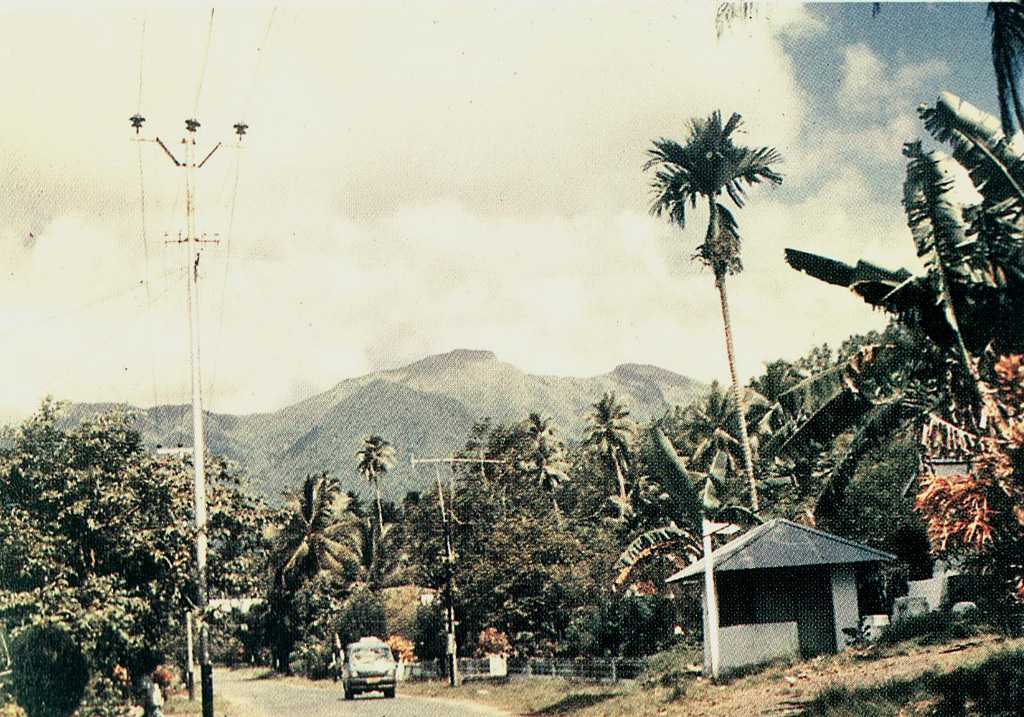
Gunung Awu volcano, one of the deadliest in Indonesia, looms above the village of Bungalawang. Deep valleys that form passageways for lahars dissect the flanks of the 1320-m-high volcano, which was constructed within a 4.5-km-wide caldera. Powerful explosive eruptions in 1711, 1812, 1856, 1892, and 1966 produced devastating pyroclastic flows and lahars that caused more than 8000 fatalities.
Photo by S. Dirasutisna, 1990 (Volcanological Survey of Indonesia).
 This image is made available under the Creative Commons BY-NC 4.0 license terms.
Awu