
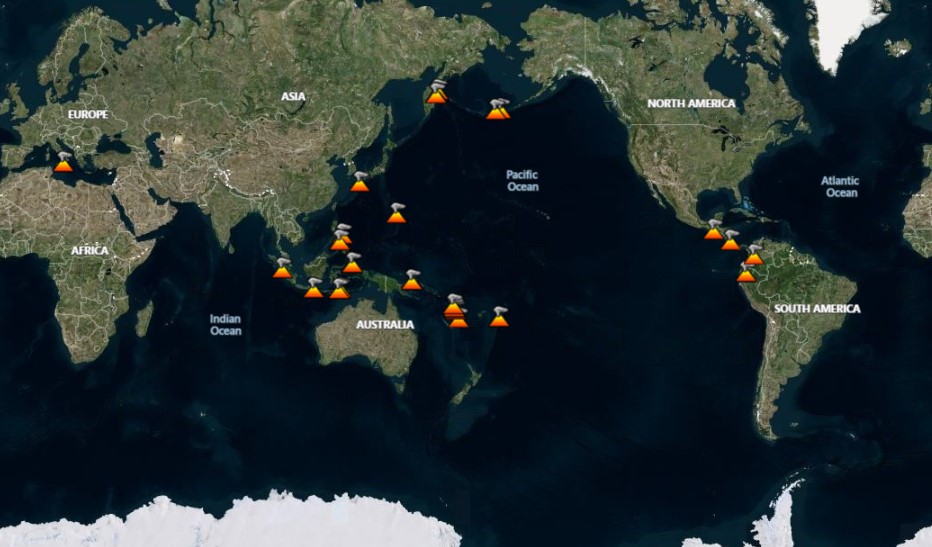
The Weekly Volcanic Activity Report is a cooperative project between the Smithsonian's Global Volcanism Program and the US Geological Survey's Volcano Hazards Program. Updated by 2300 UTC every Thursday (changed from Wednesdays starting in January 2026) and averaging 16 reported volcanoes, this is not a comprehensive list of all eruptions this week, but rather a summary of activity that meet criteria discussed in the "Criteria and Disclaimers" section below.
Volcanic activity reported here is preliminary and subject to change. Carefully reviewed, detailed narratives over longer time periods are published as reports of the Bulletin of the Global Volcanism Network available through volcano profile pages.
| Name | Country | Volcanic Region | Eruption Start Date | Report Type |
|---|---|---|---|---|
| Inielika | Indonesia | Sunda Volcanic Arc | — | New Eruptive Activity |
| Kelud | Indonesia | Sunda Volcanic Arc | — | New Eruptive Activity |
| Lokon-Empung | Indonesia | Sangihe Volcanic Arc | — | New Eruptive Activity |
| Mayon | Philippines | Eastern Philippine Volcanic Arc | 2026 Jan 6 | New Eruptive Activity |
| Merapi | Indonesia | Sunda Volcanic Arc | 2020 Dec 31 | New Eruptive Activity |
| Nyamulagira | DR Congo | Albertine Rift Volcanic Province | 2018 Apr 14 | New Eruptive Activity |
| Rotorua | New Zealand | Taupo Volcanic Arc | — | New Eruptive Activity |
| Etna | Italy | Sicily Volcanic Province | — | Continuing Eruptive Activity |
| Guagua Pichincha | Ecuador | Northern Andean Volcanic Arc | — | Continuing Eruptive Activity |
| Karangetang | Indonesia | Sangihe Volcanic Arc | — | Continuing Eruptive Activity |
| Kīlauea | United States | Hawaiian-Emperor Hotspot Volcano Group | 2024 Dec 23 | Continuing Eruptive Activity |
| Popocatépetl | Mexico | Trans-Mexican Volcanic Arc | 2005 Jan 9 | Continuing Eruptive Activity |
| Sheveluch | Russia | Eastern Kamchatka Volcanic Arc | 1999 Aug 15 | Continuing Eruptive Activity |
| Soufrière Hills | United Kingdom | Lesser Antilles Volcanic Arc | — | Continuing Eruptive Activity |
Inielika (Indonesia) | 31 January-6 February 2001 | New Eruptive Activity
|
|
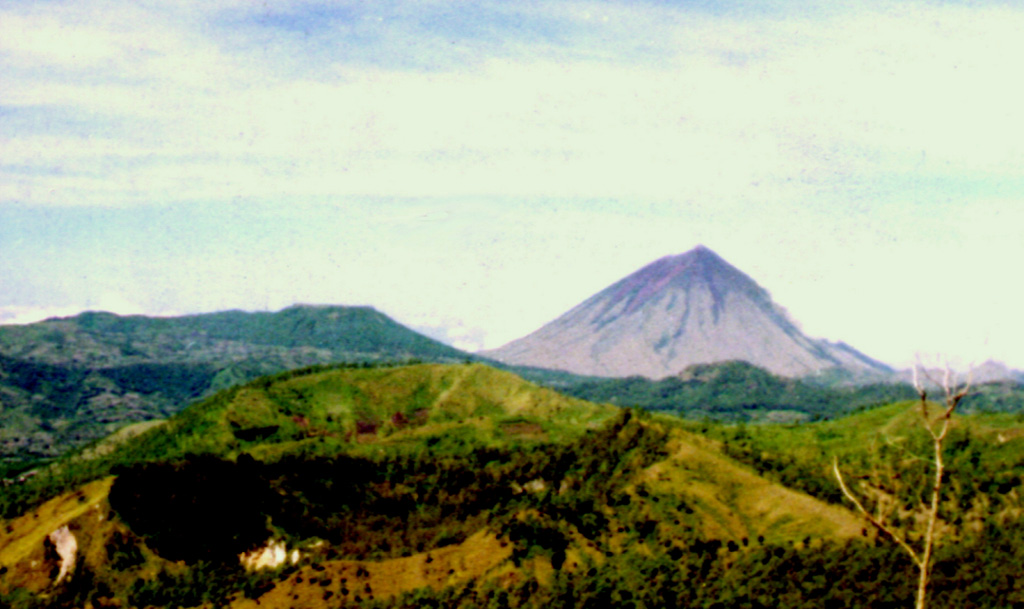 Inielika InielikaSunda Volcanic Arc |
The VSI reported that during 23-29 January no explosive activity occurred, but a plume of white ash rose 100-500 m above the crater. The volcano remained at Alert Level 3 (on a scale of 1-4). Source: Pusat Vulkanologi dan Mitigasi Bencana Geologi (PVMBG, also known as CVGHM) |
Kelud (Indonesia) | 31 January-6 February 2001 | New Eruptive Activity
|
|
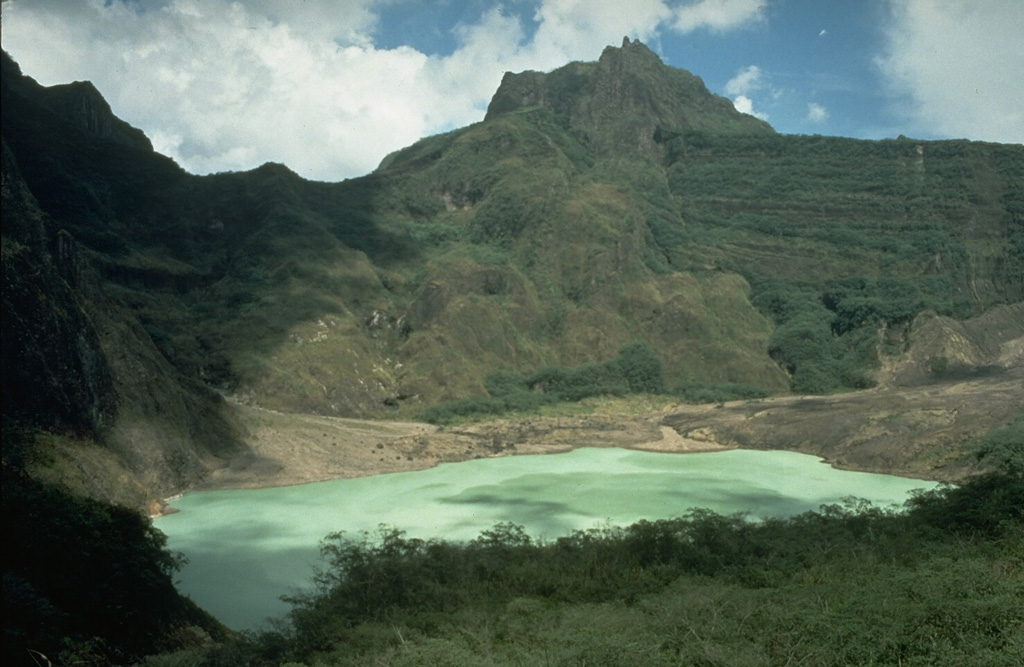 Kelud KeludSunda Volcanic Arc |
The VSI reported that activity remained normal during 23-29 January. There were no major changes since the previous week when the Alert Level was raised from level 1 to 2 on 19 January after several monitored parameters changed at the volcano. Kelut remained at Alert Level 2 (on a scale of 1-4). Source: Pusat Vulkanologi dan Mitigasi Bencana Geologi (PVMBG, also known as CVGHM) |
Lokon-Empung (Indonesia) | 31 January-6 February 2001 | New Eruptive Activity
|
|
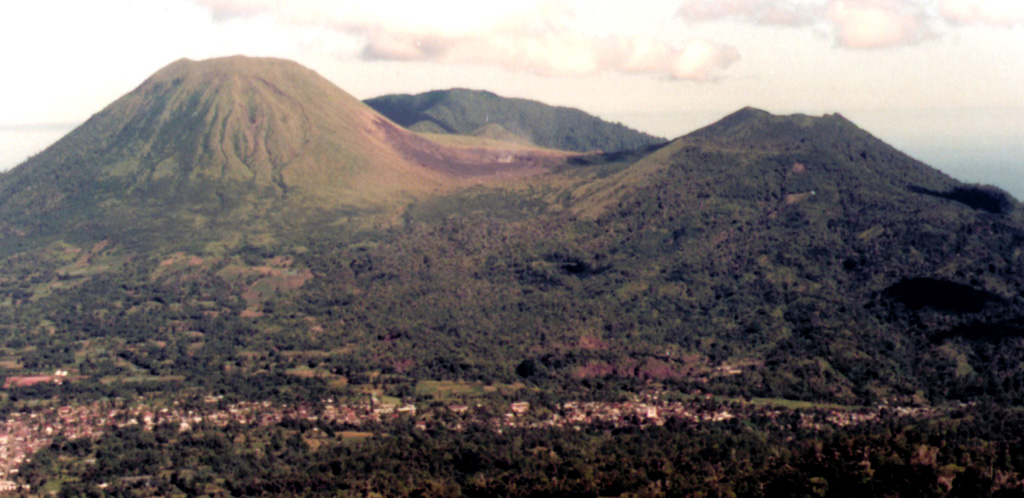 Lokon-Empung Lokon-EmpungSangihe Volcanic Arc |
The VSI reported that volcanic activity increased in comparison to the previous week. Explosions began occurring at 1920 on 28 January and produced glowing ejecta (volcanic bombs) that fell on the N slope of the volcano. The height of the ash cloud that was produced by the eruption could not be measured due to unfavorable weather conditions. A strong sulfurous smell was detected from Kakaskasen observatory. On the morning of 29 January an ash plume rose continuously up to 300 m above the crater. The Alert Level at the volcano was raised during the report period from level 2 to 3 (on a scale of 1-4). Source: Pusat Vulkanologi dan Mitigasi Bencana Geologi (PVMBG, also known as CVGHM) |
Mayon (Philippines) | 31 January-6 February 2001 | New Eruptive Activity
|
|
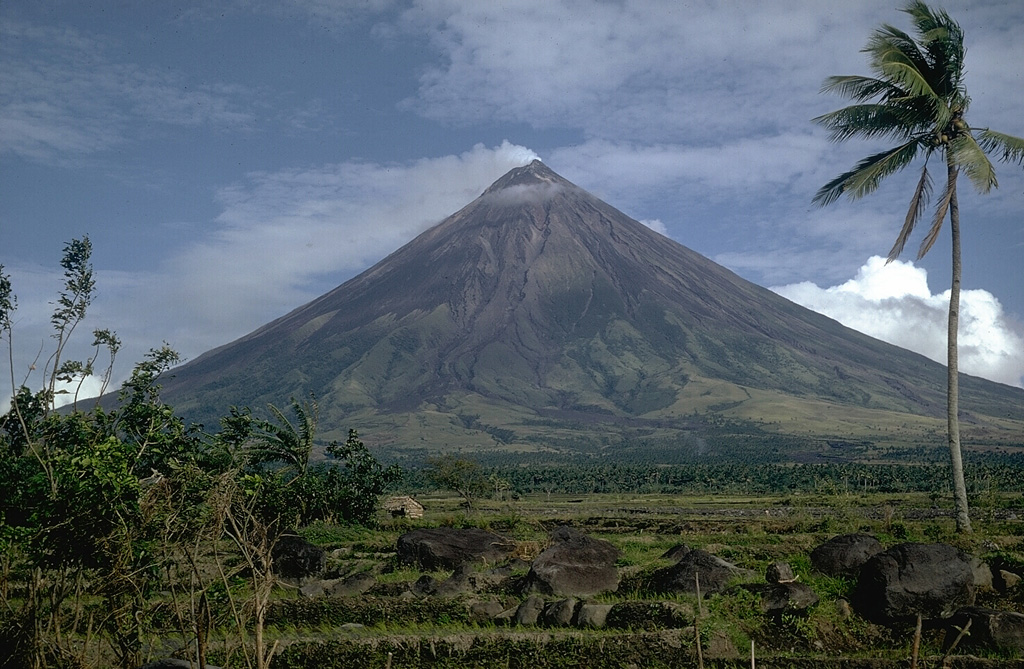 Mayon MayonEastern Philippine Volcanic Arc |
PHIVOLCS reported that numerous shallow earthquakes, high SO2 emission rates, and sustained inflation during the week reflected the active state of the growing summit lava dome. They reported that during the week up to 46 volcanic earthquakes were recorded per day, the SO2 emission rate increased from 2,600 metric tons per day (t/d) on 1 February to 5,330 t/d on 5 February, and electronic tiltmeters on the N flank of the cone continued to detect inflation at the volcano's edifice. Incandescence was visible periodically at the summit. On 1 February, officials recommended that residents of the five towns within the 6-km-radius Permanent Danger Zone evacuate the area. In addition, PHIVOLCS warned residents just outside of the Permanent Danger Zone to be alert for potential hazardous volcanic flows, which may be channeled by rivers and gullies that radiate from the summit. Mayon remained at Alert Level 3 (on a scale of 0-5). Sources: Philippine Institute of Volcanology and Seismology (PHIVOLCS), Reuters, Agence France-Presse (AFP) |
Merapi (Indonesia) | 31 January-6 February 2001 | New Eruptive Activity
|
|
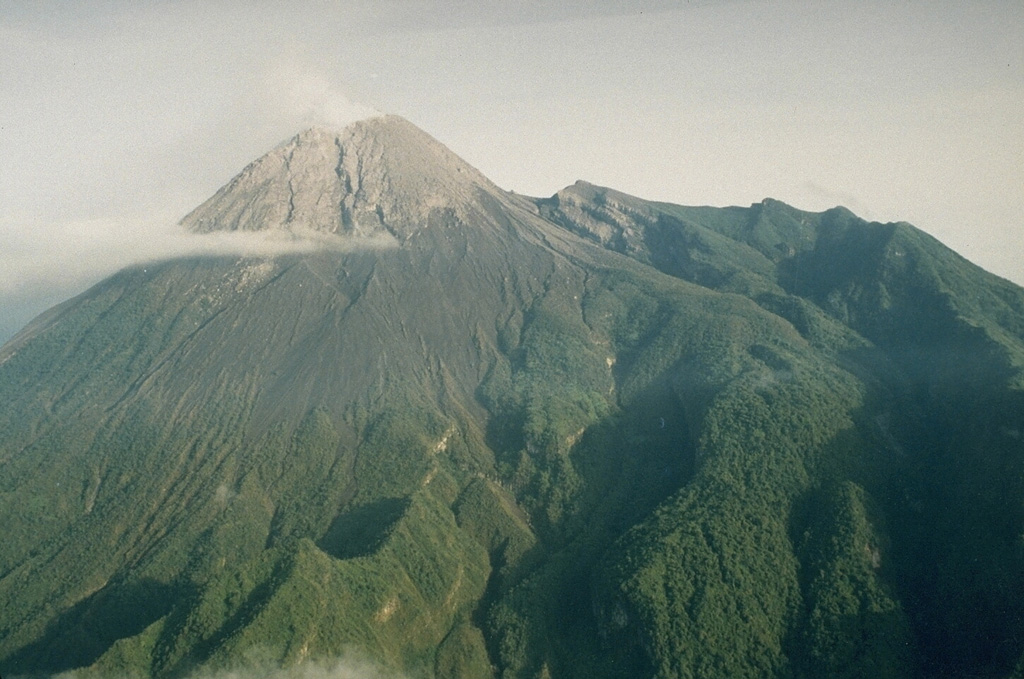 Merapi MerapiSunda Volcanic Arc |
The VSI reported that activity continued to increase during 23 January-1 February. At 0000 on 27 January an eruption produced continuous pyroclastic flows and molten lava avalanches that lasted as long as 2 hours. The eruption also produced a thick ash plume that rose 2 km above the volcano's summit and was accompanied by a strong sulfurous smell. On 28 January, "lava dome 2001" partially collapsed, resulting in pyroclastic flows and molten lava avalanches that occurred at 2-5 minute intervals. The avalanche and pyroclastic-flow material traveled down the Sat and Bebeng rivers to the SW, and Senowo River to the W. The maximum runout distance of 4.5 km occurred in the Sat River. Ash fell in 5 districts within a 15-20 km radius around the volcano; Dukun, Srumbung, Salam, Ngluwar, and Muntilan. On 31 January, pyroclastic flows continuously entered the Sat River, and to a lesser extent the Senowo and Bebeng rivers. The maximum runout distance was ~3.5 km. Again, ash fell on the towns within a ~15 km radius around the volcano. Visual observations and photographic analysis revealed that the dome became higher and larger than it was during the previous report period, and that there was a new active point at the summit that may have been a fumarole or a hot spot. The volcano remained at Alert Level 3 (on a scale of 1-4). Sources: Pusat Vulkanologi dan Mitigasi Bencana Geologi (PVMBG, also known as CVGHM), Agence France-Presse (AFP), Associated Press |
Nyamulagira (DR Congo) | 31 January-6 February 2001 | New Eruptive Activity
|
|
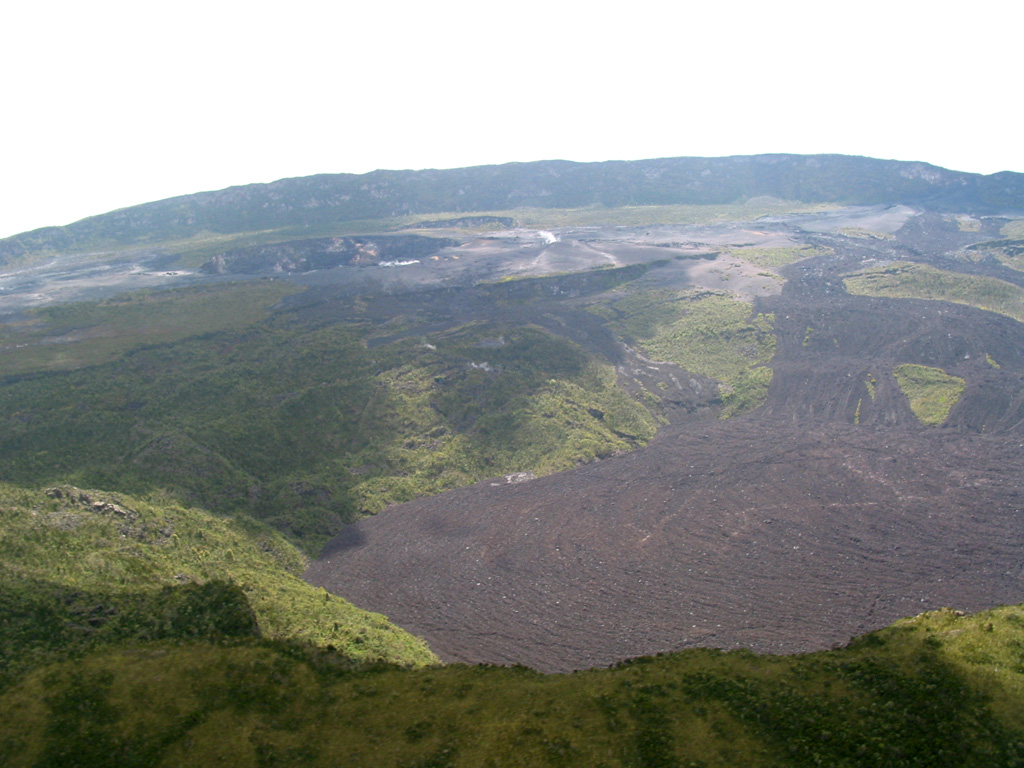 Nyamulagira NyamulagiraAlbertine Rift Volcanic Province |
According to a preliminary report from USAID/OFDA, Nyamuragira began erupting at 0032 on 6 February. Observations made during a flight over the volcano revealed that there were active lava flows. The lava appeared to be flowing from two fissures; one to the W towards the town of Kitchanga, and another to the S in the direction of the town of Mugunga (Sake) and Nyiragongo volcano. Smoke was observed near the volcano and the sound of thunder was heard. Cloudy conditions prevented clear observations of the volcano. Source: US Agency for International Development / Bureau for Humanitarian Assistance |
Rotorua (New Zealand) | 31 January-6 February 2001 | New Eruptive Activity
|
|
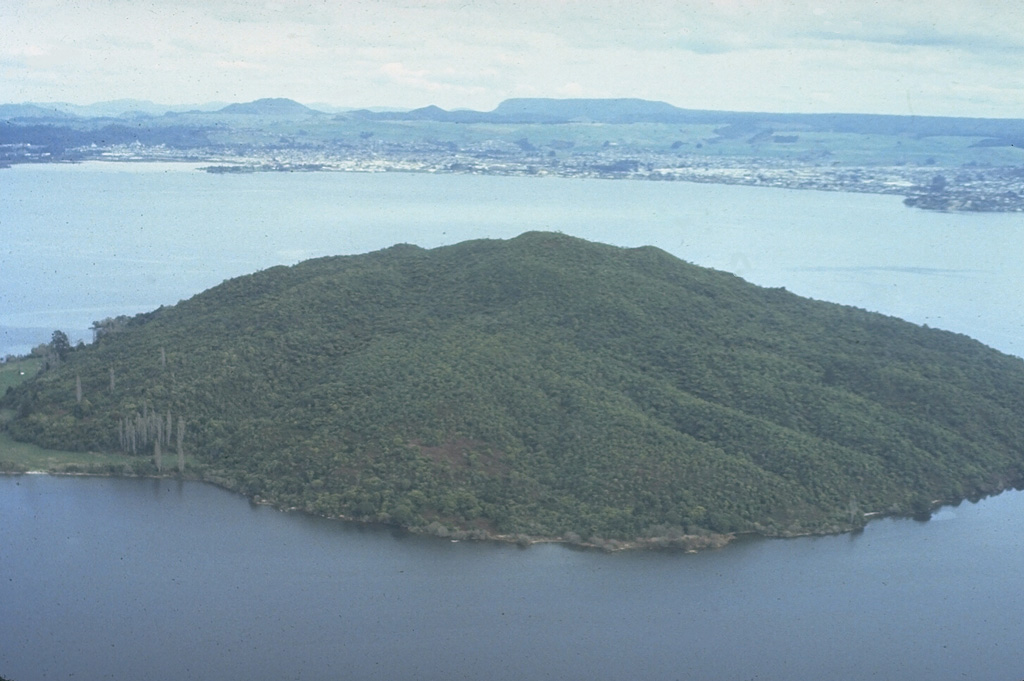 Rotorua RotoruaTaupo Volcanic Arc |
The IGNS wrote, "On Friday 26 January at about 1530 to 1540, a muddy hot pool (Spring 721) erupted violently in the largest hydrothermal eruption in Kuirau Park since 1966. Blocks of rock debris and mud were blasted to a height of about 100 m. Blocks up to a meter in diameter were blown over 50 m from the vent, with fragments up to 10 cm landing over 100 m away. The steam cloud from the eruption was visible several kilometers away." The eruption deposited debris 120 m to the E of the vent and ~30 m to the W. The original hot pool was about 3 meters in diameter; the newly formed crater was about 10-12 m in diameter. |
Etna (Italy) | 31 January-6 February 2001 | Continuing Eruptive Activity
|
|
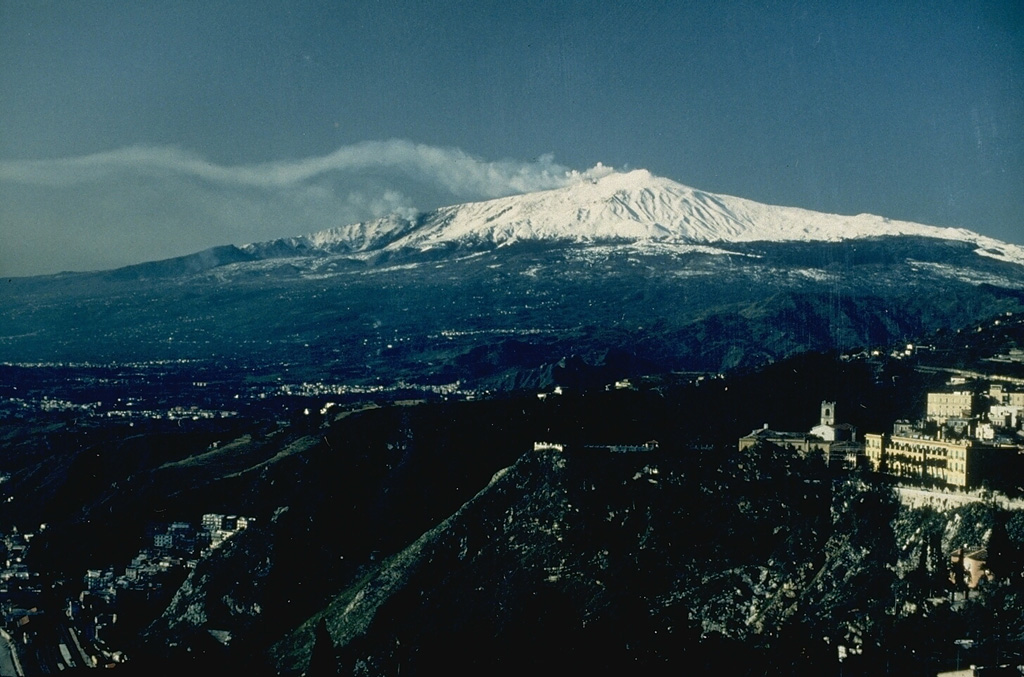 Etna EtnaSicily Volcanic Province |
According to the Italy's Volcanoes website, since 20 January lava has continuously issued at a low but persistent rate from a vent on the NNE flank of the Southeast Crater. The lava formed a small field of overlapping and adjacent flows that extend a few hundred meters. At Bocca Nuova Crater Strombolian activity increased, with ejecta being thrown above the crater rim. Source: Italy's Volcanoes |
Guagua Pichincha (Ecuador) | 31 January-6 February 2001 | Continuing Eruptive Activity
|
|
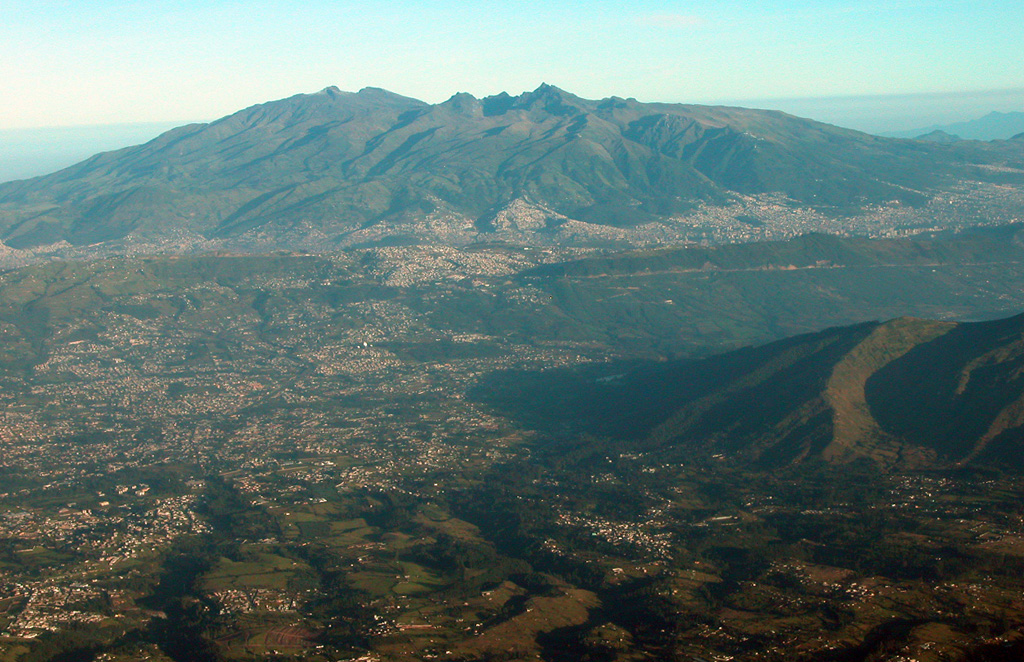 Guagua Pichincha Guagua PichinchaNorthern Andean Volcanic Arc |
The IG reported on 31 January that seismicity and volcanic activity remained at moderate levels. Continuous dome growth persisted at dome 9 and small morphologic changes were observed at the dome the previous week. Source: Instituto Geofísico-Escuela Politécnica Nacional (IG-EPN) |
Karangetang (Indonesia) | 31 January-6 February 2001 | Continuing Eruptive Activity
|
|
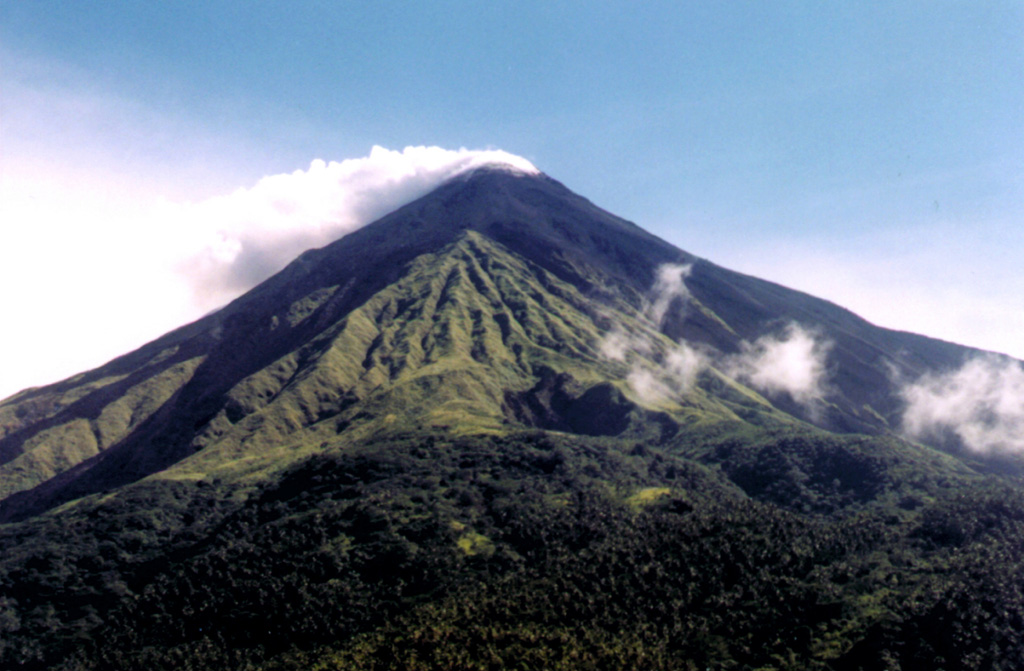 Karangetang KarangetangSangihe Volcanic Arc |
The VSI reported that during 23-29 January explosive activity continued, with explosions on both 25 and 28 January. At 2227 on 25 January a minor explosion produced a thick ash plume that rose 700 m above the volcano, blew to the W, and dropped ash over the sea. The explosion also produced a lava avalanche that traveled ~1,250 m down the Kelitu River. The second explosion during the report period occurred at 2109 on 28 January and produced a Strombolian-type eruption with glowing ejecta that reached up to 300 m above the crater. In addition, a black ash-filled plume rose to ~1 km above the volcano. The explosion opened a new crater in the lava dome and produced a lava avalanche that traveled ~1.5 km down the W slope of the volcano. The volcano remained at Alert Level 2 (on a scale of 1-4). Source: Pusat Vulkanologi dan Mitigasi Bencana Geologi (PVMBG, also known as CVGHM) |
Kīlauea (United States) | 31 January-6 February 2001 | Continuing Eruptive Activity
|
|
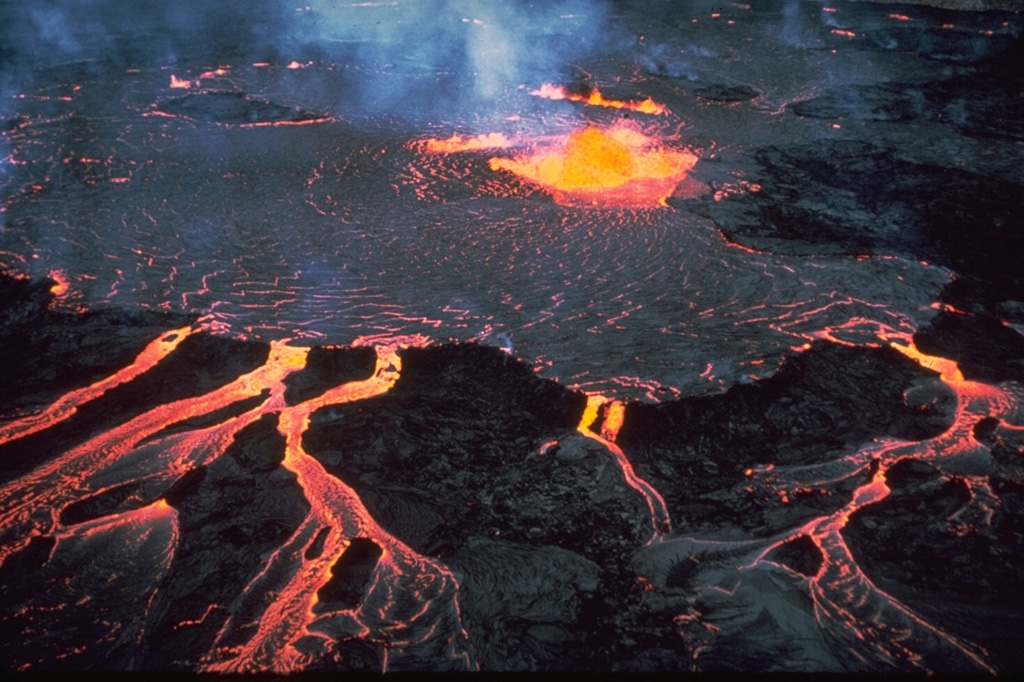 Kīlauea KīlaueaHawaiian-Emperor Hotspot Volcano Group |
The HVO reported that lava had not entered the sea since 29 January. Surface lava flow activity occurred primarily on the E branch of the flow on the Pūlama pali, with some breakouts occurring along the trace of the W branch of the flow. Overall, volcanic tremor near Puʻu ʻŌʻō and in Kīlauea's caldera was at low-to-moderate levels. Tiltmeters in the summit area and along the E rift zone showed flat signals. Source: US Geological Survey Hawaiian Volcano Observatory (HVO) |
Popocatépetl (Mexico) | 31 January-6 February 2001 | Continuing Eruptive Activity
|
|
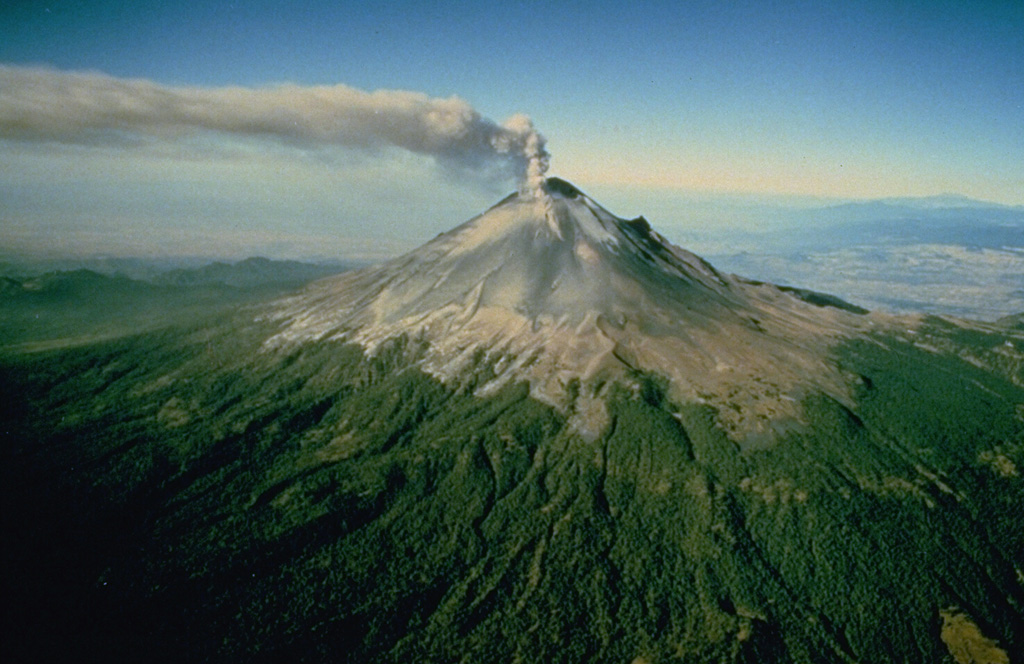 Popocatépetl PopocatépetlTrans-Mexican Volcanic Arc |
The Washington VAAC reported that during 1530 to 1545 on 30 January a moderate ash emission was visible on the CENAPRED camera; it rose to ~7 km a.s.l. and blew to the NNE. At 1345 on 1 February a small eruption was visible on GOES-8 imagery. The narrow plume of ash rose to ~6.7 km and blew to the NNE. The volcano remained at Alert Level Yellow Phase III, with a restricted area of 12-km-radius. Sources: Centro Nacional de Prevencion de Desastres (CENAPRED), Washington Volcanic Ash Advisory Center (VAAC) |
Sheveluch (Russia) | 31 January-6 February 2001 | Continuing Eruptive Activity
|
|
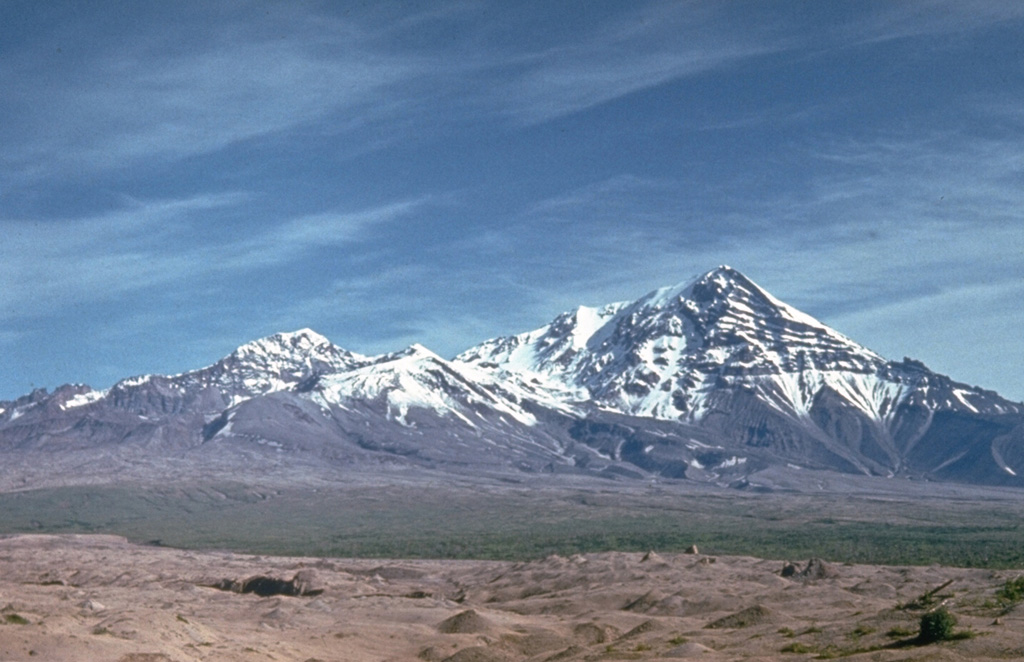 Sheveluch SheveluchEastern Kamchatka Volcanic Arc |
The KVERT reported that at 1802 and 1820 on 29 January, shallow earthquakes were registered beneath the volcano that were accompanied by short-lived explosions. The ash cloud produced from the first explosion reached ~2.5 km above the volcano, while the second eruption's ash cloud could not be observed. During 26-31 January a gas-and-steam plume rose 50-800 m above the volcano, and on 1 February a gas-and-steam plume rose 2 km above the volcano. The Concern Color Code remained at Yellow. |
Soufrière Hills (United Kingdom) | 31 January-6 February 2001 | Continuing Eruptive Activity
|
|
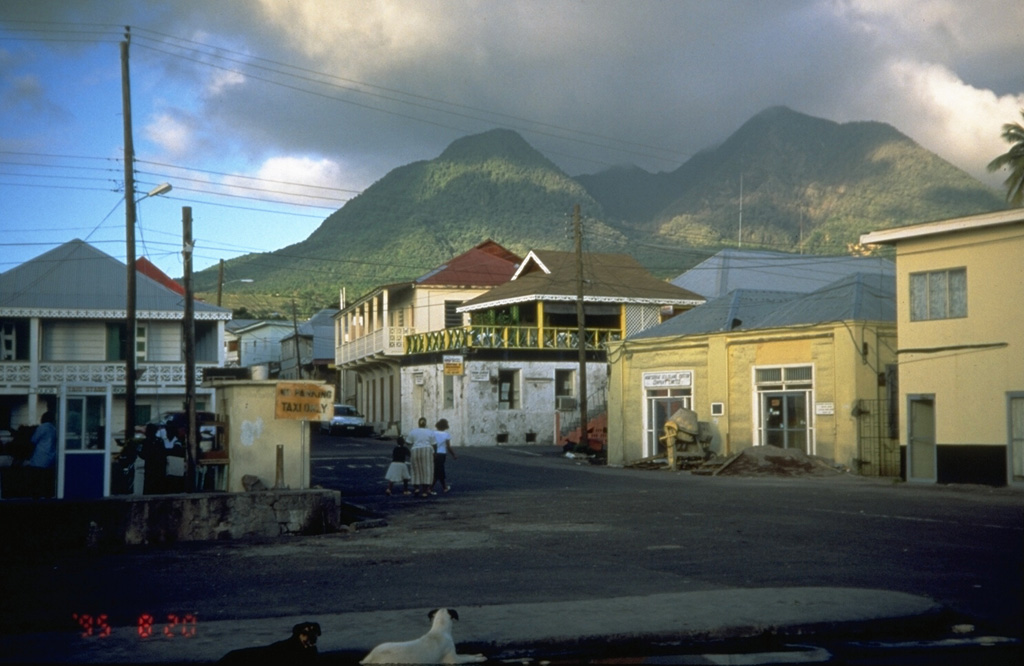 Soufrière Hills Soufrière HillsLesser Antilles Volcanic Arc |
The MVO reported that activity at the Soufrière Hills Volcano was lower than during the previous week, although the lava dome continued to grow. The level of seismicity was also generally lower. During the morning of 29 January a very low-energy swarm of 20 volcano-tectonic earthquakes occurred to the NE of the volcano. During the week, brief observations revealed that volcanic activity remained concentrated on the SE side of the dome. On 1 February, a small pyroclastic flow was observed in the White River Valley. It traveled ~1 km to the SE and produced a small ash cloud that rose to a maximum height of ~1.5 km a.s.l. |
Since the Weekly Volcanic Activity Report began in November 2000, there have been 22,859 individual reports over 1,335 weeks (average of 17 per week) on 351 different volcanoes.
Use the dropdowns to choose the year and week for archived Weekly Reports.
The RSS (Really Simple Syndication) feed is identical to the Weekly Volcanic Activity Report minus some features including the header information (latitude and longitude and summit elevation), the Geological Summary, and a link to the GVP volcano profile page. At the end of each report is a list of the sources used. Each report includes a link from the volcano's name back to the more complete information on the GVP website.
The CAP (Common Alerting Protocol) feeds are XML files specifically formatted for disaster management. They are similar in content to the RSS feed, but contain no active links.
Loading the network link into Google Earth will automatically load placemarks for volcanoes in the current weekly report. Placemark balloons include the volcano name, report date, report text, sources, and links back to the GVP volcano profile page and to the complete Weekly Report for that week.
 Download Smithsonian / USGS Weekly Volcanic Activity Report Network RSS Feed
Download Smithsonian / USGS Weekly Volcanic Activity Report Network CAP Feed
Download Smithsonian / USGS Weekly Volcanic Activity Report Network Link
The Weekly Volcanic Activity Report does not necessarily include all volcanic activity that occurred on Earth during the week. More than a dozen volcanoes globally have displayed essentially continuous eruptive activity for decades or longer, and such routine activity is typically not reported here. Submarine activity is reported when information is available. The Weekly Volcanic Activity Report summarizes volcanic activity that meets one or more of the following criteria:
- A volcano observatory raises or lowers the alert level at the volcano.
- A volcanic ash advisory has been released by a volcanic ash advisory center (VAAC) stating that an ash cloud has been produced from the volcano.
- A verifiable news report of new activity or a change in activity at the volcano has been issued.
- Observers have reported a significant change in volcanic activity. Such activity can include, but is not restricted to, pyroclastic flows, lahars, lava flows, dome collapse, or increased unrest.
Reports categorized as "Activity (New)" indicate eruptive activity that has occurred after at least 3 months of quiescence. Once a volcano is included in this section, updates will remain on that list unless the activity continues for more than 1 month without escalating, after which time updates will be listed in the "Activity (Continuing)" section. Reports are included in the "Unrest" sections (New or Continuing) if the volcano is undergoing non-eruptive activity such as seismicity or deformation that is unusually high for that volcano or is increasing. The "Other" category includes non-eruptive and non-unrest reports, such as Alert Level decreases or previous ash deposits resuspended by winds. Reports through 2025 were only divided into "New Activity/Unrest" and "Continuing Activity", which have been automatically converted to the "Activity (New)" and "Activity (Continuing)" groups, respectively, without a review of content that might change the category to "Unrest" or "Other".
It is important to note that volcanic activity meeting one or more of these criteria may occur during the week, but may not be included in the Weekly Volcanic Activity Report because we did not have the relevant information at the time.
1. The Weekly Volcanic Activity Report is intended to provide timely information about global volcanism on a weekly basis. Consequently, the report is generated rapidly by summarizing volcanic reports from various sources, with little time for fact checking. The accuracy of the Weekly Volcanic Activity Report is dependent upon the quality of the volcanic activity reports we receive. Reports published in the Bulletin of the Global Volcanism Network are cover longer time periods and are more carefully reviewed, although all of the volcanoes discussed in the Weekly Volcanic Activity Report are not necessarily reported in the Bulletin. Reports are updated on the Weekly Volcanic Activity Report web page as they are received, therefore information may be included regarding events that occurred before the current report period.
2. Rapidly developing events lead to coverage that is often fragmentary. Volcanoes, their eruptions, and their plumes and associated atmospheric effects are complex phenomena that may require months to years of data analysis in order to create a comprehensive summary and interpretation of events.
3. Preliminary accounts sometimes contain exaggerations and "false alarms," and accordingly, this report may include some events ultimately found to be erroneous or misleading.
4. Many news agencies do not archive the articles they post on the Internet, and therefore the links to some sources may not be active. To obtain information about the cited articles that are no longer available on the Internet contact the source.
5. USGS Disclaimer Statement for this Website:
Information presented on this website is considered public information and may be distributed or copied. Use of appropriate byline/photo/image credit is requested. We strongly recommend that USGS data be acquired directly from a USGS server and not through other sources that may change the data in some way. While USGS makes every effort to provide accurate and complete information, various data such as names, telephone numbers, etc. may change prior to updating. USGS welcomes suggestions on how to improve our home page and correct errors. USGS provides no warranty, expressed or implied, as to the accuracy, reliability or completeness of furnished data.
Some of the documents on this server may contain live references (or pointers) to information created and maintained by other organizations. Please note that USGS does not control and cannot guarantee the relevance, timeliness, or accuracy of these outside materials.
For site security purposes and to ensure that this service remains available to all users, this government computer system employs software programs to monitor network traffic to identify unauthorized attempts to upload or change information, or otherwise cause damage. Unauthorized attempts to upload information or change information on this website are strictly prohibited and may be punishable under the Computer Fraud and Abuse Act of 1986 and the National Information Infrastructure Protection Act. Information may also be used for authorized law enforcement investigations. (Last modified September 21, 1999.)
U.S. Department of the Interior, U.S. Geological Survey, Reston, VA, USA
URL: https://volcano.si.edu/reports_weekly.cfm

 Cite this Report