

Report on Lewotolok (Indonesia) — 4 June-10 June 2025
Smithsonian Institution / US Geological Survey
Weekly Volcanic Activity Report, 4 June-10 June 2025
Managing Editor: Sally Sennert.
Please cite this report as:
Global Volcanism Program, 2025. Report on Lewotolok (Indonesia) (Sennert, S, ed.). Weekly Volcanic Activity Report, 4 June-10 June 2025. Smithsonian Institution and US Geological Survey.
Lewotolok
Indonesia
8.274°S, 123.508°E; summit elev. 1431 m
All times are local (unless otherwise noted)
The Pusat Vulkanologi dan Mitigasi Bencana Geologi (PVMBG) reported that an eruption at Lewotolok was ongoing during 4-10 June. Gray or white-to-gray ash plumes rose 500-700 m above the summit of the cone and drifted NW, W, and SW during 4-5 and 8-9 June. Clear nighttime webcam images showed incandescent material at the summit cone, being ejected above the summit cone, and on the upper flanks. Lava effusion increased on 4 June and flows were descending three flanks. By 5 June the S flow was 700 m from the crater rim, the SE flow was 1 km from the crater rim, and the W flow was 300 m from the crater rim. A drone overflight was conducted on 7 June; the SE flow had advanced 200 m for a total length of 1.2 km, indicating a slower advancement rate. The Alert Level remained at 2 (on a scale of 1-4) and the public was warned to stay 2 km away from the vent and 2.5 km away on the S, SE, and W flanks.
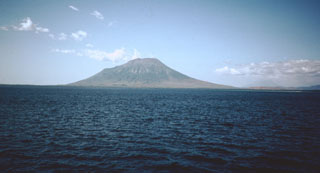
Geological Summary. The Lewotolok (or Lewotolo) stratovolcano occupies the eastern end of an elongated peninsula extending north into the Flores Sea, connected to Lembata (formerly Lomblen) Island by a narrow isthmus. It is symmetrical when viewed from the north and east. A small cone with a 130-m-wide crater constructed at the SE side of a larger crater forms the volcano's high point. Many lava flows have reached the coastline. Eruptions recorded since 1660 have consisted of explosive activity from the summit crater.
Source: Pusat Vulkanologi dan Mitigasi Bencana Geologi (PVMBG, also known as CVGHM)
