
| Country | Chile - Bolivia |
| Volcanic Region | Central Andean Volcanic Arc |
| Landform | Volc Type | Composite | Stratovolcano |
| Last Known Eruption | 1995 CE |
| Coordinates | 20.73°S, 68.55°W |
| Elevation | 5,163 m (16,939 ft) |
| Volcano Number | 355040 |
 Google Earth Placemark with Features Google Earth Placemark with Features
| |
 Cite Volcano Profile Cite Volcano Profile
| |
The Global Volcanism Program has no Weekly Volcanic Activity Reports available for Irruputuncu.
Cite this Report
Minor, late-1995 eruption; the first unambiguous modern report
In the course of field work on volcanic rocks in the region, Anita Grunder observed a dark, vertical plume coming from the top of Irruputuncu at about 1000 on 26 November 1995. This dark plume lasted a few minutes, then returned to a white plume, and then again became dark and returned to white. The dark plume was dark gray to black and of the same puffy form as the white plume. The plumes dispersed very slowly to the E and the column height was same whether black or white. It was hard to judge the column size, but it seemed perhaps a few times the relief of the volcano suggesting they were kilometers tall. Grunder's field assistant, Maximino Burotto Huerta, said he had seen similar behavior on 1 September. Ordinarily, either a white wisp of steam or nothing is seen emanating from the peak. The sighting on 26 November was from ~30 km SSE, not far from the village of Ujina.
Grunder was in the area for 31 days between 24 August and 5 December 1995, though typically not in sight of the volcano. She observed no plumes on 27 November and 1-5 December 1995. These observations suggested that the activity consisted of modest phreatic eruptions.
Available literature lacks clear documentation of any historical Irruputuncu eruptions. The stratovolcano was the subject of unconfirmed press reports of an eruption in December 1989, but when visited by a state geologist on 25 March 1990 he found only fumarolic activity (BGVN 15:03). Irruputuncu sits within the collapse scarp related to a Holocene debris avalanche. There are two summit craters, the southernmost of which has been fumarolically active.
Information Contacts: Anita Grunder, Department of Geosciences, 104 Wilkinson Hall, Oregon State University, Corvallis OR 97331, USA.
The Global Volcanism Program has no Weekly Reports available for Irruputuncu.
Reports are organized chronologically and indexed below by Month/Year (Publication Volume:Number), and include a one-line summary. Click on the index link or scroll down to read the reports.
03/1990 (BGVN 15:03) Eruption reported by press but geologist observes only fumarolic activity
01/1997 (BGVN 22:01) Minor, late-1995 eruption; the first unambiguous modern report
Information is preliminary and subject to change. All times are local (unless otherwise noted)
Cite this Report
Eruption reported by press but geologist observes only fumarolic activity
December press reports in Bolivia of an eruption . . .[located 25 km NNW of Olca Volcano] remain unconfirmed, and attempts by Bolivian geologists to fly over the volcano in January were stymied by poor weather. State oil company (ENAP) geologist Patricio Sepulveda reported only normal fumarolic activity at Irruputuncu on 25 March.
Information Contacts: J. Naranjo, SERNAGEOMIN.
Cite this Report
Minor, late-1995 eruption; the first unambiguous modern report
In the course of field work on volcanic rocks in the region, Anita Grunder observed a dark, vertical plume coming from the top of Irruputuncu at about 1000 on 26 November 1995. This dark plume lasted a few minutes, then returned to a white plume, and then again became dark and returned to white. The dark plume was dark gray to black and of the same puffy form as the white plume. The plumes dispersed very slowly to the E and the column height was same whether black or white. It was hard to judge the column size, but it seemed perhaps a few times the relief of the volcano suggesting they were kilometers tall. Grunder's field assistant, Maximino Burotto Huerta, said he had seen similar behavior on 1 September. Ordinarily, either a white wisp of steam or nothing is seen emanating from the peak. The sighting on 26 November was from ~30 km SSE, not far from the village of Ujina.
Grunder was in the area for 31 days between 24 August and 5 December 1995, though typically not in sight of the volcano. She observed no plumes on 27 November and 1-5 December 1995. These observations suggested that the activity consisted of modest phreatic eruptions.
Available literature lacks clear documentation of any historical Irruputuncu eruptions. The stratovolcano was the subject of unconfirmed press reports of an eruption in December 1989, but when visited by a state geologist on 25 March 1990 he found only fumarolic activity (BGVN 15:03). Irruputuncu sits within the collapse scarp related to a Holocene debris avalanche. There are two summit craters, the southernmost of which has been fumarolically active.
Information Contacts: Anita Grunder, Department of Geosciences, 104 Wilkinson Hall, Oregon State University, Corvallis OR 97331, USA.
|
|
||||||||||||||||||||||||||
There is data available for 1 confirmed eruptive period.
1995 Sep 1 - 1995 Sep 26 Confirmed Eruption (Explosive / Effusive) VEI: 2
| Episode 1 | Eruption (Explosive / Effusive) | |||||||||||||||||||
|---|---|---|---|---|---|---|---|---|---|---|---|---|---|---|---|---|---|---|---|
| 1995 Sep 1 - 1995 Sep 26 | Evidence from Observations: Reported | ||||||||||||||||||
|
List of 2 Events for Episode 1
|
|||||||||||||||||||
[ 1989 Dec 16 ± 15 days ] Uncertain Eruption
| Episode 1 | Eruption (Explosive / Effusive) | ||||
|---|---|---|---|---|
| 1989 Dec 16 ± 15 days - Unknown | Evidence from Unknown | |||
This compilation of synonyms and subsidiary features may not be comprehensive. Features are organized into four major categories: Cones, Craters, Domes, and Thermal Features. Synonyms of features appear indented below the primary name. In some cases additional feature type, elevation, or location details are provided.
Synonyms |
| Irruputunco | Iruputuncu |
There are no samples for Irruputuncu in the Smithsonian's NMNH Department of Mineral Sciences Rock and Ore collection.
| Copernicus Browser | The Copernicus Browser replaced the Sentinel Hub Playground browser in 2023, to provide access to Earth observation archives from the Copernicus Data Space Ecosystem, the main distribution platform for data from the EU Copernicus missions. |
| MIROVA | Middle InfraRed Observation of Volcanic Activity (MIROVA) is a near real time volcanic hot-spot detection system based on the analysis of MODIS (Moderate Resolution Imaging Spectroradiometer) data. In particular, MIROVA uses the Middle InfraRed Radiation (MIR), measured over target volcanoes, in order to detect, locate and measure the heat radiation sourced from volcanic activity. |
| MODVOLC Thermal Alerts | Using infrared satellite Moderate Resolution Imaging Spectroradiometer (MODIS) data, scientists at the Hawai'i Institute of Geophysics and Planetology, University of Hawai'i, developed an automated system called MODVOLC to map thermal hot-spots in near real time. For each MODIS image, the algorithm automatically scans each 1 km pixel within it to check for high-temperature hot-spots. When one is found the date, time, location, and intensity are recorded. MODIS looks at every square km of the Earth every 48 hours, once during the day and once during the night, and the presence of two MODIS sensors in space allows at least four hot-spot observations every two days. Each day updated global maps are compiled to display the locations of all hot spots detected in the previous 24 hours. There is a drop-down list with volcano names which allow users to 'zoom-in' and examine the distribution of hot-spots at a variety of spatial scales. |
|
WOVOdat
Single Volcano View Temporal Evolution of Unrest Side by Side Volcanoes |
WOVOdat is a database of volcanic unrest; instrumentally and visually recorded changes in seismicity, ground deformation, gas emission, and other parameters from their normal baselines. It is sponsored by the World Organization of Volcano Observatories (WOVO) and presently hosted at the Earth Observatory of Singapore.
GVMID Data on Volcano Monitoring Infrastructure The Global Volcano Monitoring Infrastructure Database GVMID, is aimed at documenting and improving capabilities of volcano monitoring from the ground and space. GVMID should provide a snapshot and baseline view of the techniques and instrumentation that are in place at various volcanoes, which can be use by volcano observatories as reference to setup new monitoring system or improving networks at a specific volcano. These data will allow identification of what monitoring gaps exist, which can be then targeted by remote sensing infrastructure and future instrument deployments. |
| Volcanic Hazard Maps | The IAVCEI Commission on Volcanic Hazards and Risk has a Volcanic Hazard Maps database designed to serve as a resource for hazard mappers (or other interested parties) to explore how common issues in hazard map development have been addressed at different volcanoes, in different countries, for different hazards, and for different intended audiences. In addition to the comprehensive, searchable Volcanic Hazard Maps Database, this website contains information about diversity of volcanic hazard maps, illustrated using examples from the database. This site is for educational purposes related to volcanic hazard maps. Hazard maps found on this website should not be used for emergency purposes. For the most recent, official hazard map for a particular volcano, please seek out the proper institutional authorities on the matter. |
| EarthScope Consortium SAGE seismic stations/networks | EarthScope Consortium operates the NSF Geodetic Facility for the Advancement of Geoscience (GAGE) and NSF Seismological Facility for the Advancement of Geoscience (SAGE). The linked map shows the location of seismic stations from all available networks (permanent or temporary) within a radius of 0.18° (about 20 km at mid-latitudes) from the given location of Irruputuncu. Users can customize a variety of filters and options in the left panel. Note that if there are no stations are known the map will default to show the entire world with a "No data matched request" error notice. |
| Large Eruptions of Irruputuncu | Information about large Quaternary eruptions (VEI >= 4) is cataloged in the Large Magnitude Explosive Volcanic Eruptions (LaMEVE) database of the Volcano Global Risk Identification and Analysis Project (VOGRIPA). |
| EarthChem | EarthChem develops and maintains databases, software, and services that support the preservation, discovery, access and analysis of geochemical data, and facilitate their integration with the broad array of other available earth science parameters. EarthChem is operated by a joint team of disciplinary scientists, data scientists, data managers and information technology developers who are part of the NSF-funded data facility Integrated Earth Data Applications (IEDA). IEDA is a collaborative effort of EarthChem and the Marine Geoscience Data System (MGDS). |


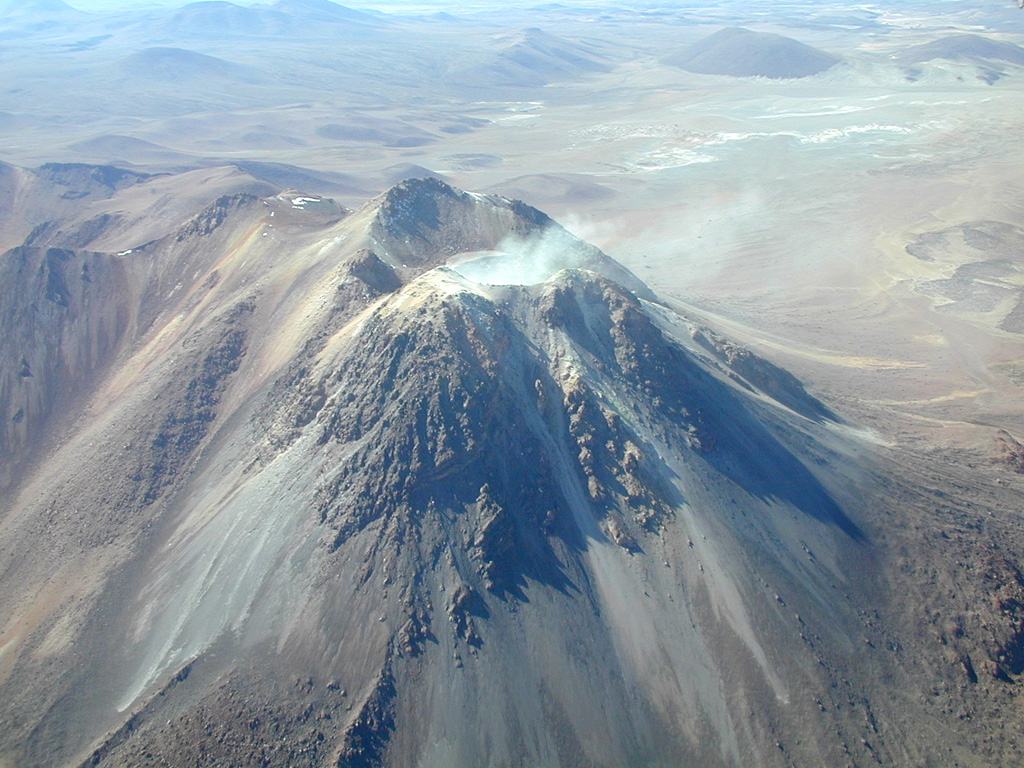
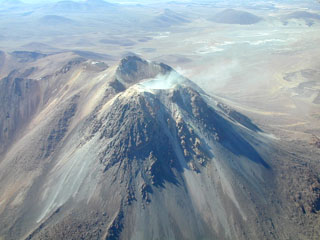 Steam rises from the fumarolically active southern summit crater of Irruputuncu, a small stratovolcano that straddles the Chile/Bolivia border. Irruputuncu, seen here from the WSW, was constructed within the collapse scarp of a Holocene debris avalanche whose deposit extends to the SW. Levees of viscous lava flows down the western flank of an edifice that was constructed within this scarp are seen at the lower left. The first unambiguous historical eruption from Irruputuncu took place in November 1995.