Keyword Collections | Keyword "spatter cone"
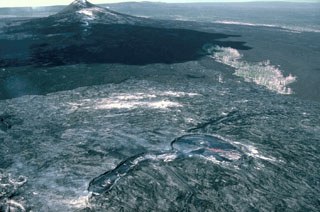 This 13 January 1987 view from the east shows the principal vents of the current eruption on Kīlauea's East Rift Zone, taken four years after the start of the eruption. The Pu‘u ‘Ō‘ō scoria cone to the left formed during the early stages of the eruption. Kūpaianaha to the lower right contains an actively convecting lava lake in this photo. The linear extension in the center foreground is at the head of a lava tube system, which insulated lava flows that reached the coast.
Photo by J. D. Griggs, 1987 (U.S. Geological Survey).
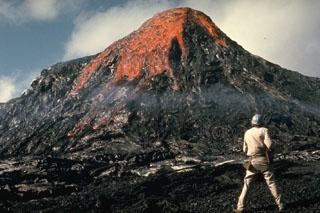 This eruption was observed by Hawaiian Volcano Observatory volcanologist Jack Lockwood on 28 February 1974, near the end of the 5-year-long Mauna Ulu eruption. As the erupting lava solidifies around the vent the feature gets progressively larger.
Photo by Robin Holcomb, 1974 (U.S. Geological Survey).
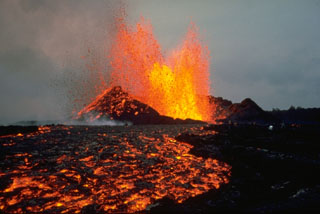 Lava fountains on 30 September 1977 produced lava flows from the Puʻu Kiai vent at Kīlauea. The eruption began along the East Rift Zone near Kalalau Crater on 13 September. The eruption ended on 1 October after producing lava flows that traveled 10 km SE to within 1 km of the coastal town of Kalapana.
Photo by Peter Lipman, 1977 (U.S. Geological Survey).
 This 12 April 1940 photo shows a lava fountain within the Mauna Loa Moku‘āweoweo caldera from the SE. The eruption began during the night of 7 April from fissures that soon migrated down the SW rift zone. A 6-km-long fissure produced lava flows that covered two-thirds of the caldera floor. The eruption lasted until 18 August.
Photo by G.O. Fagerlund (U.S. Geological Survey).
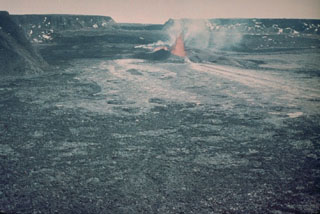
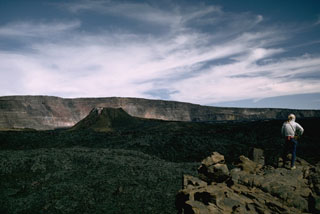 The spatter cone that formed during the 1940 eruption of Mauna Loa is seen in Moku'aweoweo caldera in this 1966 view from the southern rim of the caldera with the western caldera wall in the background. The eruption began along a 6-km-long fissure that extended across the caldera and down the SW rift zone. Activity soon became focused within the caldera and lava flows covered two-thirds of the caldera floor.
Photo by Richard Fiske, 1966 (Smithsonian Institution).
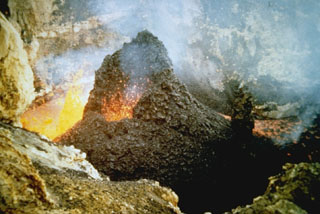 Spatter cones form when blobs of molten lava that are ejected from a vent solidify to form a steep-sided cone. This small spatter cone formed in MacKenney crater of Pacaya volcano in Guatemala on 10 February 1985, during an ongoing eruption that began in 1965. At the time of this photo, the spatter cone was 6-m high, ejecting incandescent volcanic bombs from its vent and extruding lava from its eastern (left) side.
Photo by Alfredo MacKenney, 1985.