Recently Published Bulletin Reports
Agung (Indonesia) Three eruptive events reported in April, May, and December 2022
Tengger Caldera (Indonesia) Minor ash emission in December 2023; persistent weak thermal anomaly in the Bromo crater
Saunders (United Kingdom) Persistent thermal anomalies from the summit crater lava lake during February 2023-January 2024
Shishaldin (United States) New eruption with significant Strombolian explosions, ash plumes, and ashfall
Ioto (Japan) New eruption with discolored water, ejecta, and floating pumice during October-December 2023
Purace (Colombia) Gas-and-ash emission on 16 November 2023
Etna (Italy) Strombolian explosions, lava fountains, and lava flows during July-August 2023
Suwanosejima (Japan) Eruption plumes, crater incandescence, and occasional explosions during July-October 2023
Aira (Japan) Explosions, ash plumes, ash fall, and crater incandescence during July-October 2023
Nishinoshima (Japan) Gray emissions during October 2023
Kilauea (United States) Strong lava fountains, lava flows, and spatter at Halema’uma’u during January-September 2023
Tinakula (Solomon Islands) Continued lava flows and thermal activity during June through November 2023
Agung (Indonesia) — January 2024  Cite this Report
Agung
Indonesia
8.343°S, 115.508°E; summit elev. 2997 m
All times are local (unless otherwise noted)
Three eruptive events reported in April, May, and December 2022
Mount Agung, located on the E end of the island of Bali, Indonesia, rises above the SE rim of the Batur caldera. The summit area extends 1.5 km E-W, with the highest point on the W and a steep-walled 800-m-wide crater on the E. Recorded eruptions date back to the early 19th century. A large and deadly explosive and effusive eruption occurred during 1963-64, which was characterized by voluminous ashfall, pyroclastic flows, and lahars that caused extensive damage and many fatalities. More recent activity was documented during November 2017-June 2019 that consisted of multiple explosions, significant ash plumes, lava flows at the summit crater, and incandescent ejecta. This report covers activity reported during April-May 2022 and December 2022 based on data from the Darwin Volcanic Ash Advisory Center (VAAC).
Activity during 2022 was relatively low and mainly consisted of a few ash plumes during April-May and December. An ash plume on 3 April rising to 3.7 km altitude (700 m above the summit) and drifting N was reported in a Darwin VAAC notice based on a ground report, with ash seen in HIMAWARI-8 visible imagery. Another ash plume was reported at 1120 on 27 May that rose to 5.5 km altitude (2.5 m above the summit); the plume was not visible in satellite or webcam images due to weather clouds. An eruption was reported based on seismic data at 0840 on 13 December, with an estimated plume altitude of 3.7 km; however, no ash was seen using satellite imagery in clear conditions before weather clouds obscured the summit.
Geologic Background. Symmetrical Agung stratovolcano, Bali's highest and most sacred mountain, towers over the eastern end of the island. The volcano, whose name means "Paramount," rises above the SE rim of the Batur caldera, and the northern and southern flanks extend to the coast. The summit area extends 1.5 km E-W, with the high point on the W and a steep-walled 800-m-wide crater on the E. The Pawon cone is located low on the SE flank. Only a few eruptions dating back to the early 19th century have been recorded in historical time. The 1963-64 eruption, one of the largest in the 20th century, produced voluminous ashfall along with devastating pyroclastic flows and lahars that caused extensive damage and many fatalities.
Information Contacts: Darwin Volcanic Ash Advisory Centre (VAAC), Bureau of Meteorology, Northern Territory Regional Office, PO Box 40050, Casuarina, NT 0811, Australia (URL: http://www.bom.gov.au/info/vaac/).
Tengger Caldera (Indonesia) — February 2024 Cite this Report
Tengger Caldera
Indonesia
7.942°S, 112.95°E; summit elev. 2329 m
All times are local (unless otherwise noted)
Minor ash emission in December 2023; persistent weak thermal anomaly in the Bromo crater
Tengger Caldera, located at the N end of a volcanic massif in Indonesia’s East Java, consists of five overlapping stratovolcanoes. The youngest and only active cone in the 16-km-wide caldera is Bromo, which typically produces gas-and-steam plumes, occasional ash plumes and explosions, and weak thermal signals (BGVN 44:05, 47:01). This report covers activity during January 2022-December 2023, consisting of mostly white gas-and-steam emissions and persistent weak thermal anomalies. Information was provided by the Pusat Vulkanologi dan Mitigasi Bencana Geologi (PVMBG, also known as Indonesian Center for Volcanology and Geological Hazard Mitigation, CVGHM) and satellite imagery. The Alert Level remained at 2 (on a scale of 1-4), and visitors were warned to stay at least 1 km from the crater.
Activity was generally low during the reporting period, similar to that in 2021. According to almost daily images from MAGMA Indonesia (a platform developed by PVMBG), white emissions and plumes rose from 50 to 900 m above the main crater during this period (figure 24). During several days in March and June 2022, white plumes reached heights of 1-1.2 km above the crater.
After an increase in activity at 2114 on 3 February 2023, a PVMBG team that was sent to observe white emissions rising as high as 300 m during 9-12 February and heard rumbling noises. A sulfur dioxide odor was also strong near the crater and measurements indicated that levels were above the healthy (non-hazardous) threshold of 5 parts per million; differential optical absorption spectroscopy (DOAS) measurements indicated an average flux of 190 metric tons per day on 11 February. Incandescence originating from a large fumarole in the NNW part of the crater was visible at night. The team observed that vegetation on the E caldera wall was yellow and withered. The seismic network recorded continuous tremor and deep and shallow volcanic earthquakes.
According to a PVMBG press release, activity increased on 13 December 2023 with white, gray, and brown emissions rising as high as 900 m above Bromo’s crater rim and drifting in multiple directions (figure 25). The report noted that tremor was continuous and was accompanied in December by three volcanic earthquakes. Deformation data indicated inflation in December. There was no observable difference in the persistent thermal anomaly in the crater between 11 and 16 December 2023.
All clear views of the Bromo crater throughout this time, using Sentinel-2 infrared satellite images, showed a weak persistent thermal anomaly; none of the anomalies were strong enough to cause MODVOLC Thermal Alerts. A fire in the SE part of the caldera in early September 2023 resulted in a brief period of strong thermal anomalies.
Geologic Background. The 16-km-wide Tengger caldera is located at the northern end of a volcanic massif extending from Semeru volcano. The massive volcanic complex dates back to about 820,000 years ago and consists of five overlapping stratovolcanoes, each truncated by a caldera. Lava domes, pyroclastic cones, and a maar occupy the flanks of the massif. The Ngadisari caldera at the NE end of the complex formed about 150,000 years ago and is now drained through the Sapikerep valley. The most recent of the calderas is the 9 x 10 km wide Sandsea caldera at the SW end of the complex, which formed incrementally during the late Pleistocene and early Holocene. An overlapping cluster of post-caldera cones was constructed on the floor of the Sandsea caldera within the past several thousand years. The youngest of these is Bromo, one of Java's most active and most frequently visited volcanoes.
Information Contacts: Pusat Vulkanologi dan Mitigasi Bencana Geologi (PVMBG, also known as Indonesian Center for Volcanology and Geological Hazard Mitigation, CVGHM), Jalan Diponegoro 57, Bandung 40122, Indonesia (URL: http://www.vsi.esdm.go.id/); MAGMA Indonesia, Kementerian Energi dan Sumber Daya Mineral (URL: https://magma.esdm.go.id/v1); Copernicus Browser, Copernicus Data Space Ecosystem, European Space Agency (URL: https://dataspace.copernicus.eu/browser/); Hawai'i Institute of Geophysics and Planetology (HIGP) - MODVOLC Thermal Alerts System, School of Ocean and Earth Science and Technology (SOEST), Univ. of Hawai'i, 2525 Correa Road, Honolulu, HI 96822, USA (URL: http://modis.higp.hawaii.edu/).
Saunders (United Kingdom) — February 2024 Cite this Report
Saunders
United Kingdom
57.8°S, 26.483°W; summit elev. 843 m
All times are local (unless otherwise noted)
Persistent thermal anomalies from the summit crater lava lake during February 2023-January 2024
Saunders is one of eleven islands that comprise the South Sandwich Islands in the South Atlantic. The active Mount Michael volcano has been in almost continuous eruption since November 2014 (BGVN 48:02). Recent activity has resulted in intermittent thermal anomalies and gas-and-steam emissions (BGVN 47:03, 48:02). Visits are infrequent due to its remote location, and cloud cover often prevents satellite observations. Satellite thermal imagery and visual observation of incandescence during a research expedition in 2019 (BGVN 28:02 and 44:08) and a finding confirmed by a National Geographic Society research team that summited Michael in November 2022 reported the presence of a lava lake.
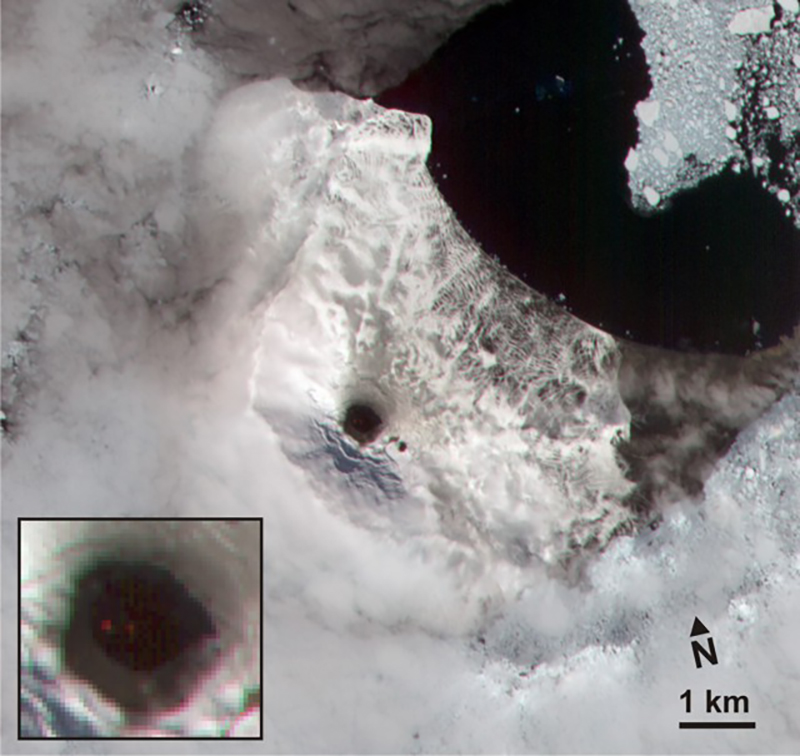
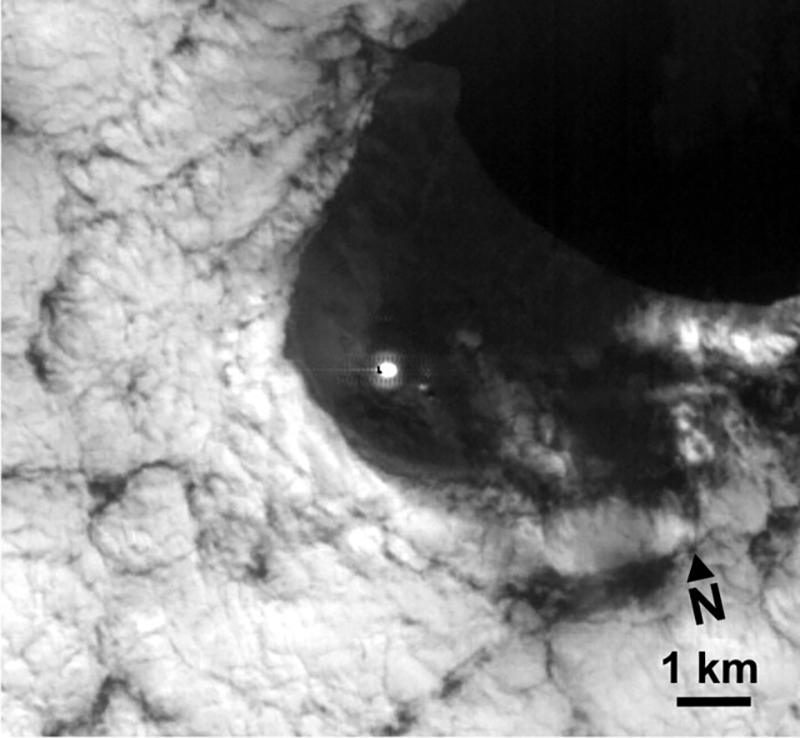
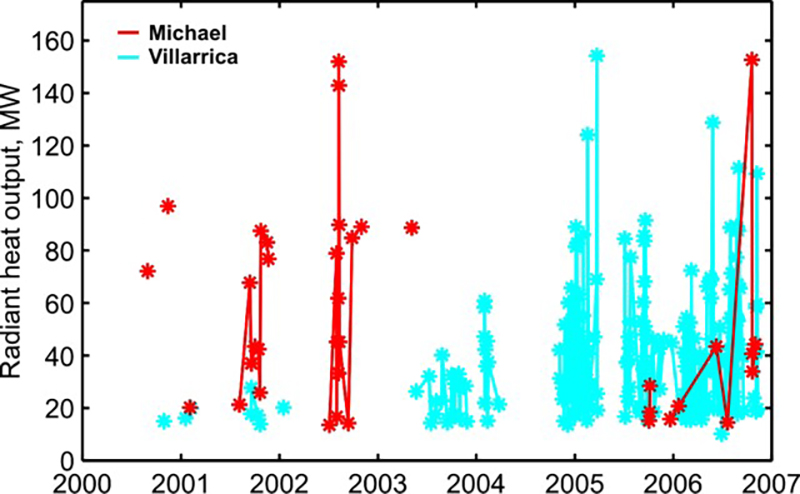
Although nearly constant cloud cover during February 2023 through January 2024 greatly limited satellite observations, thermal anomalies from the lava lake in the summit crater were detected on clear days, especially around 20-23 August 2023. Anomalies similar to previous years (eg. BGVN 48:02) were seen in both MIROVA (Middle InfraRed Observation of Volcanic Activity) data from MODIS instruments and in Sentinel 2 infrared imagery. The only notable sulfur dioxide plume detected near Saunders was on 25 September 2023, with the TROPOMI instrument aboard the Sentinel-5P satellite.
Geologic Background. Saunders Island consists of a large central volcanic edifice intersected by two seamount chains, as shown by bathymetric mapping (Leat et al., 2013). The young Mount Michael stratovolcano dominates the glacier-covered island, while two submarine plateaus, Harpers Bank and Saunders Bank, extend north. The symmetrical Michael has a 500-m-wide summit crater and a remnant of a somma rim to the SE. Tephra layers visible in ice cliffs surrounding the island are evidence of recent eruptions. Ash clouds were reported from the summit crater in 1819, and an effusive eruption was inferred to have occurred from a N-flank fissure around the end of the 19th century and beginning of the 20th century. A low ice-free lava platform, Blackstone Plain, is located on the north coast, surrounding a group of former sea stacks. A cluster of cones on the SE flank, the Ashen Hills, appear to have been modified since 1820 (LeMasurier and Thomson, 1990). Analysis of satellite imagery available since 1989 (Gray et al., 2019; MODVOLC) suggests frequent eruptive activity (when weather conditions allow), volcanic clouds, steam plumes, and thermal anomalies indicative of a persistent, or at least frequently active, lava lake in the summit crater. Due to this observational bias, there has been a presumption when defining eruptive periods that activity has been ongoing unless there is no evidence for at least 10 months.
Information Contacts: MIROVA (Middle InfraRed Observation of Volcanic Activity), a collaborative project between the Universities of Turin and Florence (Italy) supported by the Centre for Volcanic Risk of the Italian Civil Protection Department (URL: http://www.mirovaweb.it/); NASA Global Sulfur Dioxide Monitoring Page, Atmospheric Chemistry and Dynamics Laboratory, NASA Goddard Space Flight Center (NASA/GSFC), 8800 Greenbelt Road, Goddard MD 20771, USA (URL: https://so2.gsfc.nasa.gov/); Copernicus Browser (URL: https://dataspace.copernicus.eu/browser).
Shishaldin (United States) — December 2023 Cite this Report
Shishaldin
United States
54.756°N, 163.97°W; summit elev. 2857 m
All times are local (unless otherwise noted)
New eruption with significant Strombolian explosions, ash plumes, and ashfall
Shishaldin is located on the eastern half of Unimak Island, one of the Aleutian Islands. Frequent explosive activity, primarily consisting of Strombolian ash eruptions from the small summit crater, but sometimes producing lava flows, has been recorded since the 18th century. The previous eruption ended in May 2020 and was characterized by intermittent thermal activity, increased seismicity and surface temperatures, ash plumes, and ash deposits (BGVN 45:06). This report covers a new eruption during July through November 2023, which consisted of significant explosions, ash plumes, ashfall, and lava fountaining. Information comes from daily, weekly, and special reports from the Alaska Volcano Observatory (AVO) and various satellite data. AVO monitors the volcano using local seismic and infrasound sensors, satellite data, web cameras, and remote infrasound and lightning networks.
AVO reported that intermittent tremor and low-frequency earthquakes had gradually become more regular and consistent during 10-13 July. Strongly elevated surface temperatures at the summit were identified in satellite images during 10-13 July. On 11 July AVO raised the Aviation Color Code (ACC) to Yellow (the second color on a four-color scale) and Volcano Alert Level (VAL) to Advisory (the second level on a four-level scale) at 1439. Later in the day on 11 July summit crater incandescence was observed in webcam images. Observations of the summit suggested that lava was likely present at the crater, which prompted AVO to raise the ACC to Orange (the second highest color on a four-color scale) and the VAL to Watch (the second highest level on a four-level scale). The US Coast Guard conducted an overflight on 12 July and confirmed that lava was erupting from the summit. That same day, sulfur dioxide emissions were detected in satellite images.
A significant explosion began at 0109 on 14 July that produced an ash plume that rose to 9-12 km altitude and drifted S over the Pacific Ocean (figure 43). Webcam images and photos taken around 0700 from a ship SW off Unimak Island showed small lahar deposits, which were the result of the interaction of hot pyroclastic material and snow and ice on the flanks. There was also ashfall on the SW and N flanks. A smaller explosion at 0710 generated an ash plume that rose to 4.5 km altitude. Webcam images and pilot reports showed continued low-level ash emissions during the morning, rising to less than 4.6 km altitude; those emissions included a small ash plume near the summit around 1030 resulting from a small explosion.
Seismic tremor amplitude began increasing at around 1700 on 15 July; strongly elevated surface temperatures were also reported. An ash plume rose to 4.6 km altitude and drifted SSE at 2100, based on a satellite image. A continuous ash plume during 2150 through 2330 rose to 5 km altitude and extended 125 km S. At 2357 AVO raised the ACC to Red (the highest color on a four-color scale) and the VAL to Warning (the highest level on a four-level scale), noting that seismicity remained elevated for more than six hours and explosion signals were frequently detected by regional infrasound (pressure sensor) networks. Explosions generated an ash plume that rose to 4.9 km altitude and drifted as far as 500 km SE. Activity throughout the night declined and by 0735 the ACC was lowered to Orange and the VAL to Watch. High-resolution satellite images taken on 16 July showed pyroclastic deposits extending as far as 3 km from the vent; these deposits generated lahars that extended further down the drainages on the flanks. Ash deposits were mainly observed on the SSE flank and extended to the shore of Unimak Island. During 16-17 July lava continued to erupt at the summit, which caused strongly elevated surface temperatures that were visible in satellite imagery.
Lava effusion increased at 0100 on 18 July, as noted in elevated surface temperatures identified in satellite data, increasing seismic tremor, and activity detected on regional infrasound arrays. A significant ash plume at 0700 rose to 7 km altitude and continued until 0830, eventually reaching 9.1 km altitude and drifting SSE (figure 44). As a result, the ACC was raised to Red and the VAL to Warning. By 0930 the main plume detached, but residual low-level ash emissions continued for several hours, remaining below 3 km altitude and drifting S. The eruption gradually declined and by 1208 the ACC was lowered to Orange and the VAL was lowered to Watch. High-resolution satellite images showed ash deposits on the SW flank and pyroclastic deposits on the N, E, and S flanks, extending as far as 3 km from the vent; lahars triggered by the eruption extended farther down the flanks (figure 45). Lava continued to erupt from the summit crater on 19 July.
Elevated surface temperatures were detected in satellite images during 19-25 July, despite occasional weather cloud cover, which was consistent with increased lava effusion. During 22-23 July satellite observations acquired after the eruption from 18 July showed pyroclastic flow and lahar deposits extending as far as 3 km down the N, NW, and NE flanks and as far as 1.5 km down the S and SE flanks. Ash deposits covered the SW and NE flanks. No lava flows were observed outside the crater. On 22 July a sulfur dioxide plume was detected in satellite data midday that had an estimated mass of 10 kt. In a special notice issued at 1653 on 22 July AVO noted that eruptive activity had intensified over the previous six hours, which was characterized by an hours-long steady increase in seismic tremor, intermittent infrasound signals consistent with small explosions, and an increase in surface temperatures that were visible in satellite data. Pilots first reported low-level ash plumes at around 1900. At 2320 an ash plume had risen to 9 km altitude based on additional pilot reports and satellite images. The ACC was increased to Red and the VAL to Warning at 2343. Satellite images indicated growth of a significantly higher ash plume that rose to 11 km altitude continued until 0030 and drifted NE. During the early morning hours of 23 July ash plumes had declined to 4.6 k altitude. Seismic tremor peaked at 0030 on 23 July and began to rapidly decline at 0109; active ash emissions were no longer visible in satellite data by 0130. The ACC was lowered to Orange and the VAL to Watch at 0418; bursts of increased seismicity were recorded throughout the morning, but seismicity generally remained at low levels. Elevated surface temperatures were visible in satellite data until about 0600. On 24 July pilots reported seeing vigorous gas-and-steam plumes rising to about 3 km altitude; the plumes may have contained minor amounts of ash.
During 24-25 July low level seismicity and volcanic tremor were detected at low levels following the previous explosion on 23 July. Strongly elevated surface temperatures were observed at the summit crater in satellite data. Around 2200 on 25 July seismicity began to increase, followed by infrasound signals of explosions after 0200 on 26 July. An ash plume rose to 3 km altitude at 0500 and drifted ENE, along with an associated sulfur dioxide plume that drifted NE and had an estimated mass of 22 kt. Diffuse ash emissions were visible in satellite data and rose to 6.1-7.6 km altitude and extended 125 km from the volcano starting around 1130. These ash events were preceded by about seven hours of seismic tremor, infrasound detections of explosions, and five hours of increased surface temperatures visible in satellite data. Activity began to decline around 1327, which included low-frequency earthquakes and decreased volcanic tremor, and infrasound data no longer detected significant explosions. Surface temperatures remained elevated through the end of the month.
Seismicity, volcanic tremor, and ash emissions remained at low levels during early August. Satellite images on 1 August showed that some slumping had occurred on the E crater wall due to the recent explosive activity. Elevated surface temperatures continued, which was consistent with cooling lava. On 2 August small explosive events were detected, consistent with low-level Strombolian activity. Some episodes of volcanic tremor were reported, which reflected low-level ash emissions. Those ash emissions rose to less than 3 km altitude and drifted as far as 92.6 km N. Pilots that were located N of the volcano observed an ash plume that rose to 2.7 km altitude. Seismicity began to increase in intensity around 0900 on 3 August. Seismicity continued to increase throughout the day and through the night with strongly elevated surface temperatures, which suggested that lava was active at the surface.
An ash cloud that rose to 7.6-7.9 km altitude and drifted 60-75 km NE was visible in a satellite image at 0520 on 4 August. Pilots saw and reported the plume at 0836 (figure 46). By 0900 the plume had risen to 9.1 km altitude and extended over 100 km NE. AVO raised the ACC to Red and the VAL to Warning as a result. Seismic tremor levels peaked at 1400 and then sharply declined at 1500 to slightly elevated levels; the plume was sustained during the period of high tremor and drifted N and NE. The ACC was lowered to Orange and the VAL to Watch at 2055. During 5-14 August seismicity remained low and surface temperatures were elevated based on satellite data due to cooling lava. On 9 August a small lava flow was observed that extended from the crater rim to the upper NE flank. It had advanced to 55 m in length and appeared in satellite imagery on 11 August. Occasional gas-and-steam plumes were noted in webcam images. At 1827 AVO noted that seismic tremor had steadily increased during the afternoon and erupting lava was visible at the summit in satellite images.
Strong explosion signals were detected at 0200 on 15 August. An ash cloud that was visible in satellite data extended 100 km NE and may have risen as high as 11 km altitude around 0240. By 0335 satellite images showed the ash cloud rising to 7.6 km altitude and drifting NE. Significant seismicity and explosions were detected by the local AVO seismic and infrasound networks, and volcanic lightning was detected by the World Wide Lightning Location Network (WWLLN). A sulfur dioxide plume associated with the eruption drifted over the S Bering Sea and parts of Alaska and western Canada. Seismicity was significantly elevated during the eruption but had declined by 1322. A pilot reported that ash emissions continued, rising as high as 4.9 km altitude. Elevated surface temperatures detected in satellite data were caused by hot, eruptive material (pyroclastic debris and lava) that accumulated around the summit. Eruptive activity declined by 16 August and the associated sulfur dioxide plume had mostly dissipated; remnants continued to be identified in satellite images at least through 18 August. Surface temperatures remained elevated based on satellite images, indicating hot material on the upper parts of the volcano. Small explosions were detected in infrasound data on the morning of 19 August and were consistent with pilot reports of small, short-lived ash plumes that rose to about 4.3 km altitude. Low-level explosive activity was reported during 20-24 August, according to seismic and infrasound data, and weather clouds sometimes prevented views. Elevated surface temperatures were observed in satellite images, which indicated continued hot material on the upper parts of the volcano.
Seismic tremor began to increase at around 0300 on 25 August and was followed by elevated surface temperatures identified in satellite images, consistent with erupting lava. Small explosions were recorded in infrasound data. The ACC was raised to Red and the VAL to Warning at 1204 after a pilot reported an ash plume that rose to 9.1 km altitude. Seismicity peaked at 1630 and began to rapidly decline at around 1730. Ash plumes rose as high as 10 km altitude and drifted as far as 400 km NE. By 2020 the ash plumes had declined to 6.4 km altitude and continued to drift NE. Ash emissions were visible in satellite data until 0000 on 26 August and seismicity was at low levels. AVO lowered the ACC to Orange and the VAL to Watch at 0030. Minor explosive activity within the summit crater was detected during 26-28 August and strongly elevated surface temperatures were still visible in satellite imagery through the rest of the month. An AVO field crew working on Unimak Island observed a mass flow that descended the upper flanks beginning around 1720 on 27 August. The flow produced a short-lived ash cloud that rose to 4.5 km altitude and rapidly dissipated. The mass flow was likely caused by the collapse of spatter that accumulated on the summit crater rim.
Similar variable explosive activity was reported in September, although weather observations sometimes prevented observations. A moderate resolution satellite image from the afternoon of 1 September showed gas-and-steam emissions filling the summit crater and obscuring views of the vent. In addition, hot deposits from the previous 25-26 August explosive event were visible on the NE flank near the summit, based on a 1 September satellite image. On 2 and 4 September seismic and infrasound data showed signals of small, repetitive explosions. Variable gas-and-steam emissions from the summit were visible but there was no evidence of ash. Possible summit crater incandescence was visible in nighttime webcam images during 3-4 September.
Seismicity began to gradually increase at around 0300 on 5 September and activity escalated at around 0830. A pilot reported an ash plume that rose to 7.6 km altitude at 0842 and continued to rise as high as possibly 9.7 km altitude and drifted SSE based on satellite images (figure 47). The ACC was raised to Red and the VAL to Warning at 0900. In addition to strong tremor and sustained explosions, the eruption produced volcanic lightning that was detected by the WWLLN. Around 1100 seismicity decreased and satellite data confirmed that the altitude of the ash emissions had declined to 7.6 km altitude. By 1200 the lower-altitude portion of the ash plume had drifted 125 km E. Significant ash emissions ended by 1330 based on webcam images. The ACC was lowered to Orange and the VAL to Watch at 1440. Satellite images showed extensive pyroclastic debris flows on most of the flanks that extended 1.2-3.3 km from the crater rim.
During 6-13 September elevated surface temperatures continued to be observed in satellite data, seismicity remained elevated with weak but steady tremor, and small, low-frequency earthquakes and small explosions were reported, except on 12 September. On 6 September a low-level ash plume rose to 1.5-1.8 km altitude and drifted SSE. Occasional small and diffuse gas-and-steam emissions at the summit were visible in webcam images. Around 1800 on 13 September seismic tremor amplitudes began to increase, and small explosions were detected in seismic and infrasound data. Incandescent lava at the summit was seen in a webcam image taken at 0134 on 14 September during a period of elevated tremor. No ash emissions were reported during the period of elevated seismicity. Lava fountaining began around 0200, based on webcam images. Satellite-based radar observations showed that the lava fountaining activity led to the growth of a cone in the summit crater, which refilled most of the crater. By 0730 seismicity significantly declined and remained at low levels.
Seismic tremor began to increase around 0900 on 15 September and rapidly intensified. An explosive eruption began at around 1710, which prompted AVO to raise the ACC to Red and the VAL to Warning. Within about 30 minutes ash plumes drifted E below a weather cloud at 8.2 km altitude. The National Weather Service estimated that an ash-rich plume rose as high as 12.8 km altitude and produced volcanic lightning. The upper part of the ash plume detached from the vent around 1830 and drifted E, and was observed over the Gulf of Alaska. Around the same time, seismicity dramatically decreased. Trace ashfall was reported in the community of False Pass (38 km ENE) between 1800-2030 and also in King Cove and nearby marine waters. Activity declined at around 1830 although seismicity remained elevated, ash emissions, and ashfall continued until 2100. Lightning was again detected beginning around 1930, which suggested that ash emissions continued. Ongoing explosions were detected in infrasound data, at a lower level than during the most energetic phase of this event. Lightning was last detected at 2048. By 2124 the intensity of the eruption had decreased, and ash emissions were likely rising to less than 6.7 km altitude. Seismicity returned to pre-eruption levels. On 16 September the ACC was lowered to Orange and the VAL to Watch at 1244; the sulfur dioxide plume that was emitted from the previous eruption event was still visible over the northern Pacific Ocean. Elevated surface temperatures, gas-and-steam emissions from the vent, and new, small lahars were reported on the upper flanks based on satellite and webcam images. Minor deposits were reported on the flanks which were likely the result of collapse of previously accumulated lava near the summit crater.
Elevated seismicity with tremor, small earthquakes, and elevated surface temperatures were detected during 17-23 September. Minor gas-and-steam emissions were visible in webcam images. On 20 September small volcanic debris flows were reported on the upper flanks. On 21 September a small ash deposit was observed on the upper flanks extending to the NE based on webcam images. Seismic tremor increased significantly during 22-23 September. Regional infrasound sensors suggested that low-level eruptive activity was occurring within the summit crater by around 1800 on 23 September. Even though seismicity was at high levels, strongly elevated surface temperatures indicating lava at the surface were absent and no ash emissions were detected; weather clouds at 0.6-4.6 km altitude obscured views. At 0025 on 24 September AVO noted that seismicity continued at high levels and nearly continuous small infrasound signals began, likely from low-level eruptive activity. Strongly elevated surface temperatures were identified in satellite images by 0900 and persisted throughout the day; the higher temperatures along with infrasound and seismic data were consistent with lava erupting at the summit. Around 1700 similarly elevated surface temperatures were detected from the summit in satellite data, which suggested that more vigorous lava fountaining had started. Starting around 1800 low-level ash emissions rose to altitudes less than 4.6 km altitude and quickly dissipated.
Beginning at midnight on 25 September, a series of seismic signals consistent with volcanic flows were recorded on the N side of the volcano. A change in seismicity and infrasound signals occurred around 0535 and at 0540 a significant ash cloud formed and quickly reached 14 km altitude and drifted E along the Alaska Peninsula. The cloud generated at least 150 lightning strokes with thunder that could be heard by people in False Pass. Seismicity rapidly declined to near background levels around 0600. AVO increased the ACC to Red and the VAL to Warning at 0602. The ash cloud detached from the volcano at around 0700, rose to 11.6 km altitude, and drifted ESE. Trace to minor amounts of ashfall were reported by the communities of False Pass, King Cove, Cold Bay, and Sand Point around 0700. Ash emissions continued at lower altitudes of 6-7.6 km altitude at 0820. Small explosions at the vent area continued to be detected in infrasound data and likely represented low-level eruptive activity near the vent. Due to the significant decrease in seismicity and ash emissions the ACC was lowered to Orange and the VAL to Watch at 1234. Radar data showed significant collapses of the crater that occurred on 25 September. Satellite data also showed significant hot, degassing pyroclastic and lahar deposits on all flanks, including more extensive flows on the ENE and WSW sections below two new collapse scarps. Following the significant activity during 24-25 September, only low-level activity was observed. Seismicity decreased notably near the end of the strong activity on 25 September and continued to decrease through the end of the month, though tremor and small earthquakes were still reported. No explosive activity was detected in infrasound data through 2 October. Gas-and-steam emissions rose to 3.7 km altitude, as reported by pilots and seen in satellite images. Satellite data from 26 September showed that significant collapses had occurred at the summit crater and hot, steaming deposits from pyroclastic flows and lahars were present on all the flanks, particularly to the ENE and WSW. A small ash cloud was visible in webcam images on 27 September, likely from a collapse at the summit cone. High elevated surface temperatures were observed in satellite imagery during 27-28 September, which were likely the result of hot deposits on the flanks erupted on 25 September. Minor steaming at the summit crater and from an area on the upper flanks was visible in webcam images on 28 September.
During October, explosion events continued between periods of low activity. Seismicity significantly increased starting at around 2100 on 2 October; around the same time satellite images showed an increase in surface temperatures consistent with lava fountaining. Small, hot avalanches of rock and lava descended an unspecified flank. In addition, a distinct increase in infrasound, seismicity, and lightning detections was followed by an ash plume that rose to 12.2 km altitude and drifted S and E at 0520 on 3 October, based on satellite images. Nighttime webcam images showed incandescence due to lava fountaining at the summit and pyroclastic flows descending the NE flank. AVO reported that a notable explosive eruption started at 0547 and lasted until 0900 on 3 October, which prompted a rise in the ACC to Red and the VAL to Warning. Subsequent ash plumes rose to 6-7.6 km altitude by 0931. At 1036 the ACC was lowered back to Orange and the VAL to Watch since both seismic and infrasound data quieted substantially and were slightly above background levels. Gas-and-steam emissions were observed at the summit, based on webcam images. Trace amounts of ashfall were observed in Cold Bay. Resuspended ash was present at several kilometers altitude near the volcano. During the afternoon, low-level ash plumes were visible at the flanks, which appeared to be largely generated by rock avalanches off the summit crater following the explosive activity. These ash plumes rose to 3 km altitude and drifted W. Trace amounts of ashfall were reported by observers in Cold Bay and Unalaska and flights to these communities were disrupted by the ash cloud. Satellite images taken after the eruption showed evidence of pyroclastic flows and lahar deposits in drainages 2 km down the SW flank and about 3.2 km down the NE flank, and continued erosion of the crater rim. Small explosion craters at the end of the pyroclastic flows on the NE flank were noted for the first time, which may have resulted from gas-and-steam explosions when hot deposits interact with underlying ice.
During 4 October seismicity, including frequent small earthquakes, remained elevated, but was gradually declining. Ash plumes were produced for over eight hours until around 1400 that rose to below 3.7 km altitude. These ash plumes were primarily generated off the sides of the volcano where hot rock avalanches from the crater rim had entered drainages to the SW and NE. Two explosion craters were observed at the base of the NE deposits about 3.2 km from the crater rim. Webcam images showed the explosion craters were a source of persistent ash emissions; occasional collapse events also generated ash. Seismicity remained elevated with sulfur dioxide emissions that had a daily average of more than 1,000 tons per day, and frequent small earthquakes through the end of the month. Frequent elevated surface temperatures were identified in satellite images and gas-and-steam plumes were observed in webcam images, although weather conditions occasionally prevented clear views of the summit. Emissions were robust during 14-16 October and were likely generated by the interaction of hot material and snow and ice. During the afternoon of 21 October a strong gas-and-steam plume rose to 3-4.6 km altitude and extended 40 km WSW, based on satellite images and reports from pilots. On 31 October the ACC was lowered to Yellow and the VAL was lowered to Advisory.
Activity in November was characterized by elevated seismicity with ongoing seismic tremor and small, low-frequency earthquakes, elevated surface temperatures, and gas-and-steam emissions. There was an increase in seismic and infrasound tremor amplitudes starting at 1940 on 2 November. As a result, the ACC was again raised to Orange and the VAL was increased to Watch, although ash was not identified in satellite data. An ash cloud rose to 6.1 km altitude and drifted W according to satellite data at 2000. By 0831 on 3 November ash emissions were no longer visible in satellite images. On 6 and 9 November air pressure sensors detected signals consistent with small explosions. Small explosions were detected in infrasound data consistent with weak Strombolian activity on 19 and 21 November. Seismicity started to decrease on 21 November. On 25 November gas-and-steam emissions were emitted from the vent as well as from a scarp on the NE side of the volcano near the summit. A gas-and-steam plume extended about 50 km SSE and was observed in satellite and webcam images on 26 November. On 28 November small explosions were observed in seismic and local infrasound data and gas-and-steam emissions were visible from the summit and from the upper NE collapse scarp based on webcam images. Possible small explosions were observed in infrasound data on 30 November. Weakly elevated surface temperatures and a persistent gas-and-steam plume from the summit and collapse scarps on the upper flanks. A passing aircraft reported the gas-and-steam plume rose to 3-3.4 km altitude on 30 November, but no significant ash emissions were detected.
Satellite data. MODIS thermal anomaly data provided through MIROVA (Middle InfraRed Observation of Volcanic Activity) showed a strong pulse of thermal activity beginning in July 2023 that continued through November 2023 (figure 48). This strong activity was due to Strombolian explosions and lava fountaining events at the summit crater. According to data from MODVOLC thermal alerts, a total of 101 hotspots were detected near the summit crater in July (11-14, 16-19, 23-24 and 26), August (4, 25-26, and 29), September (5, 12, and 17), and October (3, 4, and 8). Infrared satellite data showed large lava flows descending primarily the northern and SE flanks during the reporting period (figure 49). Sulfur dioxide plumes often exceeded two Dobson Units (DUs) and drifted in different directions throughout the reporting period, based on satellite data from the TROPOMI instrument on the Sentinel-5P satellite (figure 50).
Geologic Background. The symmetrical glacier-covered Shishaldin in the Aleutian Islands is the westernmost of three large stratovolcanoes in the eastern half of Unimak Island. The Aleuts named the volcano Sisquk, meaning "mountain which points the way when I am lost." Constructed atop an older glacially dissected edifice, it is largely basaltic in composition. Remnants of an older edifice are exposed on the W and NE sides at 1,500-1,800 m elevation. There are over two dozen pyroclastic cones on its NW flank, which is covered by massive aa lava flows. Frequent explosive activity, primarily consisting of Strombolian ash eruptions from the small summit crater, but sometimes producing lava flows, has been recorded since the 18th century. A steam plume often rises from the summit crater.
Information Contacts: Alaska Volcano Observatory (AVO), a cooperative program of a) U.S. Geological Survey, 4200 University Drive, Anchorage, AK 99508-4667 USA (URL: https://avo.alaska.edu/), b) Geophysical Institute, University of Alaska, PO Box 757320, Fairbanks, AK 99775-7320, USA, and c) Alaska Division of Geological & Geophysical Surveys, 794 University Ave., Suite 200, Fairbanks, AK 99709, USA (URL: http://dggs.alaska.gov/); MIROVA (Middle InfraRed Observation of Volcanic Activity), a collaborative project between the Universities of Turin and Florence (Italy) supported by the Centre for Volcanic Risk of the Italian Civil Protection Department (URL: http://www.mirovaweb.it/); Hawai'i Institute of Geophysics and Planetology (HIGP) - MODVOLC Thermal Alerts System, School of Ocean and Earth Science and Technology (SOEST), Univ. of Hawai'i, 2525 Correa Road, Honolulu, HI 96822, USA (URL: http://modis.higp.hawaii.edu/); NASA Global Sulfur Dioxide Monitoring Page, Atmospheric Chemistry and Dynamics Laboratory, NASA Goddard Space Flight Center (NASA/GSFC), 8800 Greenbelt Road, Goddard, Maryland, USA (URL: https://so2.gsfc.nasa.gov/); Copernicus Browser, Copernicus Data Space Ecosystem, European Space Agency (URL: https://dataspace.copernicus.eu/browser/).
Ioto
Japan
24.751°N, 141.289°E; summit elev. 169 m
All times are local (unless otherwise noted)
New eruption with discolored water, ejecta, and floating pumice during October-December 2023
Ioto (Iwo-jima), located about 1,200 km S of Tokyo, lies within a 9-km-wide submarine caldera along the Izu-Bonin-Mariana volcanic arc. Previous eruptions date back to 1889 and have consisted of dominantly phreatic explosions, pumice deposits during 2001, and discolored water. A submarine eruption during July through December 2022 was characterized by discolored water, pumice deposits, and gas emissions (BGVN 48:01). This report covers a new eruption during October through December 2023, which consisted of explosions, black ejecta, discolored water, and floating pumice, based on information from the Japan Meteorological Association (JMA), the Japan Coast Guard (JCG), and satellite data.
JMA reported that an eruption had been occurring offshore of Okinahama on the SE side of the island since 21 October, which was characterized by volcanic tremor, according to the Japan Maritime Self-Defense Force (JMSDF) Iwo Jima Air Base (figure 22). According to an 18 October satellite image a plume of discolored water at the site of this new eruption extended NE (figure 23). During an overflight conducted on 30 October, a vent was identified about 1 km off the coast of Okinahama. Observers recorded explosions every few minutes that ejected dark material about 20 m above the ocean and as high as 150 m. Ejecta from the vent formed a black-colored island about 100 m in diameter, according to observations conducted from the air by the Earthquake Research Institute of the University of Tokyo in cooperation with the Mainichi newspaper (figure 24). Occasionally, large boulders measuring more than several meters in size were also ejected. Observations from the Advanced Land Observing Satellite Daichi-2 and Sentinel-2 satellite images also confirmed the formation of this island (figure 23). Brown discolored water and floating pumice were present surrounding the island.
The eruption continued during November. During an overflight on 3 November observers photographed the island and noted that material was ejected 169 m high, according to a news source. Explosions gradually became shorter, and, by the 3rd, they occurred every few seconds; dark and incandescent material were ejected about 800 m above the vent. On 4 November eruptions were accompanied by explosive sounds. Floating, brown-colored pumice was present in the water surrounding the island. There was a brief increase in the number of volcanic earthquakes during 8-14 November and 24-25 November. The eruption temporarily paused during 9-11 November and by 12 November eruptions resumed to the W of the island. On 10 November dark brown-to-dark yellow-green discolored water and a small amount of black floating material was observed (figure 25). A small eruption was reported on 18 November off the NE coast of the island, accompanied by white gas-and-steam plumes (figure 23). Another pause was recorded during 17-19 November, which then resumed on 20 November and continued erupting intermittently. According to a field survey conducted by the National Institute for Disaster Prevention Science and Technology on 19 November, a 30-m diameter crater was visible on the NE coast where landslides, hot water, and gray volcanic ash containing clay have occurred and been distributed previously. Erupted blocks about 10 cm in diameter were distributed about 90-120 m from the crater. JCG made observations during an overflight on 23 November and reported a phreatomagmatic eruption. Explosions at the main vent generated dark gas-and-ash plumes that rose to 200 m altitude and ejected large blocks that landed on the island and in the ocean (figure 26). Discolored water also surrounded the island. The size of the new island had grown to 450 m N-S x 200 m E-W by 23 November, according to JCG.
The eruption continued through 11 December, followed by a brief pause in activity, which then resumed on 31 December, according to JMA. Intermittent explosions produced 100-m-high black plumes at intervals of several minutes to 30 minutes during 1-10 December. Overflights were conducted on 4 and 15 December and reported that the water surrounding the new island was discolored to dark brown-to-dark yellow-green (figure 27). No floating material was reported during this time. In comparison to the observations made on 23 November, the new land had extended N and part of it had eroded away. In addition, analysis by the Geospatial Information Authority of Japan using SAR data from Daichi-2 also confirmed that the area of the new island continued to decrease between 4 and 15 December. Ejected material combined with wave erosion transformed the island into a “J” shape, 500-m-long and with the curved part about 200 m offshore of Ioto. The island was covered with brown ash and blocks, and the surrounding water was discolored to greenish-brown and contained an area of floating pumice. JCG reported from an overflight on 4 December that volcanic ash-like material found around the S vent on the NE part of the island was newly deposited since 10 November (figure 28). By 15 December the N part of the “J” shaped island had separated and migrated N, connecting to the Okinahama coast and the curved part of the “J” had eroded into two smaller islands (figure 27).
References. Ukawa, M., Fujita, E., Kobayashi, T., 2002, Recent volcanic activity of Iwo Jima and the 2001 eruption, Monthly Chikyu, Extra No. 39, 157-164.
Geologic Background. Ioto, in the Volcano Islands of Japan, lies within a 9-km-wide submarine caldera. The volcano is also known as Ogasawara-Iojima to distinguish it from several other "Sulfur Island" volcanoes in Japan. The triangular, low-elevation, 8-km-long island narrows toward its SW tip and has produced trachyandesitic and trachytic rocks that are more alkalic than those of other volcanoes in this arc. The island has undergone uplift for at least the past 700 years, accompanying resurgent doming of the caldera; a shoreline landed upon by Captain Cook's surveying crew in 1779 is now 40 m above sea level. The Motoyama plateau on the NE half of the island consists of submarine tuffs overlain by coral deposits and forms the island's high point. Many fumaroles are oriented along a NE-SW zone cutting through Motoyama. Numerous recorded phreatic eruptions, many from vents on the W and NW sides of the island, have accompanied the uplift.
Information Contacts: Japan Meteorological Agency (JMA), 1-3-4 Otemachi, Chiyoda-ku, Tokyo 100-8122, Japan (URL: http://www.jma.go.jp/jma/indexe.html); Japan Coast Guard (JCG) Volcano Database, Hydrographic and Oceanographic Department, 3-1-1, Kasumigaseki, Chiyoda-ku, Tokyo 100-8932, Japan (URL: https://www1.kaiho.mlit.go.jp/GIJUTSUKOKUSAI/kaiikiDB/kaiyo22-2.htm); Copernicus Browser, Copernicus Data Space Ecosystem, European Space Agency (URL: https://dataspace.copernicus.eu/browser/); Asahi, 5-3-2, Tsukiji, Chuo Ward, Tokyo, 104-8011, Japan (URL: https://www.asahi.com/ajw/articles/15048458).
Purace (Colombia) — December 2023 Cite this Report
Purace
Colombia
2.3095°N, 76.3948°W; summit elev. 4650 m
All times are local (unless otherwise noted)
Gas-and-ash emission on 16 November 2023
Puracé, located in Colombia, is a stratovolcano that contains a 500-m-wide summit crater. It is part of the Los Coconucos volcanic chain that is a NW-SE trending group of seven cones and craters. The most recent eruption occurred during March 2022 that was characterized by frequent seismicity and gas-and-steam emissions (BGVN 47:06). This report covers a brief eruption during November 2023 based on monthly reports from the Popayán Observatory, part of the Servicio Geologico Colombiano (SGC).
Activity during November 2022 through November 2023 primarily consisted of seismicity: VT-type events, LP-type events, HB-type events, and TR-type events (table 4). Maximum sulfur dioxide values were measured weekly and ranged from 259-5,854 tons per day (t/d) during November 2022 through April 2023. White gas-and-steam emissions were also occasionally reported.
SGC issued a report on 25 October that noted a significant increase in the number of earthquakes associated with rock fracturing. These earthquakes were located SE of the crater between Puracé and Piocollo at depths of 1-4 km. There were no reported variations in sulfur dioxide values, but SGC noted high carbon dioxide values, compared to those recorded in the first half of 2023.
SGC reported that at 1929 on 16 November the seismic network detected a signal that was possibly associated with a gas-and-ash emission, though it was not confirmed in webcam images due to limited visibility. On 17 November an observer confirmed ash deposits on the N flank. Webcam images showed an increase in degassing both inside the crater and from the NW flank, rising 700 m above the crater.
Table 4. Seismicity at Puracé during November 2022-November 2023. Volcano-tectonic (VT), long-period (LP), hybrid (HB), and tremor (TR) events are reported each month. Courtesy of SGC.
| Month |
Volcano-tectonic |
Long-period |
Hybrid |
Tremor |
| Nov 2022 |
429 |
2,023 |
5 |
831 |
| Dec 2022 |
423 |
1,390 |
9 |
834 |
| Jan 2023 |
719 |
1,622 |
0 |
957 |
| Feb 2023 |
598 |
1,701 |
2 |
1,124 |
| Mar 2023 |
331 |
2,408 |
147 |
607 |
| Apr 2023 |
614 |
4,427 |
33 |
148 |
| May 2023 |
620 |
3,717 |
170 |
109 |
| Jun 2023 |
467 |
3,293 |
86 |
148 |
| Jul 2023 |
1,116 |
5,809 |
183 |
542 |
| Aug 2023 |
692 |
2,927 |
94 |
321 |
| Sep 2023 |
887 |
1,505 |
82 |
848 |
| Oct 2023 |
2,373 |
2,949 |
135 |
692 |
| Nov 2023 |
1,212 |
2,302 |
69 |
293 |
Geologic Background. Puracé is an active andesitic volcano with a 600-m-diameter summit crater at the NW end of the Los Coconucos Volcanic Chain. This volcanic complex includes nine composite and five monogenetic volcanoes, extending from the Puracé crater more than 6 km SE to the summit of Pan de Azúcar stratovolcano. The dacitic massif which the complex is built on extends about 13 km NW-SE and 10 km NE-SW. Frequent small to moderate explosive eruptions reported since 1816 CE have modified the morphology of the summit crater, with the largest eruptions in 1849, 1869, and 1885.
Information Contacts: Servicio Geologico Colombiano (SGC), Diagonal 53 No. 34-53 - Bogotá D.C., Colombia (URL: https://www.sgc.gov.co/volcanes).
Etna
Italy
37.748°N, 14.999°E; summit elev. 3357 m
All times are local (unless otherwise noted)
Strombolian explosions, lava fountains, and lava flows during July-August 2023
Etna, located on the Italian island of Sicily, has had documented eruptions dating back to 1500 BCE. Activity typically originates from multiple cones at the summit, where several craters have formed and evolved. The currently active craters are Northeast Crater (NEC), Voragine (VOR), and Bocca Nuova (BN), and the Southeast Crater (SEC); VOR and BN were previously referred to as the “Central Crater”. The original Southeast crater formed in 1978, and a second eruptive site that opened on its SE flank in 2011 was named the New Southeast Crater (NSEC). Another eruptive site between the SEC and NSEC developed during early 2017 and was referred to as the "cono della sella" (saddle cone). The current eruption period began in November 2022 and has been characterized by intermittent Strombolian activity, lava flows, and ash plumes (BGVN 48:08). This report updates activity during July through October 2023, which includes primarily gas-and-steam emissions; during July and August Strombolian explosions, lava fountains, and lava flows were reported, based on weekly and special reports by the Osservatorio Etneo (OE), part of the Catania Branch of Italy's Istituo Nazionale di Geofisica e Vulcanologica (INGV) and satellite data.
Variable fumarolic degassing was reported at all summit craters (BN, VOR, NEC, and SEC) throughout the entire reporting period (table 15). The MIROVA (Middle InfraRed Observation of Volcanic Activity) volcano hotspot detection system based on the analysis of MODIS data showed frequent low-to-moderate power thermal anomalies during the reporting period (figure 399). During mid-August there was a pulse in activity that showed an increase in the power of the anomalies due to Strombolian activity, lava fountains, and lava flows. Infrared satellite imagery captured strong thermal anomalies at the central and southeast summit crater areas (figure 400). Accompanying thermal activity were occasional sulfur dioxide plumes that exceeded 2 Dobson Units (DUs) recorded by the TROPOMI instrument on the Sentinel-5P satellite (figure 401).
Table 15. Summary of activity at the four primary crater areas at the summit of Etna during July-October 2023. Information is from INGV weekly reports.
| Month |
Bocca Nuova (BN) |
Voragine (VOR) |
Northeast Crater (NEC) |
Southeast Crater (SEC) |
| Jul 2023 |
Continuous degassing. |
No observations. |
Weak gas emissions. |
Continuous degassing. Sporadic and weak-to-moderate ash emissions. Strombolian explosions. |
| Aug 2023 |
Continuous degassing. |
No observations. |
No observations. |
Continuous degassing. Occasional ash emissions. Strombolian activity, lava fountaining, and lava flows. |
| Sep 2023 |
Variable degassing. Crater incandescence. |
Weak fumarolic activity. |
Weak fumarolic activity. |
Variable degassing. |
| Oct 2023 |
Continuous degassing. |
Weak fumarolic activity. |
Weak fumarolic activity. |
Continuous degassing. |
Activity during July and August was relatively low and mainly consisted of degassing at the summit craters, particularly at SEC and BN. Cloudy weather prevented clear views of the summit during early July. During the night of 2 July some crater incandescence was visible at SEC. Explosive activity resumed at SEC during 9-10 July, which was characterized by sporadic and weak ash emissions that rapidly dispersed in the summit area (figure 402). INGV reported moderate Strombolian activity began at 2034 on 14 July and was confined to the inside of the crater and fed by a vent located in the E part of SEC. An ash emission was detected at 2037. A new vent opened on 15 July in the SE part of BN and began to produce continuous gas-and-steam emissions. During an inspection carried out on 28 July pulsating degassing, along with audible booms, were reported at two active vents in BN. Vigorous gas-and-steam emissions intermittently generated rings. On rare occasions, fine, reddish ash was emitted from BN1 and resuspended by the gas-and-steam emissions.
Around 2000 on 13 August INGV reported a sudden increase in volcanic tremor amplitude. Significant infrasonic activity coincided with the tremor increase. Incandescent flashes were visible through the cloud cover in webcam images of SEC (figure 403). Strombolian activity at SEC began to gradually intensify starting at 2040 as seismicity continued to increase. The Aviation Color Code (ACC) was raised to Yellow (the second lowest-level on a four-color scale) at 2126 and then to Orange (the second highest-level on a four-color scale) at 2129 due to above-background activity. The activity rapidly transitioned from Strombolian activity to lava fountains around 2333 that rose 300-400 m above the crater (figure 403). Activity was initially focused on the E vent of the crater, but then the vent located above the S flank of the cone also became active. A lava flow from this vent traveled SW into the drainage created on 10 February 2022, overlapping with previous flows from 10 and 21 February 2022 and 21 May 2023, moving between Monte Barbagallo and Monte Frumento Supino (figure 404). The lava flow was 350 m long, oriented NNE-SSW, and descended to an elevation of 2.8 km. Flows covered an area of 300,000 m2 and had an estimated volume of 900,000 m3. The ACC was raised to Red at 2241 based on strong explosive activity and ashfall in Rifugio Sapienza-Piano Vetore at 1.7 km elevation on the S flank. INGV reported that pyroclastic flows accompanied this activity.
Activity peaked between 0240 and 0330 on 14 August, when roughly 5-6 vents erupted lava fountains from the E to SW flank of SEC. The easternmost vents produced lava fountains that ejected material strongly to the E, which caused heavy fallout of incandescent pyroclastic material on the underlying flank, triggering small pyroclastic flows. This event was also accompanied by lightning both in the ash column and in the ash clouds that were generated by the pyroclastic flows. A fracture characterized by a series of collapse craters (pit craters) opened on the upper SW flank of SEC. An ash cloud rose a few kilometers above the crater and drifted S, causing ash and lapilli falls in Rifugio Sapienza and expanding toward Nicolosi, Mascalucia, Catania, and up to Syracuse. Ashfall resulted in operational problems at the Catania airport (50 km S), which lasted from 0238 until 2000. By 0420 the volcanic tremor amplitude values declined to background levels. After 0500 activity sharply decreased, although the ash cloud remained for several hours and drifted S. By late morning, activity had completely stopped. The ACC was lowered to Orange as volcanic ash was confined to the summit area. Sporadic, minor ash emissions continued throughout the day. At 1415 the ACC was lowered to Yellow and then to Green at 1417.
During the night of 14-15 August only occasional flashes were observed, which were more intense during avalanches of material inside the eruptive vents. Small explosions were detected at SEC at 2346 on 14 August and at 0900 on 26 August that each produced ash clouds which rapidly dispersed into the atmosphere (figure 405). According to a webcam image, an explosive event detected at 2344 at SEC generated a modest ash cloud that was rapidly dispersed by winds. The ACC was raised to Yellow at 2355 on 14 August due to increasing unrest and was lowered to Green at 0954 on 15 August.
Activity during September and October was relatively low and mainly characterized by variable degassing from BN and SEC. Intense, continuous, and pulsating degassing was accompanied by roaring sounds and flashes of incandescence at BN both from BN1 and the new pit crater that formed during late July (figure 406). The degassing from the new pit crater sometimes emitted vapor rings. Cloudy weather during 6-8 September prevented observations of the summit craters .
Geologic Background. Mount Etna, towering above Catania on the island of Sicily, has one of the world's longest documented records of volcanism, dating back to 1500 BCE. Historical lava flows of basaltic composition cover much of the surface of this massive volcano, whose edifice is the highest and most voluminous in Italy. The Mongibello stratovolcano, truncated by several small calderas, was constructed during the late Pleistocene and Holocene over an older shield volcano. The most prominent morphological feature of Etna is the Valle del Bove, a 5 x 10 km caldera open to the east. Two styles of eruptive activity typically occur, sometimes simultaneously. Persistent explosive eruptions, sometimes with minor lava emissions, take place from one or more summit craters. Flank vents, typically with higher effusion rates, are less frequently active and originate from fissures that open progressively downward from near the summit (usually accompanied by Strombolian eruptions at the upper end). Cinder cones are commonly constructed over the vents of lower-flank lava flows. Lava flows extend to the foot of the volcano on all sides and have reached the sea over a broad area on the SE flank.
Information Contacts: Sezione di Catania - Osservatorio Etneo, Istituto Nazionale di Geofisica e Vulcanologia (INGV), Sezione di Catania, Piazza Roma 2, 95123 Catania, Italy (URL: http://www.ct.ingv.it/it/); MIROVA (Middle InfraRed Observation of Volcanic Activity), a collaborative project between the Universities of Turin and Florence (Italy) supported by the Centre for Volcanic Risk of the Italian Civil Protection Department (URL: http://www.mirovaweb.it/); NASA Global Sulfur Dioxide Monitoring Page, Atmospheric Chemistry and Dynamics Laboratory, NASA Goddard Space Flight Center (NASA/GSFC), 8800 Greenbelt Road, Goddard MD 20771, USA (URL: https://so2.gsfc.nasa.gov/); Copernicus Browser, Copernicus Data Space Ecosystem, European Space Agency (URL: https://dataspace.copernicus.eu/browser/).
Suwanosejima (Japan) — December 2023 Cite this Report
Suwanosejima
Japan
29.638°N, 129.714°E; summit elev. 796 m
All times are local (unless otherwise noted)
Eruption plumes, crater incandescence, and occasional explosions during July-October 2023
Suwanosejima is an 8-km-long island that consists of a stratovolcano and two active summit craters, located in the northern Ryukyu Islands, Japan. Volcanism over the past century has been characterized by Strombolian explosions, ash plumes, and ashfall. The current eruption began in October 2004 and has more recently consisted of frequent eruption plumes, explosions, and incandescent ejecta (BGVN 48:07). This report covers similar activity of ash plumes, explosions, and crater incandescence during July through October 2023 using monthly reports from the Japan Meteorological Agency (JMA) and satellite data.
Thermal activity during the reporting period was relatively low; only one low-power thermal anomaly was detected during mid-July and one during early August, based on a MIROVA (Middle InfraRed Observation of Volcanic Activity) Log Radiative Power graph of the MODIS thermal anomaly data. On two clear weather days, a thermal anomaly was visible in infrared satellite images (figure 81).
Low-level activity was reported at the Otake crater during July and no explosions were detected. Eruption plumes rose as high as 1.8 km above the crater. On 13 July an ash plume rose 1.7 km above the crater rim, based on a webcam image. During the night of the 28th crater incandescence was visible in a webcam image. An eruptive event reported on 31 July produced an eruption plume that rose 2.1 km above the crater. Seismicity consisted of 11 volcanic earthquakes on the W flank, the number of which had decreased compared to June (28) and 68 volcanic earthquakes near the Otake crater, which had decreased from 722 in the previous month. According to observations conducted by the University of Tokyo Graduate School of Science, Kyoto University Disaster Prevention Research Institute, Toshima Village, and JMA, the amount of sulfur dioxide emissions released during the month was 400-800 tons per day (t/d).
Eruptive activity in the Otake crater continued during August and no explosions were reported. An eruptive event produced a plume that rose 1 km above the crater at 1447 on 12 August. Subsequent eruptive events were recorded at 0911 on 16 August, at 1303 on 20 August, and at 0317 on 21 August, which produced ash plumes that rose 1-1.1 km above the crater and drifted SE, SW, and W. On 22 August an ash plume was captured in a webcam image rising 1.4 km above the crater (figure 82). Multiple eruptive events were detected on 25 August at 0544, 0742, 0824, 1424, and 1704, which generated ash plumes that rose 1.1-1.2 km above the crater and drifted NE, W, and SW. On 28 August a small amount of ashfall was observed as far as 1.5 km from the crater. There were 17 volcanic earthquakes recorded on the W flank of the volcano and 79 recorded at the Otake crater during the month. The amount of sulfur dioxide emissions released during the month was 400-800 t/d.
Activity continued at the Otake crater during September. Occasionally, nighttime crater incandescence was observed in webcam images and ashfall was reported. An eruptive event at 1949 on 4 September produced an ash plume that rose 1 km above the crater and drifted SW. On 9 September several eruption events were detected at 0221, 0301, and 0333, which produced ash plumes that rose 1.1-1.4 km above the crater rim and drifted W; continuous ash emissions during 0404-0740 rose to a maximum height of 2 km above the crater rim (figure 83). More eruptive events were reported at 1437 on 10 September, at 0319 on 11 September, and at 0511 and 1228 on 15 September, which generated ash plumes that rose 1-1.8 km above the crater. During 25, 27, and 30 September, ash plumes rose as high as 1.3 km above the crater rim. JMA reported that large blocks were ejected as far as 300 m from the center of the crater. There were 18 volcanic earthquakes detected beneath the W flank and 82 volcanic earthquakes detected near the Otake crater. The amount of sulfur dioxide released during the month ranged from 600 to 1,600 t/d.
Activity during early-to-mid-October consisted of occasional explosions, a total number of 13, and ash plumes that rose as high as 1.9 km above the Otake crater rim on 29 October (figure 84). These explosions are the first to have occurred since June 2023. Continuous ash emissions were reported during 0510-0555 on 1 October. Explosions were recorded at 0304, 2141, and 2359 on 2 October, at 0112 on 3 October, and at 1326 on 6 October, which produced ash plumes that rose as high as 1 km above the crater rim and drifted SW and W. An explosion was noted at 0428 on 3 October, but emission details were unknown. A total of eight explosions were recorded by the seismic network at 1522 on 14 October, at 0337, 0433, 0555, 1008, and 1539 on 15 October, and at 0454 and 0517 on 16 October. Ash plumes from these explosions rose as high as 900 m above the crater and drifted SE. Eruptive events during 25-27 and 29-30 October generated plumes that rose as high as 1.9 km above the crater and drifted SE, S, and SW. Ash was deposited in Toshima village (3.5 km SSW). Eruptive activity occasionally ejected large volcanic blocks as far as 600 m from the crater. Nighttime crater incandescence was visible in webcams. Intermittent ashfall was reported as far as 1.5 km from the crater. There were 43 volcanic earthquakes detected on the W flank during the month, and 184 volcanic earthquakes detected near the Otake crater. The amount of sulfur dioxide emitted ranged between 400 and 900 t/d.
Geologic Background. The 8-km-long island of Suwanosejima in the northern Ryukyu Islands consists of an andesitic stratovolcano with two active summit craters. The summit is truncated by a large breached crater extending to the sea on the E flank that was formed by edifice collapse. One of Japan's most frequently active volcanoes, it was in a state of intermittent Strombolian activity from Otake, the NE summit crater, between 1949 and 1996, after which periods of inactivity lengthened. The largest recorded eruption took place in 1813-14, when thick scoria deposits covered residential areas, and the SW crater produced two lava flows that reached the western coast. At the end of the eruption the summit of Otake collapsed, forming a large debris avalanche and creating an open collapse scarp extending to the eastern coast. The island remained uninhabited for about 70 years after the 1813-1814 eruption. Lava flows reached the eastern coast of the island in 1884. Only about 50 people live on the island.
Information Contacts: Japan Meteorological Agency (JMA), 1-3-4 Otemachi, Chiyoda-ku, Tokyo 100-8122, Japan (URL: http://www.jma.go.jp/jma/indexe.html); MIROVA (Middle InfraRed Observation of Volcanic Activity), a collaborative project between the Universities of Turin and Florence (Italy) supported by the Centre for Volcanic Risk of the Italian Civil Protection Department (URL: http://www.mirovaweb.it/); Hawai'i Institute of Geophysics and Planetology (HIGP) - MODVOLC Thermal Alerts System, School of Ocean and Earth Science and Technology (SOEST), Univ. of Hawai'i, 2525 Correa Road, Honolulu, HI 96822, USA (URL: http://modis.higp.hawaii.edu/); Copernicus Browser, Copernicus Data Space Ecosystem, European Space Agency (URL: https://dataspace.copernicus.eu/browser/).
Aira
Japan
31.5772°N, 130.6589°E; summit elev. 1117 m
All times are local (unless otherwise noted)
Explosions, ash plumes, ash fall, and crater incandescence during July-October 2023
Aira caldera, located in the northern half of Kagoshima Bay, Japan, contains the post-caldera Sakurajima volcano. Eruptions typically originate from the Minamidake crater, and since the 8th century, ash deposits have been recorded in the city of Kagoshima (10 km W), one of Kyushu’s largest cities. The Minamidake summit cone and crater has had persistent activity since 1955; the Showa crater on the E flank has also been intermittently active since 2006. The current eruption period began during March 2017 and has recently been characterized by intermittent explosions, eruption plumes, and ashfall (BGVN 48:07). This report updates activity during July through October 2023 and describes explosive events, ash plumes, nighttime crater incandescence, and ashfall, according to monthly activity reports from the Japan Meteorological Agency (JMA) and satellite data.
Thermal activity remained at low levels during this reporting period, according to the MIROVA (Middle InfraRed Observation of Volcanic Activity) system (figure 149). There was a slight increase in the number of anomalies during September through October. Occasional thermal anomalies were visible in infrared satellite images mainly at the Minamidake crater (Vent A is located to the left and Vent B is located to the right) (figure 150).
Table 30. Number of monthly explosive events, days of ashfall, area of ash covered, and sulfur dioxide emissions from Sakurajima’s Minamidake crater at Aira during July-October 2023. Note that smaller ash events are not listed. Ashfall days were measured at Kagoshima Local Meteorological Observatory and ashfall amounts represent material covering all the Kagoshima Prefecture. Data courtesy of JMA monthly reports.
| Month |
Explosive events |
Days of ashfall |
Ashfall amount (g/m2) |
SO2 emissions (tons/day) |
| Jul 2023 |
3 |
0 |
0 |
1,600-3,200 |
| Aug 2023 |
3 |
10 |
7 |
1,800-3,300 |
| Sep 2023 |
3 |
7 |
3 |
1,600-2,300 |
| Oct 2023 |
33 |
8 |
61 |
2,200-4,200 |
JMA reported that during July, there were eight eruptions, three of which were explosion events in the Showa crater. Large blocks were ejected as far as 600 m from the Showa crater. Very small eruptions were occasionally reported at the Minamidake crater. Nighttime incandescence was observed in both the Showa and Minamidake crater. Explosions were reported on 16 July at 2314 and on 17 July at 1224 and at 1232 (figure 151). Resulting eruption plumes rose 700-2,500 m above the crater and drifted N. On 23 July the number of volcanic earthquakes on the SW flank of the volcano increased. A strong Mw 3.1 volcanic earthquake was detected at 1054 on 26 July. The number of earthquakes recorded throughout the month was 545, which markedly increased from 73 in June. No ashfall was observed at the Kagoshima Regional Meteorological Observatory during July. According to a field survey conducted during the month, the daily amount of sulfur dioxide emissions was 1,600-3,200 tons per day (t/d).
There were three eruptions reported at the Minamidake crater during August, each of which were explosive. The explosions occurred on 9 August at 0345, on 13 August at 2205, and on 31 August at 0640, which generated ash plumes that rose 800-2,000 m above the crater and drifted W. There were two eruptions detected at Showa crater; on 4 August at 2150 ejecta traveled 800 m from the Showa crater and associated eruption plumes rose 2.3 km above the crater. The explosion at 2205 on 13 August generated an ash plume that rose 2 km above the crater and was accompanied by large blocks that were ejected 600 m from the Minamidake crater (figure 152). Nighttime crater incandescence was visible in a high-sensitivity surveillance camera at both craters. Seismicity consisted of 163 volcanic earthquakes, 84 of which were detected on the SW flank. According to the Kagoshima Regional Meteorological Observatory there was a total of 7 g/m2 of ashfall over the course of 10 days during the month. According to a field survey, the daily amount of sulfur dioxide emitted was 1,800-3,300 t/d.
During September, four eruptions were reported, three of which were explosion events. These events occurred at 1512 on 9 September, at 0018 on 11 September, and at 2211 on 13 September. Resulting ash plumes generally rose 800-1,100 m above the crater. An explosion produced an ash plume at 2211 on 13 September that rose as high as 1.7 km above the crater. Large volcanic blocks were ejected 600 m from the Minamidake crater. Smaller eruptions were occasionally observed at the Showa crater. Nighttime crater incandescence was visible at the Minamidake crater. Seismicity was characterized by 68 volcanic earthquakes, 28 of which were detected beneath the SW flank. According to the Kagoshima Regional Meteorological Observatory there was a total of 3 g/m2 of ashfall over the course of seven days during the month. A field survey reported that the daily amount of sulfur dioxide emitted was 1,600-2,300 t/d.
Eruptive activity during October consisted of 69 eruptions, 33 of which were described as explosive. These explosions occurred during 4 and 11-21 October and generated ash plumes that rose 500-3,600 m above the crater and drifted S, E, SE, and N. On 19 October at 1648 an explosion generated an ash plume that rose 3.6 km above the crater (figure 153). No eruptions were reported in the Showa crater; white gas-and-steam emissions rose 100 m above the crater from a vent on the N flank. Nighttime incandescence was observed at the Minamidake crater. On 24 October an eruption was reported from 0346 through 0430, which included an ash plume that rose 3.4 km above the crater. Ejected blocks traveled 1.2 km from the Minamidake crater. Following this eruption, small amounts of ashfall were observed from Arimura (4.5 km SE) and a varying amount in Kurokami (4 km E) (figure 154). The number of recorded volcanic earthquakes during the month was 190, of which 14 were located beneath the SW flank. Approximately 61 g/m2 of ashfall was reported over eight days of the month. According to a field survey, the daily amount of sulfur dioxide emitted was 2,200-4,200 t/d.
Geologic Background. The Aira caldera in the northern half of Kagoshima Bay contains the post-caldera Sakurajima volcano, one of Japan's most active. Eruption of the voluminous Ito pyroclastic flow accompanied formation of the 17 x 23 km caldera about 22,000 years ago. The smaller Wakamiko caldera was formed during the early Holocene in the NE corner of the caldera, along with several post-caldera cones. The construction of Sakurajima began about 13,000 years ago on the southern rim and built an island that was joined to the Osumi Peninsula during the major explosive and effusive eruption of 1914. Activity at the Kitadake summit cone ended about 4,850 years ago, after which eruptions took place at Minamidake. Frequent eruptions since the 8th century have deposited ash on the city of Kagoshima, located across Kagoshima Bay only 8 km from the summit. The largest recorded eruption took place during 1471-76.
Information Contacts: Japan Meteorological Agency (JMA), 1-3-4 Otemachi, Chiyoda-ku, Tokyo 100-8122, Japan (URL: http://www.jma.go.jp/jma/indexe.html); MIROVA (Middle InfraRed Observation of Volcanic Activity), a collaborative project between the Universities of Turin and Florence (Italy) supported by the Centre for Volcanic Risk of the Italian Civil Protection Department (URL: http://www.mirovaweb.it/); Copernicus Browser, Copernicus Data Space Ecosystem, European Space Agency (URL: https://dataspace.copernicus.eu/browser/).
Nishinoshima (Japan) — November 2023 Cite this Report
Nishinoshima
Japan
27.247°N, 140.874°E; summit elev. 100 m
All times are local (unless otherwise noted)
Gray emissions during October 2023
Nishinoshima is a small island in the Ogasawara Arc, about 1,000 km S of Tokyo, Japan. It contains prominent submarine peaks to the S, W, and NE. Recorded eruptions date back to 1973, with the current eruption period beginning in October 2022. Eruption plumes and fumarolic activity characterize recent activity (BGVN 48:10). This report covers the end of the eruption for September through October 2023, based on information from monthly reports of the Japan Meteorological Agency (JMA) monthly reports, and satellite data.
No eruptive activity was reported during September 2023, although JMA noted that the surface temperature was slightly elevated compared to the surrounding area since early March 2023. The Japan Coast Guard (JCG) conducted an overflight on 20 September and reported white gas-and-steam plumes rising 3 km above the central crater of the pyroclastic cone, as well as multiple white gas-and-steam emissions emanating from the N, E, and S flanks of the crater to the coastline. In addition, dark reddish brown-to-green discolored water was distributed around almost the entire circumference of the island.
Similar low-level activity was reported during October. Multiple white gas-and-steam emissions rose from the N, E, and S flanks of the central crater of the pyroclastic cone and along the coastline; these emissions were more intense compared to the previous overflight observations. Dark reddish brown-to-green discolored water remained visible around the circumference of the island. On 4 October aerial observations by JCG showed a small eruption consisting of continuous gas-and-steam emissions emanating from the central crater, with gray emissions rising to 1.5 km altitude (figure 129). According to observations from the marine weather observation vessel Keifu Maru on 26 October, white gas-and-steam emissions persisted from the center of the pyroclastic cone, as well as from the NW, SW, and SE coasts of the island for about five minutes. Slightly discolored water was visible up to about 1 km.
Frequent low-to-moderate power thermal anomalies were recorded in the MIROVA graph (Middle InfraRed Observation of Volcanic Activity) during September (figure 130). Occasional anomalies were detected during October, and fewer during November through December. A thermal anomaly was visible in the crater using infrared satellite imagery on 6, 8, 11, 16, 18, 21, and 23 September and 8, 13, 21, 26, and 28 October (figure 131).
Geologic Background. The small island of Nishinoshima was enlarged when several new islands coalesced during an eruption in 1973-74. Multiple eruptions that began in 2013 completely covered the previous exposed surface and continued to enlarge the island. The island is the summit of a massive submarine volcano that has prominent peaks to the S, W, and NE. The summit of the southern cone rises to within 214 m of the ocean surface 9 km SSE.
Information Contacts: Japan Meteorological Agency (JMA), 1-3-4 Otemachi, Chiyoda-ku, Tokyo 100-8122, Japan (URL: http://www.jma.go.jp/jma/indexe.html); MIROVA (Middle InfraRed Observation of Volcanic Activity), a collaborative project between the Universities of Turin and Florence (Italy) supported by the Centre for Volcanic Risk of the Italian Civil Protection Department (URL: http://www.mirovaweb.it/); Copernicus Browser, Copernicus Data Space Ecosystem, European Space Agency (URL: https://dataspace.copernicus.eu/browser/).
Kilauea (United States) — October 2023 Cite this Report
Kilauea
United States
19.421°N, 155.287°W; summit elev. 1222 m
All times are local (unless otherwise noted)
Strong lava fountains, lava flows, and spatter at Halema’uma’u during January-September 2023
Kīlauea is on the island of Hawai’i and overlaps the E flank of the Mauna Loa volcano. Its East Rift Zone (ERZ) has been intermittently active for at least 2,000 years. An extended eruption period began in January 1983 and was characterized by open lava lakes and lava flows from the summit caldera and the East Rift Zone. During May 2018 magma migrated into the Lower East Rift Zone (LERZ) and opened 24 fissures along a 6-km-long NE-trending fracture zone that produced lava flows traveling in multiple directions. As lava emerged from the fissures, the lava lake at Halema'uma'u drained and explosions sent ash plumes to several kilometers altitude (BGVN 43:10).
The current eruption period started during September 2021 and has been characterized by low-level lava effusions in the active Halema’uma’u lava lake (BGVN 48:01). This report covers three notable eruption periods during February, June, and September 2023 consisting of lava fountaining, lava flows, and spatter during January through September 2023 using information from daily reports, volcanic activity notices, and abundant photo, map, and video data from the US Geological Survey's (USGS) Hawaiian Volcano Observatory (HVO).
Activity during January 2023. Small earthquake swarms were recorded on 2 January 2023; increased seismicity and changes in the pattern of deformation were noted on the morning of 5 January. At around 1500 both the rate of deformation and seismicity drastically increased, which suggested magma movement toward the surface. HVO raised the Volcano Alert Level (VAL) to Watch (the second highest level on a four-level scale) and the Aviation Color Code (ACC) to Orange (the second highest color on a four-color scale) at 1520.
Multiple lava fountains and lava effusions from vents in the central eastern portion of the Halema’uma’u crater began on 5 January around 0434; activity was confined to the eastern half of the crater and within the basin of the western half of the crater, which was the focus of the eruption in 2021-2022 (figure 525). Incandescence was visible in webcam images at 1634 on 5 January, prompting HVO to raise the VAL to Warning (the highest level on a four-level scale) and the ACC to Red (the highest color on a four-color scale). Lava fountains initially rose as high as 50 m above the vent at the onset of the eruption (figure 526) but then declined to a more consistent 5-6 m height in the proceeding days. By 1930 that same day, lava had covered most of the crater floor (an area of about 1,200,000 m2) and the lava lake had a depth of 10 m. A higher-elevation island that formed during the initial phase of the December 2020 eruption remained exposed, appearing darker in images, along with a ring of older lava around the lava lake that was active prior to December 2022. Overnight during 5-6 January the lava fountains continued to rise 5 m high, and the lava effusion rate had slowed.
On 6 January at 0815 HVO lowered the VAL to Watch and the ACC to Orange due to the declining effusion rates. Sulfur dioxide emission rates ranged from 3,000-12,500 tonnes per day (t/d), the highest value of which was recorded on 6 January. Lava continued to erupt from the vents during 6-8 January, although the footprint of the active area had shrunk; a similar progression has been commonly observed during the early stages of recent eruptions at Halema’uma’u. On 9 January HVO reported one dominant lava fountain rising 6-7 m high in the E half of the crater. Lava flows built up the margins of the lake, causing the lake to be perched. On 10 January the eastern lava lake had an area of approximately 120,000 m2 that increased to 250,000 m2 by 17 January. During 13-31 January several small overflows occurred along the margins of the E lake. A smaller area of lava was active within the basin in the W half of the crater that had been the focus of activity during 2021-2022. On 19 January just after 0200 a small ooze-out was observed on the crater’s W edge.
Activity during February 2023. Activity continued in the E part of Halema’uma’u crater, as well as in a smaller basin in the W part of the 2021-2022 lava lake (figure 527). The E lava lake contained a single lava fountain and frequent overflows. HVO reported that during the morning of 1 February the large E lava lake began to cool and crust over in the center of the lake; two smaller areas of lava were observed on the N and S sides by the afternoon. The dominant lava fountain located in the S part of the lava lake paused for roughly 45 minutes at 2315 and resumed by midnight, rising 1-2 m. At 0100 on 2 February lava from the S part was effusing across the entire E lava lake area, covering the crusted over portion in the center of the lake and continuing across the majority of the previously measured 250,000 m2 by 0400. A small lava pond near the E lake produced an overflow around 0716 on 2 February. On 3 February some lava crust began to form against the N and E levees, which defined the 250,000 m2 eastern lava lake. The small S lava fountain remained active, rising 1-6 m high during 3-9 February; around 0400 on 5 February occasional bursts doubled the height of the lava fountain.
A large breakout occurred overnight during 2100 on 4 February to 0900 on 5 February on the N part of the crater floor, equal to or slightly larger in size than the E lava lake. A second, smaller lava fountain appeared in the same area of the E lava lake between 0300 and 0700 on 5 February and was temporarily active. This large breakout continued until 7 February. A small, brief breakout was reported in the S of the E lava lake around midnight on 7 February. In the W lake, as well as the smaller lava pond in the central portion of the crater floor, contained several overflows during 7-10 February and intermittent fountaining. Activity at the S small lava pond and the small S lava fountain within the E lake declined during 9-10 February. The lava pond in the central portion of the crater floor had nearly continuous, expansive flows during 10-13 February; channels from the small central lava pond seemed to flow into the larger E lake. During 13-18 February a small lava fountain was observed in the small lava pond in the central portion of the crater floor. Continuous overflows persisted during this time.
Activity in the eastern and central lakes began to decline in the late afternoon of 17 February. By 18 February HVO reported that the lava effusions had significantly declined, and that the eastern and central lakes were no longer erupting. The W lake in the basin remained active but at a greatly reduced level that continued to decline. HVO reported that this decrease in activity is attributed to notable deflationary tilt that began early on the morning of 17 February and lasted until early 19 February. By 19 February the W lake was mostly crusted over although some weak lava flows remained, which continued through 28 February. The sulfur dioxide emission rates ranged 250-2,800 t/d, the highest value of which was recorded on 6 February.
Activity during March 2023. The summit eruption at Halema’uma’u crater continued at greatly reduced levels compared to the previous two months. The E and central vents stopped effusing lava, and the W lava lake remained active with weak lava flows; the lake was mostly crusted over, although slowly circulating lava intermittently overturned the crust. By 6 March the lava lake in the W basin had stopped because the entire surface was crusted over. The only apparent surface eruptive activity during 5-6 March was minor ooze-outs of lava onto the crater floor, which had stopped by 7 March. Several hornitos on the crater floor still glowed through 12 March according to overnight webcam images, but they did not erupt any lava. A small ooze-out of lava was observed just after 1830 in the W lava lake on 8 March, which diminished overnight. The sulfur dioxide emission rate ranged from 155-321 t/d on 21 March. The VAL was lowered to Advisory, and the ACC was lowered to Yellow (the second lowest on a four-color scale) on 23 March due to a pause in the eruption since 7 March.
Activity during April-May 2023. The eruption at Halema’uma’u crater was paused; no lava effusions were visible on the crater floor. Sulfur dioxide emission rates ranged from 75-185 t/d, the highest of which was measured on 22 April. During May and June summit seismicity was elevated compared to seismicity that preceded the activity during January.
Activity during June 2023. Earthquake activity and changes in the patterns of ground deformation beneath the summit began during the evening of 6 June. The data indicated magma movement toward the surface, prompting HVO to raise the VAL to Watch and the ACC to Orange. At about 0444 on 7 June incandescence in Halema’uma’u crater was visible in webcam images, indicating that a new eruption had begun. HVO raised the VAL to Warning and the ACC to Red (the highest color on a four-color scale). Lava flowed from fissures that had opened on the crater floor. Multiple minor lava fountains were active in the central E portion of the Halema’uma’u crater, and one vent opened on the W wall of the caldera (figure 528). The eruptive vent on the SW wall of the crater continued to effuse into the lava lake in the far SW part of the crater (figure 529). The largest lava fountain consistently rose 15 m high; during the early phase of the eruption, fountain bursts rose as high as 60 m. Lava flows inundated much of the crater floor and added about 6 m depth of new lava within a few hours, covering approximately 10,000 m2. By 0800 on 7 June lava filled the crater floor to a depth of about 10 m. During 0800-0900 the sulfur dioxide emission rate was about 65,000 t/d. Residents of Pahala (30 km downwind of the summit) reported minor deposits of fine, gritty ash and Pele’s hair. A small spatter cone had formed at the vent on the SW wall by midday, and lava from the cone was flowing into the active lava lake. Fountain heights had decreased from the onset of the eruption and were 4-9 m high by 1600, with occasional higher bursts. Inflation switched to deflation and summit earthquake activity greatly diminished shortly after the eruption onset.
At 0837 on 8 June HVO lowered the VAL to Watch and the ACC to Orange because the initial high effusion rates had declined, and no infrastructure was threatened. The surface of the lava lake had dropped by about 2 m, likely due to gas loss by the morning of 8 June. The drop left a wall of cooled lava around the margins of the crater floor. Lava fountain heights decreased during 8-9 June but continued to rise to 10 m high. Active lava and vents covered much of the W half of Halema’uma’u crater in a broad, horseshoe-shape around a central, uplifted area (figure 530). The preliminary average effusion rate for the first 24 hours of the eruption was about 150 cubic meters per second, though the estimate did not account for vesiculated lava and variations in crater floor topography. The effusion rate during the very earliest phases of the eruption appeared significantly higher than the previous three summit eruptions based on the rapid coverage of the entire crater floor. An active lava lake, also referred to as the “western lava lake” was centered within the uplifted area and was fed by a vent in the NE corner. Two small active lava lakes were located just SE from the W lava lake and in the E portion of the crater floor.
During 8-9 June the lava in the central lava lake had a thickness of approximately 1.5 m, based on measurements from a laser rangefinder. During 9-12 June the height of the lava fountains decreased to 9 m high. HVO reported that the previously active lava lake in the E part of the crater appeared stagnant during 10-11 June. The surface of the W lake rose approximately 1 m overnight during 11-12 June, likely due to the construction of a levee around it. Only a few small fountains were active during 12-13 June; the extent of the active lava had retreated so that all activity was concentrated in the SW and central parts of Halema’uma’u crater. Intermittent spattering from the vent on the SW wall was visible in overnight webcam images during 13-18 June. On the morning of 14 June a weak lava effusion originated from near the western eruptive vent, but by 15 June there were no signs of continued activity. HVO reported that other eruptive vents in the SW lava lake had stopped during this time, following several days of waning activity; lava filled the lake by about 0.5 m. Lava circulation continued in the central lake and no active lava was reported in the northern or eastern parts of the crater. Around 0800 on 15 June the top of the SW wall spatter cone collapsed, which was followed by renewed and constant spattering from the top vent and a change in activity from the base vent; several new lava flows effused from the top of the cone, as well as from the pre-existing tube-fed flow from its base. Accumulation of lava on the floor resulted in a drop of the central basin relative to the crater floor, allowing several overflows from the SW lava lake to cascade into the basin during the night of 15 June into the morning of 16 June.
Renewed lava fountaining was reported at the eruptive vent on the SW side of the crater during 16-19 June, which effused lava into the far SW part of the crater. This activity was described as vigorous during midday on 16 June; a group of observatory geologists estimated that the lava was consistently ejected at least 10 m high, with some spatter ejected even higher and farther. Deposits from the fountain further heightened and widened the spatter cone built around the original eruptive vent in the lower section of the crater wall. Multiple lava flows from the base of the cone were fed into the SW lava lake and onto the southwestern-most block from the 2018 collapse within Halema’uma’u on 17 June (figure 531); by 18 June they focused into a single flow feeding into the SW lava lake. On the morning of 19 June a second lava flow from the base of the eruptive cone advanced into the SW lava lake.
Around 1600 on 19 June there was a rapid decline in lava fountaining and effusion at the eruptive vent on the SW side of the crater; vent activity had been vigorous up to that point (figure 532). Circulation in the lava lake also slowed, and the lava lake surface dropped by several meters. Overnight webcam images showed some previously eruptive lava still flowing onto the crater floor, which continued until those flows began to cool. By 21 June no lava was erupting in Halema’uma’u crater. Overnight webcam images during 29-30 June showed some incandescence from previously erupted lava flows as they continued to cool. Seismicity in the crater declined to low levels. Sulfur dioxide emission rates ranged 160-21,000 t/d throughout the month, the highest measurement of which was recorded on 8 June. On 30 June the VAL was lowered to Advisory (the second level on a four-level scale) and the ACC was lowered to Yellow. Gradual inflation was detected at summit tiltmeters during 19-30 June.
Activity during July-August 2023. During July, the eruption paused; no lava was erupting in Halema’uma’u crater. Nighttime webcam images showed some incandescence from previously erupted lava as it continued to cool on the crater floor. During the week of 14 August HVO reported that the rate in seismicity increased, with 467 earthquakes of Mw 3.2 and smaller occurring. Sulfur dioxide emission rates remained low, ranging from 75-86 t/d, the highest of which was recorded on 10 and 15 August. On 15 August beginning at 0730 and lasting for several hours, a swarm of approximately 50 earthquakes were detected at a depth of 2-3 km below the surface and about 2 km long directly S of Halema’uma’u crater. HVO reported that this was likely due to magma movement in the S caldera region. During 0130-0500 and 1700-2100 on 21 August two small earthquake swarms of approximately 20 and 25 earthquakes, respectively, occurred at the same location and at similar depths. Another swarm of 50 earthquakes were recorded during 0430-0830 on 23 August. Elevated seismicity continued in the S area through the end of the month.
Activity during September 2023. Elevated seismicity persisted in the S summit with occasional small, brief seismic swarms. Sulfur dioxide measurements were relatively low and were 70 t/d on 8 September. About 150 earthquakes occurred during 9-10 September, and tiltmeter and Global Positioning System (GPS) data showed inflation in the S portion of the crater.
At 0252 on 10 September HVO raised the VAL to Watch and the ACC to Orange due to increased earthquake activity and changes in ground deformation that indicated magma moving toward the surface. At 1515 the summit eruption resumed in the E part of the caldera based on field reports and webcam images. Fissures opened on the crater floor and produced multiple minor lava fountains and flows (figure 533). The VAL and ACC were raised to Warning and Red, respectively. Gas-and-steam plumes rose from the fissures and drifted downwind. A line of eruptive vents stretched approximately 1.4 km from the E part of the crater into the E wall of the down dropped block by 1900. The lava fountains at the onset of the eruption had an estimated 50 m height, which later rose 20-25 m high. Lava erupted from fissures on the down dropped block and expanded W toward Halema’uma’u crater. Data from a laser rangefinder recorded about 2.5 m thick of new lava added to the W part of the crater. Sulfur dioxide emissions were elevated in the eruptive area during 1600-1500 on 10 September, measuring at least 100,000 t/d.
At 0810 on 11 September HVO lowered the VAL and ACC back to Watch and Orange due to the style of eruption and the fissure location had stabilized. The initial extremely high effusion rates had declined (but remained at high levels) and no infrastructure was threatened. An eruption plume, mainly comprised of sulfur dioxide and particulates, rose as high as 3 km altitude. Several lava fountains were active on the W side of the down dropped block during 11-15 September, while the easternmost vents on the down dropped block and the westernmost vents in the crater became inactive on 11 September (figure 534). The remaining vents spanned approximately 750 m and trended roughly E-W. The fed channelized lava effusions flowed N and W into Halema’uma’u. The E rim of the crater was buried by new lava flows; pahoehoe lava flows covered most of the crater floor except areas of higher elevation in the SW part of the crater. The W part of the crater filled about 5 m since the start of the eruption, according to data from a laser rangefinder during 11-12 September. Lava fountaining continued, rising as high as 15 m by the morning of 12 September. During the morning of 13 September active lava flows were moving on the N and E parts of the crater. The area N of the eruptive vents that had active lava on its surface became perched and was about 3 m higher than the surrounding ground surface. By the morning of 14 September active lava was flowing on the W part of the down dropped block and the NE parts of the crater. The distances of the active flows progressively decreased. Spatter had accumulated on the S (downwind) side of the vents, forming ramparts about 20 m high.
Vigorous spattering was restricted to the westernmost large spatter cone with fountains rising 10-15 m high. Minor spattering occurred within the cone to the E of the main cone, but HVO noted that the fountains remained mostly below the rim of the cone. Lava continued to effuse from these cones and likely from several others as well, traveled N and W, confined to the W part of the down-dropped block and the NE parts of Halema’uma’u. Numerous ooze-outs of lava were visible over other parts of the crater floor at night. Laser range-finder measurements taken of the W part of the crater during 14-15 September showed that lava filled the crater by 10 m since the start of the eruption. Sulfur dioxide emissions remained elevated after the onset of the eruption, ranging 20,000-190,000 t/d during the eruption activity, the highest of which occurred on 10 September.
Field crews observed the eruptive activity on 15 September; they reported a notable decrease or stop in activity at several vents. Webcam images showed little to no fountaining since 0700 on 16 September, though intermittent spattering continued from the westernmost large cone throughout the night of 15-16 September. Thermal images showed that lava continued to flow onto the crater floor. On 16 September HVO reported that the eruption stopped around 1200 and that there was no observable activity anywhere overnight or on the morning of 17 September. HVO field crews reported that active lava was no longer flowing onto Halema’uma’u crater floor and was restricted to a ponded area N of the vents on the down dropped block. They reported that spattering stopped around 1115 on 16 September. Nighttime webcam images showed some incandescence on the crater floor as lava continued to cool. Field observations supported by geophysical data showed that eruptive tremor in the summit region decreased over 15-16 September and returned to pre-eruption levels by 1700 on 16 September. Sulfur dioxide emissions were measured at a rate of 800 t/d on 16 September while the eruption was waning, and 200 t/d on 17 September, which were markedly lower compared to measurements taken the previous week of 20,000-190,000 t/d.
Geologic Background. Kilauea overlaps the E flank of the massive Mauna Loa shield volcano in the island of Hawaii. Eruptions are prominent in Polynesian legends; written documentation since 1820 records frequent summit and flank lava flow eruptions interspersed with periods of long-term lava lake activity at Halemaumau crater in the summit caldera until 1924. The 3 x 5 km caldera was formed in several stages about 1,500 years ago and during the 18th century; eruptions have also originated from the lengthy East and Southwest rift zones, which extend to the ocean in both directions. About 90% of the surface of the basaltic shield volcano is formed of lava flows less than about 1,100 years old; 70% of the surface is younger than 600 years. The long-term eruption from the East rift zone between 1983 and 2018 produced lava flows covering more than 100 km2, destroyed hundreds of houses, and added new coastline.
Information Contacts: Hawaiian Volcano Observatory (HVO), U.S. Geological Survey, PO Box 51, Hawai'i National Park, HI 96718, USA (URL: http://hvo.wr.usgs.gov/).
Tinakula (Solomon Islands) — December 2023 Cite this Report
Tinakula
Solomon Islands
10.386°S, 165.804°E; summit elev. 796 m
All times are local (unless otherwise noted)
Continued lava flows and thermal activity during June through November 2023
Tinakula is a remote 3.5 km-wide island in the Solomon Islands, located 640 km ESE of the capital, Honiara. The current eruption period began in December 2018 and has more recently been characterized by intermittent lava flows and thermal activity (BGVN 48:06). This report covers similar activity during June through November 2023 using satellite data.
During clear weather days (20 July, 23 September, 23 October, and 12 November), infrared satellite imagery showed lava flows that mainly affected the W side of the island and were sometimes accompanied by gas-and-steam emissions (figure 54). The flow appeared more intense during July and September compared to October and November. According to the MODVOLC thermal alerts, there were a total of eight anomalies detected on 19 and 21 July, 28 and 30 October, and 16 November. Infrared MODIS satellite data processed by MIROVA (Middle InfraRed Observation of Volcanic Activity) detected a small cluster of thermal activity occurring during late July, followed by two anomalies during August, two during September, five during October, and five during November (figure 55).
Geologic Background. The small 3.5-km-wide island of Tinakula is the exposed summit of a massive stratovolcano at the NW end of the Santa Cruz islands. It has a breached summit crater that extends from the summit to below sea level. Landslides enlarged this scarp in 1965, creating an embayment on the NW coast. The Mendana cone is located on the SE side. The dominantly andesitic volcano has frequently been observed in eruption since the era of Spanish exploration began in 1595. In about 1840, an explosive eruption apparently produced pyroclastic flows that swept all sides of the island, killing its inhabitants. Recorded eruptions have frequently originated from a cone constructed within the large breached crater. These have left the upper flanks and the steep apron of lava flows and volcaniclastic debris within the breach unvegetated.
Information Contacts: MIROVA (Middle InfraRed Observation of Volcanic Activity), a collaborative project between the Universities of Turin and Florence (Italy) supported by the Centre for Volcanic Risk of the Italian Civil Protection Department (URL: http://www.mirovaweb.it/); Hawai'i Institute of Geophysics and Planetology (HIGP) - MODVOLC Thermal Alerts System, School of Ocean and Earth Science and Technology (SOEST), Univ. of Hawai'i, 2525 Correa Road, Honolulu, HI 96822, USA (URL: http://modis.higp.hawaii.edu/); Copernicus Browser, Copernicus Data Space Ecosystem, European Space Agency (URL: https://dataspace.copernicus.eu/browser/).
Search Bulletin Archive by Publication Date
Select a month and year from the drop-downs and click "Show Issue" to have that issue displayed in this tab.
The default month and year is the latest issue available.
Bulletin of the Global Volcanism Network - Volume 31, Number 10 (October 2006)
Etna (Italy)
Lava flows from multiple vents during 22 September to 4 November
Home Reef (Tonga)
More details on the new island and drifting pumice rafts, including satellite data
Kilauea (United States)
PKK lava tube active August-November 2006; 10 October collapse pit at Pu`u `O`o
Likuruanga (Papua New Guinea)
Tragic CO2-gas accident in open hole at inactive volcano
Rabaul (Papua New Guinea)
Eruptions of varying intensity at Tavurvur; explosion on 14 November 2006
San Miguel (El Salvador)
Restlessness persists during 2005-6; heavy tropical rains trigger lahars
Saunders (United Kingdom)
Clear IR satellite view on 28 October 2006 suggests lava inside the crater
Ubinas (Peru)
New reporting reveals ashfalls, large ballistic blocks, lahar hazards, and evacuations
Etna
Italy
37.748°N, 14.999°E; summit elev. 3357 m
All times are local (unless otherwise noted)
Lava flows from multiple vents during 22 September to 4 November
The following Etna report from Sonia Calvari and Boris Behncke is based on daily observations by numerous staff members of the Istituto Nazionale di Geofisica e Vulcanologia (INGV). As previously reported here (BGVN 31:08), a 10-day-long eruption vented from the base of the Southeast Crater (SEC) in mid-July 2006. Eruptive activity then shifted to the crater's summit vent during 31 August-15 September, leading to lava overflows and repeated collapse on the SEC cone (BGVN 31:08).
This report discusses the time period 22 September to 4 November, an interval with multiple episodes of eruptive activity (roughly eight in all, seven of which involved a return of activity at the SEC summit). The activity typically included lava flows and Strombolian eruptions. In general, the eruptive episodes became increasingly brief and vigorous. Eruptions came from the SEC's summit as well as from multiple vents along fractures on the SEC's sides or adjacent to it that developed during the reporting interval.
As mentioned above, in general, during the reporting interval, the renowned SEC summit area was only episodically active. Since the SEC's collapse of September 2006, it has had a breached E wall. During this reporting interval, lava flows escaped the crater through the breach to form narrow rivulets down the steep upper SE flank. Ash from SEC fell on Catania on 30 October.
On 12 October a fissure opened at ~ 2,800-m elevation on the ESE base of the SEC cone, ~ 1 km from SEC's summit. Lava from this vent traveled SE, and a map showing the vents and pattern of flows through 20 November indicated lava extending ~ 2 km from the 2,800-m vent (Behncke and Neri, 2006). The 2,800-m vent also sits along the path of some of the SEC lavas from the summit crater. By late November, a complex flow field from both SEC summit and the 2,800-m vents lay on the SE side of the SEC. The field extended from the summit ~ 3 km, and its distal ends reached the W wall of the Valle del Bove.
Two other important vents began erupting in late October. One was on the SEC's upper S flank. The other, at 3,050 m elevation, stood ~ 1 km SW of the SEC's crater and at a spot ~ 0.5 km from the nearest margin of Bocca Nuova's crater. Although lava emissions from this vent at 3050-m elevation stopped, they later restarted and by 20 November the vent had created a large SW-trending field of lava flows roughly the size of those from the SEC summit and 2800-m vent.
Eruptive behavior 22 September-4 November. During this time interval, the seven episodes determined by eruptive activity at the SEC occurred as follows.
The first episode, which was five days long, started late 22 September from the summit of the SEC. Activity during the first two days was limited to mild Strombolian explosions, but lava began to overflow the SEC's crater on 24 September, spilling onto the cone's SE flank. This activity ceased sometime on 27 September.
The 2nd episode began late the afternoon of 3 October with Strombolian explosions from the SEC summit, which increased in vigor during the following hours. Late that evening lava began to spill down the SE side of the SEC cone adjacent to flows of the previous two episodes. Following a sharp decline in tremor amplitude on the afternoon of 5 October, the activity ended sometime between midnight and the early morning of 6 October.
The 3rd eruptive episode occurred between the evening of 10 October and the evening of the following day. The SEC's summit produced vigorous Strombolian activity and lava again descended the SEC cone's SE flank. A sharp drop in tremor amplitude on the afternoon of 11 October indicated the eruptions imminent cessation.
At the tail end of the 3rd episode, a short eruptive fissure opened with vents at ~ 2,800-m elevation. Monitoring cameras fixed the start of this activity at 2328 on 12 October. The SEC's summit was quiet throughout the following eight days, leaving this burst to be considered as activity late in the 3rd episode, rather than representing the start of the 4th episode in the SEC's sporadic on-and-off behavior.
Trending N90°E-N100°E, the new fissure resided on the ESE flank at the base of SEC, a spot also on the Valle del Bove's W wall. For the first few days, lava was emitted non-explosively, quietly spreading in the upper Valle del Bove and advancing a few hundred meters downslope. Mild spattering on 17 October resulted in the growth of three hornitos on the upper end of the eruptive fissure.
Summit SEC activity marked the 4th episode since 22 September. As lava effusion continued from the fissure vents at 2,800 m elevation, the SEC started a powerful eruption at 0600 on 20 October. Accompanied by a rapid increase in tremor amplitude, vigorous Strombolian eruptions occurred in the central portion of the SEC's summit. A vent near the E rim of the SEC's crater, in the notch created by the collapse events of early September, produced large explosions every few minutes and quickly built a new pyroclastic cone. Lava once more flowed down the SEC's SE side, stopping N of the 2,800-m fissure. At that fissure vent, lava emission continued but appeared reduced compared to the previous days. The SEC ceased issuing lava the same day it began, 20 October.
The 5th episode involving the SEC was preceded on 22 October with a few isolated bursts of ash from the SEC. The episode began with strong activity at 0700 the next day, when the SEC's summit generated vigorous Strombolian discharges and pulsating lava fountains from two vents. The new pyroclastic cone grew rapidly. Lava spilled down the ESE flank of the cone, to the N of the flows formed in the previous episodes.
Coincident with the above eruptions, INGV researchers noted an increased lava emission from the 2,800-m vents. This led to several lava overflows (in an area adjacent to the hornitos formed 17 October).
Although Strombolian activity and fountaining at the SEC diminished on the afternoon of 23 October, strong ash emissions began at around 1700, producing an ESE-drifting plume. Pulsating ash emissions and occasional bursts of glowing tephra continued and, at about 1750, the SEC cone's S flank fractured. Lava escaped from the fracture's lower end, forming two small lobes. The longer lobe reached the base of the cone and then traveled SE, ultimately to reach ~ 1 km from their source at the new fissure. The smaller lobe took a path down the cone slightly to the W, but halted before reaching the base of the cone. The new fissure's lava supply diminished early on 24 October, stopping around noon.
Coincident with the above events, effusive activity continued without significant variations at the 2,800-m vents. The farthest flow fronts reached an elevation of ~ 2,000 m to the NW of Monte Centenari, and extended ~ 2.5 km from their source.
Field observations made on 24 October revealed that part of the new pyroclastic cone had subsided and a new collapse pit, ~ 50 m wide, had opened on the SE flank of the SEC cone, roughly in the center of the largely obliterated collapse pit of 2004-2005.
The 6th episode of SEC activity began in the late afternoon on 25 October. Initially there was an increase in tremor amplitude, as well as both ash emissions and weak Strombolian activity from the SEC's summit. Both the tremor and Strombolian discharges decreased late that evening, but at 0054 on 26 November lava was emitted from a new fissure. This fissure, on the SEC cone's SSE flank, was active only for a few hours and produced a very small lava flow. As has often been the case during the reporting interval, the 2800-m vents continued to discharge lava toward the Valle del Bove.
What was to later become another important effusive vent opened at 0231 on 26 October. The vent developed at ~ 3,050 m elevation in an area ~ 700 m S of the center of Bocca Nuova's crater and ~ 500 m SW of the center of SEC's crater. This spot sits at the S base of the central summit cone below the Bocca Nuova, and ~ 700 m to the W of the fissure that had erupted 2 hours earlier.
Fieldwork carried out on 26 October by INGV researchers revealed that the vent at 3,050 m elevation had formed at the southern end of a fracture field. That field extended across the SE flank of Etna's central summit cone to the W flank of the SEC cone. Lava extruding at the 3050-m vent poured out at a decreasing rate before a pause began on the evening of 26 October.
The 7th episode, 27 October and into early November, was first associated with a new increase in tremor amplitude and corresponding SEC ash emissions on the afternoon of the 27th. These emissions were followed at 0206 on the 28th by the reactivation of the vent at 3050-m elevation. Ash emissions and Strombolian activity occurred from the SEC between 0830 and 1100, but no lava overflows were produced. On the evening of 28 October, both effusive vents at 3,050 and 2,800 m were active.
29 October ash emissions from the SEC became more vigorous during the early morning of the 30th and fine ash fell over inhabited areas to the S, including Catania (27 km from the SEC). Intermittent bursts of glowing tephra were recorded by INGV-CT surveillance cameras, although later analysis revealed that most of the tephra was lithic rather than juvenile. Ash emissions gradually diminished and ceased at around 0800 on 29 October.
Ash was again emitted from the SEC shortly before 1300 on 31 October, and in minor quantities at least once per day through 5 November. No incandescent ejections occurred from this crater after 28 October until the evening of 4 November (during 1830-2005) when weak Strombolian explosions were recorded by the INGV-CT surveillance cameras.
The vent at 3050-m elevation continued to emit lava on 29 October. The effusion rate was estimated as 1 to 5 m3 per second. Emitted lava descended SW to ~ 2,400 m elevation.
Lava also continued to flow from the 2,800-m vents on the 29th, but the associated lava flow front advancing from these vents had moved little since 24 October. Lava continued to flow from both vents during the first days of November, but the effusion rate had clearly dropped by the 3rd when active flows had retreated upslope from the distal fronts. Similarly, a helicopter overflight on the morning of 5 November disclosed actively flowing lava confined to the uppermost parts of the lava flow fields.
References. Behncke, B., and Neri, M., 2006, Mappa delle colate laviche aggiornata al 20 Novembre 2006 (PDF file on the INGV website).
Geologic Background. Mount Etna, towering above Catania on the island of Sicily, has one of the world's longest documented records of volcanism, dating back to 1500 BCE. Historical lava flows of basaltic composition cover much of the surface of this massive volcano, whose edifice is the highest and most voluminous in Italy. The Mongibello stratovolcano, truncated by several small calderas, was constructed during the late Pleistocene and Holocene over an older shield volcano. The most prominent morphological feature of Etna is the Valle del Bove, a 5 x 10 km caldera open to the east. Two styles of eruptive activity typically occur, sometimes simultaneously. Persistent explosive eruptions, sometimes with minor lava emissions, take place from one or more summit craters. Flank vents, typically with higher effusion rates, are less frequently active and originate from fissures that open progressively downward from near the summit (usually accompanied by Strombolian eruptions at the upper end). Cinder cones are commonly constructed over the vents of lower-flank lava flows. Lava flows extend to the foot of the volcano on all sides and have reached the sea over a broad area on the SE flank.
Information Contacts: Sonia Calvari and Boris Behncke, Istituto Nazionale di Geofisica e Vulcanologia (INGV), Sezione di Catania, Piazza Roma 2, 95123 Catania, Italy (URL: http://www.ct.ingv.it/).
Home Reef (Tonga) — October 2006 Cite this Report
Home Reef
Tonga
18.992°S, 174.775°W; summit elev. -10 m
All times are local (unless otherwise noted)
More details on the new island and drifting pumice rafts, including satellite data
An eruption from Home Reef in early August generated large volumes of pumice that floated to Fiji (over 700 km away) in the following two months; an island was also created (BGVN 31:09). Satellite data and imagery have been used to confirm these observations and provide additional information about this event.
Norman Kuring of the MODIS Ocean Color Team identified the earliest clear shot of the pumice raft in a Terra MODIS on 7 August at 2120 UTC (8 August at 1020 Tonga time). The image (figure 11) shows a circular patch of pumice over the eruption site with a small volcanic plume emerging from it. The first indication of pumice raft leaving the eruption site is in the Aqua MODIS image at 0132 UTC on 10 August, but the 9 August overpass was cloudy, so it could have happened earlier. Kuring also compiled other images showing the dispersion of the pumice through 22 August (figure 12).
Kuring also made a preliminary estimate of the area of the pumice raft on 11 August (10 August at 2150 UTC), previously encountered by the Maiken (BGVN 31:09). A mask was created to cover identifiable areas of pumice, resulting in an area of 9,338 pixels. Each pixel in the image used covers an area of 0.0468 km2. The calculated total area is approximately 440 km2 for that time. Note that this estimate does not take into account errors caused by pumice being a high-contrast target (allowing linear patches less than the pixel width to be seen), small isolated patches of pumice that could not be recognized, material hidden by clouds, or fragments suspended in the water column under the surface. In the 8 August MODIS image, the circular area was determined by Bulletin editors to be at least 8 km in diameter, so the area covered was more than 50 km2.
Simon Carn (UMBC) used the Ozone Monitoring Instrument (OMI) on NASA's Aura satellite to constrain the timing of the eruption. OMI detected SO2 emissions from the vicinity of Home Reef beginning on 8 August. Emissions appear to have peaked sometime during 8-9 August. The total SO2 mass detected E of Tonga by OMI on 9 August was ~ 25 kilotons. By 12 August there were 3.3 kilotons of SO2 in the area (figure 13). The emission episode was over by 15 August. HYSPLIT forward trajectories indicated that the SO2 released on 8 August may have reached altitudes of 5 km or more. Carn also stated that "To our knowledge this is the first example of satellite detection of emissions from a submarine volcano. Significant scrubbing of SO2 and other soluble volcanic gases is likely during such events."
Terra MODIS data from 4 September 2006 provided by Alain Bernard showed pumice rafts moving SE from Home Reef (figure 14). Pumice that previously followed a similar path was found on beaches in southern Vava'u (BGVN 31:09) by 2 September.
Island evolution. No data or reports are available to determine when the island built by the 1984 eruption (SEAN 09:02 and 09:04) eroded below the ocean surface. Recent reports from mariners and local fishermen noted that this current eruption had built a new island, implying the absence of an island at that location. An ASTER image inspected by Matt Patrick from 18 November 2005 did not show an island.
An ASTER image of the new island taken on 4 October 2006 (figure 15) has been studied by a number of scientists, including Greg Vaughan (JPL), Matt Patrick (Michigan Tech), and Alain Bernard (Univ. of Brussels). The image clearly shows the island (at 18.991°S, 174.762°W) with large ? and NE-directed anomalous areas that are likely caused by volcanic material suspended in the water. The new island is warmer than adjacent Late island. Greg Vaughan provided an annotated version of the image zoomed in on the new island, which he computed then had an area of 0.245 km2. Vaughan also noted that the "daytime image shows considerable activity in the water around the new Home Reef island [and] a thermal plume in the same shape as the pink colored area in the attached VNIR images (ASTER channels 3-2-1 as R-G-B)." Work by Alain Bernard based on the ASTER thermal bands determined that the hot lake on the island had a maximum temperature of 64.7°C on 4 October. Bernard calculated the island area to be 0.230 km2 on 4 October. Comparison with another ASTER image from 12 November showed that the island had changed shape and covered an area of 0.146 km2, a decrease of 0.084 km2 (figure 16).
Floating pumice observations. Additional pumice sightings have been reported that supplement those described earlier (BGVN 31:09). Areas known to have been impacted by the pumice now include Suva Point (where the capital of Fiji, Suva, is located) and Yasawa Island (N of Viti Levu and E of Vanua Levu). By early November pumice from Home Reef had reached Efate Island in Vanuatu.
Crew on the SV Sandpiper encountered pumice during transit from Tonga to northern Fiji on 12 September. They went through "large patches" of pumice "all afternoon" while traveling about 200 km over the course of the day. The next evening, after sunset on 13 September, the boat suddenly slowed and the water "looked like a thick chocolate shake." Lights shining down from the rigging (spreader lights) showed that they were surrounded by pumice. The crew observed pumice again on 23 September at the southern end of Vanua Levu.
Wally Johnson was flying from Suva to Taveuni on 19 September and observed large amounts of pumice in the Koro Sea, drawn out into numerous parallel strings in the direction of the prevailing wind and heading towards Taveuni. A fair bit of the pumice had been washed up into ridges on beaches on the NW coast of Taveuni, and up and into pockets on some of the recent basaltic lava flows to the SW. Bernie Joyce forwarded additional reports from Fiji. On 27 October 2006, Rebekah Mue-Soko reported that the Suva Point area of Viti Levu was filled with pumice as of 27 October, and that it had appeared sometime before 8 October. About 6 November 2006 Lyn and Darcy Smith were on the Fijian island of Yasawa, N of Viti Levu, and reported "a heap of pumice on the beach" which apparently arrived during their one-week visit.
While pumice has persisted in Fiji, some reached Vanuatu. Sandrine Wallez reported pumice on the W coast of Efate Island during the night of 4-5 November. A deposit around 10 cm thick was observed along 40 km of coastline. The largest pumice fragments were the size of a tennis ball. Pumice was still on the beaches in early December (figure 17). Shane Cronin was in Vanuatu in early October when a new batch of fresh pumice washed up on northern Efate beaches. Pumice is commonly being deposited on beaches around Vanuatu, and local residents told Cronin that they thought it was coming from up around the Ambrym-Lopevi area. Douglas Charley (DGMWR - Vanuatu) recorded explosion earthquakes on a portable geophone from south Epi (BGVN 29:04) at the beginning of September.
Geologic Background. Home Reef, a submarine volcano midway between Metis Shoal and Late Island in the central Tonga islands, was first reported active in the mid-19th century, when an ephemeral island formed. An eruption in 1984 produced a 12-km-high eruption plume, large amounts of floating pumice, and an ephemeral 500 x 1,500 m island, with cliffs 30-50 m high that enclosed a water-filled crater. In 2006 an island-forming eruption produced widespread dacitic pumice rafts that drifted as far as Australia. Another island was built during a September-October 2022 eruption.
Information Contacts: Simon Carn, Joint Center for Earth Systems Technology, University of Maryland-Baltimore County (UMBC), 1000 Hilltop Circle, Baltimore, MD 21250, USA (URL: https://jcet.umbc.edu/); Norman Kuring, NASA/Goddard Space Flight Center, Code 970.2, Greenbelt, MD 20771, USA; Greg Vaughan, NASA Jet Propulsion Laboratory, California Institute of Technology, 4800 Oak Grove Dr., Pasadena, CA 91109-8099, USA; Alain Bernard, IAVCEI Commission on Volcanic Lakes (CVL), Université Libre de Bruxelles (ULB), CP160/02, avenue F.D. Roosevelt 50, Brussels, Belgium (URL: http://www.ulb.ac.be/sciences/cvl/homereef/homereef.html); Sandrine Wallez, Department of Geology, Mines, and Water Resources (DGMWR), Port-Vila, Vanuatu; R. Wally Johnson, 45 Alroy Circuit, Hawker, ACT 2614, Australia; Shane Cronin, Institute of Natural Resources, Massey University, Palmerston, New Zealand; Tom and Amy Larson, SV Sandpiper (URL: http://sandpiper38.blogspot.com/2006_09_01_sandpiper38_archive.html); E.B. Joyce, School of Earth Sciences, The University of Melbourne, VIC 3010, Australia (URL: http://earthsci.unimelb.edu.au/home).
Kilauea (United States) — October 2006 Cite this Report
Kilauea
United States
19.421°N, 155.287°W; summit elev. 1222 m
All times are local (unless otherwise noted)
PKK lava tube active August-November 2006; 10 October collapse pit at Pu`u `O`o
-Lava from Kīlauea continued to flow through the PKK lava tube from its source at Pu`u `O`o to the ocean during this reporting period from late August to the end of November 2006. About 1 km S of Pu`u `O`o, the Campout lava flow branches off from the PKK tube. Through November, the PKK and Campout systems fed two widely separated ocean entries named East Lae`apuki and East Ka`ili`ili, respectively. Kīlauea's activity during this reporting period included numerous small breakouts from the Campout flow, new skylights along the PKK tube, and variable activity at the ocean entries, including small streams of lava crossing the coastal bench. Intermittant lava fountaining 15 m inland of the W edge of the East Lae`apuki bench was noted in late September-early October. Incandescence was also intermittently visible coming from the East Pond and January vents, the South Wall complex, and the Drainhole vent in Pu`u `O`o's crater. In general, during this reporting period the inflationary trend continued at the summit of Kīlauea, in areas S of Halema`uma`u crater and tremors remained at a very typical moderate level at Pu`u `O`o.
During 30 August-12 September, crews reported visible lava streams on the W side of the East Lae'apuki delta and occasionally from the East Ka'ili'ili entry. On 1 September, the East Lae'apuki lava bench was an estimated 22 hectares (54 acres) and East Ka`ili`ili was an estimated 2.3 hectares (5.8 acres). On 30 August, and 1 and 6 September, the Campout flow escaped from the PKK tube. On 11 September, Park Service field crews reported two lava flows visible down the entire length of the pali. Incandescence was intermittently visible from the East Pond and January vents, the South Wall complex, and the Drainhole vent in Pu`u `O`o's crater.
During 13-23 September, lava from the Campout and PKK systems continued to flow off of a lava delta into the ocean and breakout flows were visible on the pali. On 20 September, a tour pilot reported seeing three large lava flows from a breakout 10 m inland from the old sea cliff at East Lae`apuki (figures 180 and 181). On 23 September, incandescence from above Pulama pali in the direction of Pu`u`O`o was likely due to several new and reactivated skylights on the upper PKK tube.
Littoral fountaining on 27 September was reported about 15 m inland of the W edge of the East Lae`apuki bench. Lava jetted about 30 m in the air accompanied by loud rumbling and jetting sounds. Observers reported ground shaking. Over the next couple of days, 3-4 lava streams were visible on the W side of East Lae`apuki entry, as were incidents of tephra jetting and lava fountaining 15-23 m (50-75 ft) high. Glow had been visible from the East Lae`apuki entry and the Campout flow breakout on the pali, but not from the Ka`ili`ili entry. The consistent lack of visible glow from the Ka`ili`ili entry was due to the absence of a very large bench, forcing lava to remain hidden at the base of the seacliff.
Observers reported that on 28 September the floor of the Drainhole vent had been replaced by an overturning lava pond. As of 29 September, a new tube and flow that formed on the E side of the Campout flow extended ~ 180 m. Another flow went W and butted up against the PKK tube. The USGS field crew also found a small stagnant breakout of lava at ~ 60 m elevation. It flowed E to cover a little more of the long-abandoned Royal Gardens subdivision. In the Pu'u O'o vicinity, a new collapse pit photographed in early October had engulfed pre-existing spatter cones (figure 182).
During October and November, breakout flows were intermittently visible on the Pulama pali, at the base of the pali, or on the sea cliff and incandescence from vents in Pu`u`O`o was visible. For example, on 25 October, two separate break-out lava flows were visible on pali. The upper flow at about 320 m (1,050 ft) elevation consisted of 'a'a and pahoehoe and the lower flow at 114 m (375 ft) was solely pahoehoe. On 3 and 4 November, tephra jetted at the tip of the East Lae`apuki bench. On 15 November, breakouts resumed on top of the seacliff after a few weeks without activity. On 18 November, the Drainhole vent twice ejected spatter as high as 25 m above its rim. On 19 November, observers saw small explosions at East Lae`apuki ocean entry as well as well-defined streams of lava entering the ocean. The next evening, six rivers of lava flowed over the bench and into the ocean at the W entry. When weather permitted, incandescence was visible from the East Pond, the South Wall complex, the January vents, and Drainhole vent.
Geologic Background. Kilauea overlaps the E flank of the massive Mauna Loa shield volcano in the island of Hawaii. Eruptions are prominent in Polynesian legends; written documentation since 1820 records frequent summit and flank lava flow eruptions interspersed with periods of long-term lava lake activity at Halemaumau crater in the summit caldera until 1924. The 3 x 5 km caldera was formed in several stages about 1,500 years ago and during the 18th century; eruptions have also originated from the lengthy East and Southwest rift zones, which extend to the ocean in both directions. About 90% of the surface of the basaltic shield volcano is formed of lava flows less than about 1,100 years old; 70% of the surface is younger than 600 years. The long-term eruption from the East rift zone between 1983 and 2018 produced lava flows covering more than 100 km2, destroyed hundreds of houses, and added new coastline.
Information Contacts: Hawaiian Volcano Observatory (HVO), U.S. Geological Survey, PO Box 51, Hawaii National Park, HI 96718, USA (URL: https://volcanoes.usgs.gov/observatories/hvo/).
Likuruanga (Papua New Guinea) — October 2006 Cite this Report
Likuruanga
Papua New Guinea
4.953°S, 151.385°E; summit elev. 904 m
All times are local (unless otherwise noted)
Tragic CO2-gas accident in open hole at inactive volcano
Although Likuruanga volcano in West New Britain is thought to be of Pleistocene age (Johnson, 1971, 1970a, b), a boy died of carbon-dioxide (CO2) asphyxiation in a hole at Bakada village on the volcano's N flank on 21 September 2006. Details of the follow-up investigation came out in a report of the Rabaul Volcano Observatory (Mulina and Taranu, 2006). This report is a condensation of that work. The event serves as a reminder of threats from gas release in volcanic regions, even those areas in repose or unlikely to erupt again. In this case, the linkage to biogenic versus volcanogenic origins of the gas remains equivocal. Likuruanga's summit is ~ 13 km NNE of Ulawun's summit (figure 1). The volcano and Bakada village appear in several Google Earth images (figures 2 and 3).
In 2004, a logging company dug a number of holes to build latrines but ceased after finding water at shallow depths. The company ultimately left the area without refilling the holes, which are behind some of the remaining buildings (figure 4). A conspicuous disturbed area corresponded with the reported coordinates of the hole on the zoomed-in image of the village ("hole," figure 4).
Background on gas hazards. Natural sources of CO2 include volcanic outgassing, the combustion of organic matter, and the respiration processes of living aerobic organisms. CO2 gas is ~ 1.5 times heavier than air at the same temperature and can collect in depressions, and confined spaces such as caves and buildings. Without wind to ventilate an area, the denser CO2 displaces the typical atmosphere, causing an oxygen deficiency. For adult occupational exposure, one US agency recommends a ceiling limit of 3 percent CO2 for up to 10 minutes. Watanabe and Moritea (1998) studied responses of rats to various gases, including CO2. They discuss various types of asphyxia and the related diagnoses of causes of death.
Although the main component of volcanic gas is usually water vapor, other common volcanic gases can endanger life and property. These can include, as in this case, carbon dioxide (CO2); and, in an elevated temperature environment, a multitude of other gasses such as sulfur dioxide (SO2), hydrogen (H2), hydrogen sulfide (H2S), carbon monoxide (CO), and hydrogen fluoride (HF). The main dangers to health and life results from the effects of the acids and ammonia compounds on eyes and respiratory systems. The volcanic gases that pose the greatest potential hazard to people, animals, agriculture, and property are sulfur dioxide, carbon dioxide, and hydrogen fluoride.
Tragedy at Bakada village. On 21 September 2006, an 8-year-old boy, with his mother nearby, went down a large (2.6 m deep and 3.4 m wide) hole. He entered the hole trying to rescue his dog, which had fallen in. Witnesses recalled that the boy soon started shaking and screamed for help. A nearby woman went down the hole to rescue the boy and she, too, fell unconscious. Both were pulled from the hole by people at the rim with the aid of a long stick and knotted rope. The boy was dead; his hands a pale color. The woman was still breathing but vomited blood. She was rushed to a health center where she soon recovered. It was estimated that the woman was in the hole for 15 minutes and the boy somewhat longer (though this estimation remains crude as it could not be confirmed by anyone with a watch during the incident).
The following day, 22 September, villagers threw five small animals into the hole and noted that they all died immediately. The villagers also recalled that the previous year an employee of the logging company attempted to burn dried vegetation in the same hole and failed, even after adding waste diesel fuel to assist the process.
Investigation and conclusions. On 25 September RVO scientists arrived in Bakada to investigate the incident. It should be noted that for two days before their arrival there was moderate rainfall in the area. The scientists found that a frog and a dog were moving freely in the hole alongside the remains of the original five animals. The RVO report did not indicate when the frog and dog were put into the hole. In addition, a burning paper lowered into the hole continued to burn on the bottom surface.
On 27 September a return visit by RVO with instruments permitted the measurement of CO2 emissions from adjacent soil. The results listed in tables 1 and 2 show that the rate of CO2 emission varied, but generally increased as they approached the hole.
Table 1. Preliminary CO2 soil flux made with approach to the hole where the child died at Bakada village, Likuruanga volcano. The measurements were made ~ 6 days after the tragedy, on 27 September 2006. After Mulina and Taranu (2006).
| Duration (minutes) |
Concentration of CO2 (ppm) over period of time (in minutes) as measured from varying distance away from the hole |
| 1 m E |
5 m E |
100 m E |
100 m W |
250 m W |
| Soil temp=28°C |
Soil temp=28°C |
Soil temp=27.2°C |
Soil temp=29.5°C |
Soil temp=27°C |
| 0.0 |
2000 |
1380 |
1130 |
910 |
850 |
| 0.5 |
2200 |
1490 |
1140 |
930 |
860 |
| 1.0 |
2350 |
1530 |
1160 |
950 |
870 |
| 1.5 |
2400 |
1570 |
1190 |
980 |
900 |
| 2.0 |
2550 |
1700 |
1220 |
990 |
920 |
| 2.5 |
2725 |
1730 |
1250 |
1010 |
940 |
| 3.0 |
-- |
1860 |
1290 |
-- |
970 |
| 3.5 |
-- |
-- |
-- |
-- |
990 |
Table 2. Preliminary CO2 soil flux analyses at various distances from the hole; as measured on 27 September 2006. After Mulina and Taranu (2006).
| Distance from the hole |
Soil CO2 flux (ppm per minute) |
Soil CO2 flux (ppm per second) |
| 1 m |
270 |
5.4 |
| 5 m |
128 |
2.14 |
| 100 m E |
54.2 |
0.9 |
| 100 m W |
40.6 |
0.676 |
| 250 m W |
41.9 |
0.698 |
The investigators concluded that CO2 in the 2.6-m-deep hole caused the boy to die of asphyxiation and the woman attempting to rescue him to enter a semi-conscious state. It was also noted that whereas air currents may keep CO2 concentrations acceptably low on the land surface, the same does not hold true for deep holes. A final conclusion was that external factors such as rain may be able to wash out trapped CO2 from the air, but the continuing emission of the gas from the soil may lead to further accumulations during dry spells.
The authors recommended that the logging company refill all the holes and that knowledge of this tragedy be made more-widely known to cope with the dangers of toxic gases in volcanic areas. The authors also suggests that carbon isotopic analyses be carried out on the CO2 released at Bakada to determine if it is of magmatic or biogenic origin.
References. Johnson, R.W., 1971, Bamus Volcano, Lake Hargy Area, and Sulu Range, New Britain: Volcanic Geology and Petrology: Bur. Miner. Resour. Aust. Rec. 1971/55.
Johnson, R.W., 1970a, Ulawan Volcano, New Britain: geology,petrology and eruptive history between 1915 and 1967: Bur. Miner. Resour. Aust. Rec. 1970/21.
Johnson, R.W., 1970b, Likuruanga volcano, Lolobau Island, and associated volcanic centres, New Britain: geology and petrology: Bur. Miner. Resour. Aust. Rec. 1970/42.
Mulina, K., and Taranu, F., 2006, Gas related deaths at Bakada village inside Likuruanga volcano, West New Britain on 21st September 2006, report of Rabaul Volcano Observatory.
Watanabe, T. and Morita, M., 1998, Asphyxia due to oxygen deficiency by gaseous substances: Forensic Science International, v. 96, no. 1, p. 47-59.
Geologic Background. Likuruanga is a dissected, low stratovolcano with a large crater breached to the north. In September 2006, a boy died of carbon dioxide asphyxiation in a hole at Bakada village on the volcano's N flank.
Information Contacts: Rabaul Volcanological Observatory (RVO), Geohazards Management Division, Department of Mineral Policy and Geohazards Management (DMPGM), PO Box 3386, Kokopo, East New Britain Province, Papua New Guinea.
Rabaul (Papua New Guinea) — October 2006 Cite this Report
Rabaul
Papua New Guinea
4.2459°S, 152.1937°E; summit elev. 688 m
All times are local (unless otherwise noted)
Eruptions of varying intensity at Tavurvur; explosion on 14 November 2006
The Rabaul Volcano Observatory (RVO) reported that a large, sustained Vulcanian eruption began at Rabaul at about 0845 on 7 October 2006 (BGVN 31:09). A further point regarding that eruption, absent from our previous report, was that some members of the Volcanic Clouds Group (a listserv discussion group) conducted significant observations and initial modeling of the 7 October eruption clouds, including mapping the cloud's sulfur dioxide content and making forecasts of their dispersion. In the Volcaniccloud listserv discussions of the 7 October clouds, Andrew Tupper noted the following: "The cloud was at 16 km (upper troposphere/lower stratosphere) when it passed over Manus on its way NW . . . . However, the north/northeastern parts were initially higher . . . , with the eastward bit clearly stratospheric. There were multiple flights under the cloud over Micronesia for [sic] that reported that was no ash or smell?this puts a lower boundary (~ 10 km) on the cloud, consistent with our view that the bits at cruising levels had gone to the SE."
Since that event and in reference to the time interval for this report, 4 November to early December 2006, RVO has noted that activity continued at Tavurvur at varying intensities. The largest event in the reporting interval took place at 0715 on 14 November 2006; Tavurvur produced a large explosion that rose several kilometers above the cone.
During 4-13 November, mild eruptive activity continued at Tavurvur, with occasional small-to-moderate ash emissions continuing and blowing to the SE. An emission on 11 November consisted of thick white vapor accompanied by occasional small-to-moderate ash clouds that drifted variably to the SE, S, and NW and resulting in fine ash fall downwind. On 12 November the emission was blown W and NW, and on the morning of 13 November the ash cloud drifted N of the volcano.
An explosion occurred at Tavurvur at 0715 on 14 November 2006, accompanied by a thick ash cloud that rose to about 2 km above the summit before drifting NW. The explosion showered the flanks of the volcano with lava fragments, some of which fell into the sea. Fine ash fall occurred at Rabaul Town areas and downwind to the Ratavul and Nonga areas. Continuous ash emission followed the explosion. Seismic activity continued at low levels; however, high-frequency earthquakes continued to occur within the Rabaul caldera. After the large explosion on 14 November, mild eruptive activity continued at Tavurvur, consisting of continuous thick white vapor accompanied by pale gray to gray ash clouds that rose ~ 1.5 km above the summit before drifting variably S and E of Tavurvur. During 16-17 November, continuous thick white vapor accompanied by pale gray ash clouds rose to about 2.5 km above the summit before drifting variably to the NW and E with fine ash falling on settlements downwind, including Rabaul Town. One high-frequency earthquake occurred on 16 November.
Mild eruptive activity continued at Tavurvur during 18-20 November. On 18 November and on the morning of 20 November continuous gray ash clouds rose less than 200 m above the summit before being blown N and NW. Fine ash continued to fall on villages downwind including Rabaul Town. Activity on 19 November consisted of emission of thick white vapor only, accompanied by roaring noises heard between 1130 and 1400.
Quiet generally prevailed at Tavurvur during 20-23 November. Emissions then consisted of thick white vapor accompanied by a small amount of pale gray ash clouds. On 21 November the emissions accumulated in the atmosphere around the caldera causing haze, and on 22 November the emissions rose less than 1,000 m above the summit before drifting W. Fine ash fell on villages downwind. On the morning of 23 November the emission consisted of white vapor rising more than a kilometer above the summit before drifting E.
On 26 and 27 November the activity consisted of gentle sporadic emission of subcontinuous, gray to pale gray ash clouds of varying thickness. The ash clouds drifted NW to W resulting in fine ash fall downwind. From November to 1 December the emission consisted of pale gray to dark gray ash clouds being released more forcefully. The ash clouds rose less than 200 m above the summit before drifting E. On the morning of 2 December the emission consisted thick white vapor and pale gray ash clouds that rose about 2 km before being blown ENE. On 3 December thick pale gray ash clouds that rose about 1 km above the summit were emitted. The ash clouds drifted NE in the morning and then slightly to the W in the afternoon. On the morning of 4 December the ash cloud rose about 2 km before drifting E. Fine ash fall occurred in downwind areas. There was no glow from the volcano visible at night. From late morning to the afternoon of 4 December the activity consisted of emission of thick pale gray ash clouds that rose about 500m above the summit before drifting NW. In the morning of 5 December the ash cloud rose 200 m before drifting E. By mid-morning the ash clouds were rising about 1 km above the summit before drifting NNW, and during the early afternoon the ash clouds drifted briefly to the E and then S before going back to the E by late afternoon. On the morning of 6 December the ash cloud rose about a km before drifting N-NW. The emission was accompanied by loud roaring noises. Fine ash fall occurred in downwind areas including Rabaul..
There was no significant deformation until 10 December. The RVO reported that loud and continual roaring was present from 8 December 2006 until the morning of 9 December, when the roaring became intermittent. The roaring ceased on 10 December and at that time parts of the caldera underwent a rapid ~ 1 cm uplift. On 11 December the volcano was quiet with very little fume. At 0400 on 12 December, a loud explosion occurred with an airwave which shook houses in Rabaul. This event generated a billowing gray column that rose to a maximum of 1,000 m before being blown to the E. Following the 12 December explosion subsidence returned the site's level to that of 9 December. Seismic activity continued at low levels. No high frequency earthquake was recorded.
Table 5 shows the MODIS thermal anomalies observed during 22 October-12 December 2006 (see BGVN 31:09 for earlier October anomalies).
Table 5. MODIS thermal Anomalies for Rabaul volcano for 24 October through 12 December 2006. Courtesy of the Hawai'i Institute of Geophysics and Planetology.
| Date |
Time (UTC) |
Pixels |
Satellite |
| 22 Oct 2006 |
1220 |
2 |
Terra |
| 22 Oct 2006 |
1520 |
1 |
Aqua |
| 27 Oct 2006 |
1250 |
1 |
Terra |
| 16 Nov 2006 |
1230 |
1 |
Terra |
Geologic Background. The low-lying Rabaul caldera on the tip of the Gazelle Peninsula at the NE end of New Britain forms a broad sheltered harbor utilized by what was the island's largest city prior to a major eruption in 1994. The outer flanks of the asymmetrical shield volcano are formed by thick pyroclastic-flow deposits. The 8 x 14 km caldera is widely breached on the east, where its floor is flooded by Blanche Bay and was formed about 1,400 years ago. An earlier caldera-forming eruption about 7,100 years ago is thought to have originated from Tavui caldera, offshore to the north. Three small stratovolcanoes lie outside the N and NE caldera rims. Post-caldera eruptions built basaltic-to-dacitic pyroclastic cones on the caldera floor near the NE and W caldera walls. Several of these, including Vulcan cone, which was formed during a large eruption in 1878, have produced major explosive activity during historical time. A powerful explosive eruption in 1994 occurred simultaneously from Vulcan and Tavurvur volcanoes and forced the temporary abandonment of Rabaul city.
Information Contacts: Steve Saunders and Herman Patia, Rabaul Volcanological Observatory (RVO), Department of Mining, Private Mail Bag, Port Moresby Post Office, National Capitol District, Papua, New Guinea; Andrew Tupper, Darwin Volcanic Ash Advisory Centre (VAAC), Bureau of Meteorology, Darwin, Australia; National Aeronautics and Space Administration Earth Observatory (URL: http://earthobservatory.nasa.gov/NaturalHazards/); HIGP MODIS Thermal Alert System, Hawai'i Institute of Geophysics and Planetology (HIGP), University of Hawaii at Manoa, 168 East-West Road, Post 602, Honolulu, HI 96822, USA (URL: http://modis.higp.hawaii.edu/); Volcanic Clouds Group (URL: http://groups.yahoo.com/group/volcanicclouds/).
San Miguel (El Salvador) — October 2006 Cite this Report
San Miguel
El Salvador
13.434°N, 88.269°W; summit elev. 2130 m
All times are local (unless otherwise noted)
Restlessness persists during 2005-6; heavy tropical rains trigger lahars
According to El Salvador's Servicio Nacional de Estudios Territoriales (SNET) activity levels at San Miguel have generally remained similar to those during January 2002 when a minor plume rose above the summit crater (BGVN 27:02). The volcano's vigor continued into at least October 2006 at a level slightly at or above the base line of normal activity.
Recent publications have discussed the volcano and its lahar-hazard potential (Escobar, 2003; Chesner and others, 2003; Major and others, 2001). Figures 1 and 2 are taken from the latter publication.
In January 2005 observers saw new fumaroles as well as small landslides on the N and SW wall of the crater. The accumulation of mass-wasted material in the crater led to a rise in the elevation of the crater floor.
During February 2005, weak fumaroles and small rock landslides persisted in the central crater. Digital sensors installed there recorded fumarolic temperatures in real time. On the outer portions of the cone the terrain is steeply sloping and contains prominent gullies (figure 3).
The SNET reports for March and April 2005 noted that the crater was structurally weak due to the fumarolic activity, ongoing rock alteration, occasional landslides, and fractures on the western plateau. Microseismicity had increased; but it did not exceed typical base-line levels. Workers at the Santa Isabel farm (finca) noted N-flank lahars after heavy rains during March. The N flank contains abundant fine-grained volcanic deposits of the sort easily swept away during times of heavy rain.
Intense rains during May 2005 were associated with tropical storm Adrian (over an unstated interval the meteorological station near the volcano, San Miguel UES, recorded 428 mm of rainfall). As a result of the deluge, fumarolic activity from the crater increased. The crater walls remained intact, but eroded material previously deposited in the central crater that was poorly consolidated had to some degree stabilized. Substantial further compaction, settling, or collapse in the central crater seemed to have ceased by July 2005. During August 2005 the crisis at volcan Santa Ana forestalled visits to San Miguel.
A spike in seismic activity occurred during August 2005, with 7,048 long-period earthquakes, compared to July 2005, with 2,239 long-period earthquakes. SNET reports noted that based on monitoring, San Miguel generally remained within its base-line of normal behavior during the reporting interval. Figure 4 shows a histogram of long-period and volcano-tectonic events from the SNET reports for the interval September 2005-June 2006.
On 14 September 2005 a visiting group (OIKOS- Soliradaridad Internacional) made a trek to the summit and videotaped the scene there. SNET said the video disclosed a lack of significant changes in the crater; however, they saw debris-flow deposits in summit drainages on the volcano's outboard flanks. The visitors described both sounds of degassing and moderately intense odors of H2S. During the course of September the seismic system recorded several minutes of tremor.
The October 2005 SNET report noted that workers at the plantation Santa Isabel noted N-slope lahars associated with rainfall. The lahars were also described as small debris flows; they descended from the high-elevation headwater areas, which are steep sided and narrow. The November report commented about the quantity of debris-flow material accumulating at the base of some N-flank channels. The same report also mentioned that moderate degassing was seen in the crater leaving areas of abundant sulfur, which appeared as yellow zones in one or more fumarolic areas.
The November 2005 report of SNET also discussed substantial landslides inside the crater that were followed by widening of the funnel-shaped area of collapse in the central crater. The landslides had left three distinct perched remnants of the crater floor (small terraces) at various elevations on the crater walls. The crater's western plain (one such terrace of the sort mentioned above) was stable but showed areas of subsidence (figure 5).
Lahar monitoring during December 2005 disclosed erosion of easily mobilized cinders and scoria material on the N to NW flanks during the previous wet season. December seismicity was elevated, but cracks in the crater changed little compared to previous measurements. A field team visited the summit on 11 January 2006 and again in February and found few substantive changes in the crater. On the ascent route during January, the team saw a small recent "fall of material" reaching 40 cm thick. Some fumaroles discharged yellowish gases. During February the team conducted measurements of cracks on the western plain but found few changes, suggesting the headscarp had moved little if at all. February and March tremor episodes were centered at ~ 5 Hz and lasted 1-3 minutes.
The March 2006 SNET report noted small rockslides on the crater's N and S sides and, with the beginning of the rainy season in March 2006, there was a potential for the development of lahars. During the March visit the team found abundant granular material in the gullies on the NW flank, judged to be the result of debris flows. Monitored cracks remained stable.
With the arrival of the wet season in April, lahars and enhanced fumarolic output became apparent. One debris flow intersected a highway. On 23-24 April, 105 mm of rain was recorded at plantation (finca) Santa Isabel. Figure 6 shows the results of one lahar which left a trail of debris during the rainy interval. Earlier in the month on the 16th, a tremor or multi-phase episode lasted over an hour.
In April 2006, an increase in fumarole degassing within the crater and small landslides contributed to the instability of the deposits on the NW flanks of the volcano. Steam emanated from the fumaroles occasionally forming a weak column that reached the edge of the crater. There was a slight increase in seismicity throughout the month. Seismic activity increased in March and April 2006 (figure 4). Rocks in the crater show intense hydrothermal alteration with a yellowish reddish color. Small rock landslides were observed in the N and S zone of the crater.
During June 2006, the temperature of the fumaroles, opening of cracks and the gas discharge by the crater of the volcano, remained stable. There was an increase of small landslides within the crater. The analysis of the seismicity indicates that the volcano is slightly above its base line of normal behavior. New landslides and cracked rock were observed in the walls of the crater (figure 7). Rains have transferred volcanic material down the NW flank. Seismicity gradually increased in both frequency and magnitude beginning on 16 June. 47 VT earthquakes and 7,505 LP earthquakes were recorded, an amount that surpasses those registered in May; but smaller than those registered in March and April (figure 4).
During July 2006, stability continued with respect to fumarole temperatures, crack openings, and gas emissions around the crater. However, the seismicity increased by ~ 70%. Small and sporadic landslides took place inside the crater off the SE to SW walls. Intense hydrothermal alteration in the NW wall was also observed. SNET did not report any lahars during July 2006; however intense rains have continued to remove volcanic material from the NW flanks. The fumarolic field gave off weak emissions.
In August 2006, the monitored parameters such as fumarole temperature, crack opening, and visual estimates of gas discharge maintained normal levels. The seismicity diminished significantly in relation to July.
During September 2006, San Miguel reached a low level of activity. There were no significant changes in the morphology of the volcano as reported in previous months. At the S wall, there were evidence of small rock slides.
A sudden increase in seismicity occurred on 9 October 2006. Contact was made with other observatories and it was determined there were no landslides or rock falls associated with the event. Seismic increases such as 9 October had previously occurred, particularly on 19 June 2003 and from 2-6 May 2004. The 9 October increases were attributed to gas emission from the crater.
References. Chesner, C. A., Pullinger, C., Escobar, C. D., 2003, Physical and chemical evolution of San Miguel Volcano, El Salvador. GSA Special Paper 375.
Escobar, C.D., 2003, San Miguel Volcano and its Volcanic Hazards; MS thesis, Michigan Technological University, December 2003. 163 p.
Major, J.J.; Schilling, S.P., Pullinger, C.R., Escobar, C.D., Chesner, C.A, and Howell, M.M., 2001, Lahar-Hazard Zonation for San Miguel Volcano, El Salvador: U.S. Geological Survey Open-File Report 01-395. (Available on-line.)
Geologic Background. The symmetrical cone of San Miguel, one of the most active volcanoes in El Salvador, rises from near sea level to form one of the country's most prominent landmarks. A broad, deep, crater complex that has been frequently modified by eruptions recorded since the early 16th century caps the truncated unvegetated summit, also known locally as Chaparrastique. Flanks eruptions of the basaltic-andesitic volcano have produced many lava flows, including several during the 17th-19th centuries that extended to the N, NE, and SE. The SE-flank flows are the largest and form broad, sparsely vegetated lava fields crossed by highways and a railroad skirting the base of the volcano. Flank vent locations have migrated higher on the edifice during historical time, and the most recent activity has consisted of minor ash eruptions from the summit crater.
Information Contacts: Carlos Pullinger, Seccion Vulcanologia, Servicio Geológico de El Salvador, c/o Servicio Nacional de Estudios Territoriales, Alameda Roosevelt y 55 Avenida Norte, Edificio Torre El Salvador, Quinta Planta, San Salvador, El Salvador (URL: http://www.snet.gob.sv/Geologia/Vulcanologia/).
Saunders (United Kingdom) — October 2006 Cite this Report
Saunders
United Kingdom
57.8°S, 26.483°W; summit elev. 843 m
All times are local (unless otherwise noted)
Clear IR satellite view on 28 October 2006 suggests lava inside the crater
Matt Patrick sent a new Advanced Spaceborne Thermal Emission and Reflection Radiometer (ASTER) image, collected 28 October 2006 over Saunders Island . In his opinion this is the best image collected to date owing to the lack of a plume obscuring the summit crater, which was a problem in all previous images. The improved image provides a clear view of the crater (figures 5 and 6).
Analyzing the VNIR, SWIR, and Thermal Infrared (TIR) (not shown in figures 5 or 6) images together shows that the outer crater is 500-600 m wide, with a 180m high-temperature crater interior. The latter shows up as an SWIR anomaly and may indicate the rough extent of active lava flow being ~ 180 m wide. Matt Patrick chose Villarrica volcano in Chile for comparison to Mt. Michael (figure 7) since it presents a potentially good analogue in terms of morphology and activity style. Maximum radiant heat flux values were similar (up to ~ 150 MW), suggesting that the maximum intensity of activity may be similar. Mt. Michael shows a much lower frequency of thermal alerts, which may be the result of more frequent cloud cover in the South Sandwich Islands or a greater depth to molten lava in the Mt. Michael crater.
Table 1 shows a summary of thermal anomalies and possible eruptions from Moderate Resolution Imagine Spectroradiometer (MODIS) satellites since November 2005. The last reported activity of Mount Michael was noted in the SI/USGS (Smithsonian Institution/U.S. Geological Survey) Weekly Volcanic Activity Report of 12-18 October 2005 (see BGVN 31:04). At that time the first MODVOLC alerts for the volcano since May 2003 indicated an increased level of activity in the island's summit crater and a presumed semi-permanent lava lake that appeared confined to the summit crater. Those alerts occurred on 3, 5, and 6 October 2005.
Table 1. Thermal anomalies measured by MODIS satellites for Mount Michael for the period 3 October 2005 to 1 November 2006. All of the anomalies appeared on the SW side of the volcano. Courtesy of Hawai'i Institute of Geophysics and Planetology (HIGP) Thermal Alerts Team.
| Date |
Time (UTC) |
Number of pixels |
Satellite |
| 01 Nov 2006 |
0125 |
1 |
Terra |
| 31 Oct 2006 |
1600 |
1 |
Aqua |
| 21 Oct 2006 |
1120 |
1 |
Terra |
| 20 Oct 2006 |
0250 |
2 |
Aqua |
| 20 Oct 2006 |
0100 |
3 |
Terra |
| 21 Jul 2006 |
0120 |
1 |
Terra |
| 09 Jun 2006 |
0920 |
2 |
Aqua |
| 21 Jan 2006 |
0100 |
1 |
Terra |
| 20 Dec 2005 |
0100 |
1 |
Terra |
| 06 Oct 2005 |
0115 |
1 |
Terra |
| 05 Oct 2005 |
0220 |
1 |
Aqua |
| 03 Oct 2005 |
0045 |
1 |
Terra |
References. Lachlan-Cope, T., Smellie, J.L., and Ladkin, R., 2001, Discovery of a recurrent lava lake on Saunders island (South Sandwich Islands) using AVHRR imagery: Journal of Volcanology and Geothermal Research, vol. 112, no. 1-4, p. 105-116 (authors are members of the British Antarctic Survey).
LeMasurier, W.E., and Thomson, J.W. (eds), 1990, Volcanoes of the Antarctic Plate and Southern Oceans: American Geophysical Union, Washington, D.C., AGU Monograph, Antarctic Research Series, v. 48.
Geologic Background. Saunders Island consists of a large central volcanic edifice intersected by two seamount chains, as shown by bathymetric mapping (Leat et al., 2013). The young Mount Michael stratovolcano dominates the glacier-covered island, while two submarine plateaus, Harpers Bank and Saunders Bank, extend north. The symmetrical Michael has a 500-m-wide summit crater and a remnant of a somma rim to the SE. Tephra layers visible in ice cliffs surrounding the island are evidence of recent eruptions. Ash clouds were reported from the summit crater in 1819, and an effusive eruption was inferred to have occurred from a N-flank fissure around the end of the 19th century and beginning of the 20th century. A low ice-free lava platform, Blackstone Plain, is located on the north coast, surrounding a group of former sea stacks. A cluster of cones on the SE flank, the Ashen Hills, appear to have been modified since 1820 (LeMasurier and Thomson, 1990). Analysis of satellite imagery available since 1989 (Gray et al., 2019; MODVOLC) suggests frequent eruptive activity (when weather conditions allow), volcanic clouds, steam plumes, and thermal anomalies indicative of a persistent, or at least frequently active, lava lake in the summit crater. Due to this observational bias, there has been a presumption when defining eruptive periods that activity has been ongoing unless there is no evidence for at least 10 months.
Information Contacts: Matt Patrick, Michigan Technological University, Houghton, MI; Thermal Alerts Team, Hawai'i Institute of Geophysics and Planetology (HIGP), School of Ocean and Earth Science and Technology (SOEST), University of Hawai'i, 2525 Correa Road, Honolulu, HI 96822, USA (URL: http://modis.higp.hawaii.edu/); John Smellie, British Antarctic Survey, Natural Environment Research Council, High Cross, Madingly Road, Cambridge CB3 0ET, United Kingdom (URL: https://www.bas.ac.uk/); ASTER Science Project Teams, United States and Japan (URL: https://asterweb.jpl.nasa.gov/).
Ubinas
Peru
16.345°S, 70.8972°W; summit elev. 5608 m
All times are local (unless otherwise noted)
New reporting reveals ashfalls, large ballistic blocks, lahar hazards, and evacuations
Ubinas began erupting ash on 25 March 2006 (BGVN 31:03 and 31:05); ash eruptions and steam emissions continued through at least 31 October 2006. Eruptive benchmarks during that period included a lava dome in the crater on 19 April. Ashfall in late April forced the evacuation of Querapi residents, who resided ~ 4.5 km SE of the crater's active vent, to Anascapa (S of the summit). Ash columns rose to almost 8 km altitude during May.
This report discusses ongoing eruptions through 31 October 2006 as drawn from Buenos Aires Volcanic Ash Advisory Center (VAAC) reports and especially from an enlightening 26-page report published in Péru during September 2006 by the Institutio Geológico Minero y Metalúrgico?INGEMMET (Salazar and others, 2006). It includes a detailed digital elevation map with hazard zones.
Background. Ubinas lies 90 km N of the city of Moquegua and 65 km E of the city of Arequipa (figure 4). The bulk of adjacent settlements reside to the SE, and generally at more distance, towards the E. Figure 5 shows a shaded region where airfall deposits took place during the span 1550-1969. The zone of deposits includes some modern settlements.
The geologic map on figure 6 shows the area of the settlements SE of the summit includes large Holocene deposits, including those from debris avalanche(s) at ~ 3.7 ka, and units containing pyroclastic flows. The map also indicates deposits of volcaniclasics, glacial moraines, airfall-ash layers, and lava flows. Extensive Miocene deposits envelope both the NE flanks (Pampa de Para) and SW flanks.
The map of hazard zones (figure 7) indicates a nested, tear-drop shaped set of zones, with comparatively lower inferred hazard to the NE and NW. The SE-trending, elongate area of hazards follows the key drainage in that direction. Elevated hazard zones also follow many of the roads passing through the region.
Eruptions during 2006. Salazar and others (2006) reported that the current eruptive crisis could be divided into three stages. During July 2005-27 March 2006, the eruption was primarily gas discharge rising 100-300 m above the crater. During 27 March-8 April the eruptions consisted of ash emissions and gas produced by phreatic activity (figure 8). After a moderate explosion on 19 April, Ubinas produced ash and gas, and explosions ejected volcanic bombs. Several views into the crater appear on figure 9.
On 7 May 2006 a moderate explosion sent ash to ~ 3 km above the summit. Although the situation calmed in the following days, an impressive bomb fell 200 m from the crater on 24 May 2006 (figure 10). Larger outbursts occurred on 29 May and 2 June, prompting the civil defense decision to evacuate residents in the S-flank Ubinas valley, including the settlements of Ubinas, Tonohaya, San Miguel, Huatahua, and Escacha. Residents evacuated were lodged in refugee camps (figure 11).
On 18 June instruments recorded two explosions. Ash clouds discharged; the second one also ejected incandescent blocks ~ 1 km SE of the crater. The early stages of a rising plume seen at 0822 on 18 July appears on figure 12. Similar magnitude ash emissions were noted on 23, 24, and 30 June 2006, and incandescent rocks fell up to 1.2 km from the summit crater. During 10, 17-19, 22, 27 July, and 7 August 2006 there were various explosions (figure 12). Resulting ash clouds extended more than 70 km SE or SW.
In August 2006, ash plumes reached 4.6-7.6 km altitude and were occasionally visible on satellite imagery. The direction of drift of the ash varied widely. On 12 August, ash dispersed more than 100 km to the SE and S. On 14 August an astronaut on the International Space Station took a picture of the ash plume from Ubinas (figure 13).
The most significant effect on people and the environment has come from ashfall (figure 14). GOES satellite images indicate visible airborne ash for distances greater than 60 km from the vent. Figure 14 indicates net ash accumulation through about August 2006, extrapolating sampling points with concentric circles. The report specifically noted ash thicknesses of 1.5 cm at ~ 4.5 km SE in Querapi, 0.1-0.8 cm in Sacoaya, 0.5-0.8 cm in Ubinas, 0.3-0.4 cm in Anascapa, 0.15 mm in Huatahua, and less than 0.1 cm in Chacchagén. The accumulation has apparently been due to ongoing ashfalls On 13 April, several millimeters of ash dusted all surfaces in Querapi, ~ 4.5 km from the center of the summit crater.
Aviation reports of ash plumes. As summarized in table 2, ash clouds were reported by the Buenos Aires Volcanic Ash Advisory Center (VAAC) on 2 May and then during 2 August through October on a nearly daily basis. The observation sources were usually pilot's reports (AIREPs) and/or satellite images (GOES 12). After 8 August, ash emissions were essentially continuous to 31 October. During the later interval, the aviation color code was generally Red. Plumes rose to 10 km and higher during 23-26 October.
Table 2.Compilation of aviation reports (specifically, 195 Volcanic Ash Advisories, VAAs) on Ubinas and its plumes during May through 31 October. The second column shows some contractions used in the table (eg., "VA CLD FL 160" means "Volcanic ash cloud at Flight Level 160"). Flight Level is an aviation term for altitude in feet divided by 100 (eg., FL 200 = 20,000 feet = ~ 7 km altitude). Courtesy of the Buenos Aires VAAC.
| Observation date (2006) |
Eruption details: VA (Volcanic Ash), CLD (Cloud), OBS (Observed), FL (Flight Level) |
| 02 May |
VA CLD FL180/200 MOV SE |
| 02 Aug |
VA CLD DENSE ASH CLD FL160/230 MOV NE. ASH POORLY DEFINED VISIBLE GOES-12 SATELLITE IMAGE |
| 03 Aug-04 Aug |
VA CLD FL220/240 MOV SW |
| 05 Aug |
VA CLD OBS FL370 MOV NE |
| 06 Aug-07 Aug |
VA CLD OBS. ACTIVITY REPORTED CONTINUOUS AND INCREASING EMISSION FL160/260 SNTR OVER PEAK SPREAD FROM THE SUMMIT IN ALL DIRECTIONS UP TO A DISTANCE OF 20 KM |
| 07 Aug-08 Aug |
VA CLD OBS FL200 MOV E/NE |
| 10 Aug-14 Aug |
VA CLD OBS FL180/245 MOV SE. ASH OBS IN SATELLITE IMAGE |
| 17 Aug-18 Aug |
VA CLD FL 160-200 MOV SE/ESE APROX. 60NM |
| 19 Aug |
VA CLD FL180/250 MOV SW |
| 20 Aug-21 Aug |
VA CLD FL180/230 MOV ESE/SE APROX. 20NM |
| 22 Aug |
VA CLD OBS FL180/300 STNR ~ MOV SE |
| 25 Aug-26 Aug |
VA CLD OBS FL230/235 MOV S. ASH NOT IDENTIFIABLE ON SATELLITE IMAGERY |
| 28 Aug-30 Aug |
VA CLD OBS FL160/250 MOV SE. SATELLITE IMAGERY REVEALED A LIGHT TRACE OF ASH EXTENDING TO SE OF THE SUMMIT |
| 31 Aug |
VA CLD OBS FL 160/250 APROX MOV NE~E |
| 01 Sep-23 Sep |
VA CLD OBS FL 160/250 MOV NE~E |
| 24 Sep |
VA CLD FL300 MOV SSE |
| 27 Sep |
VA CLD OBS FL180/230 and up to FL280 |
| 01 Oct-11 Oct |
VA CLD OBS FL160/180 MOV E~ S |
| 12 Oct-14 Oct |
Emissions intermittent. VA CLD OBS FL160/220 MOV SE~NE~N |
| 15 Oct-21 Oct |
VA CLD FL160~ 240 MOV S~ SE |
| 23 Oct-26 Oct |
VA CLD FL180/350 (Unusually high altitude) MOV N~E~W |
| 26 Oct-29 Oct |
VA CLD FL180/240 MOV N~NW swing to S |
| 30 Oct-31 Oct |
VA CLD FL 280/300 MOV SW |
References. Rivera, M., 1998, El volcán Ubinas (sur del Perú): geología, historia eruptiva y evaluación de las amenazas volcánicas actuales: Tesis Geólogo, UNMSM, 132 p.
Rivera, M., Thouret, J.C., Gourgaud, A., 1998, Ubinas, el volcán mas activo del sur del Perú desde 1550: Geología y evaluación de las amenazas volcánicas. Boletin de la Sociedad Geológica del Perú, v. 88, p. 53-71.
Salazar, J.M., Porras, M.R., Lourdes, C.D., and Pauccara, V.C., 2006, Evaluación de seguridad físca de áreas aledañas al volcán Ubinas: INGEMMET (Instituto Geológico Minero y Metalúrgico Dirección de Geología Ambiental, September 2006), 26 p.
Thouret, J.C., Rivera, M., Worner, G., Gerbe, M.C., Finizola, A., Fornari, M., and Gonzales, K., 2005, Ubinas: the evolution of the historically most active volcano in southern Perú: Bull. Volc., v. 67, p. 557-589.
Geologic Background. The truncated appearance of Ubinas, Perú's most active volcano, is a result of a 1.4-km-wide crater at the summit. It is the northernmost of three young volcanoes located along a regional structural lineament about 50 km behind the main volcanic front. The growth and destruction of Ubinas I was followed by construction of Ubinas II beginning in the mid-Pleistocene. The upper slopes of the andesitic-to-rhyolitic Ubinas II stratovolcano are composed primarily of andesitic and trachyandesitic lava flows and steepen to nearly 45°. The steep-walled, 150-m-deep summit crater contains an ash cone with a 500-m-wide funnel-shaped vent that is 200 m deep. Debris-avalanche deposits from the collapse of the SE flank about 3,700 years ago extend 10 km from the volcano. Widespread Plinian pumice-fall deposits include one from about 1,000 years ago. Holocene lava flows are visible on the flanks, but activity documented since the 16th century has consisted of intermittent minor-to-moderate explosive eruptions.
Information Contacts: Jersy Mariño Salazar, Marco Rivera Porras, Lourdes Cacya Dueñas, Vicentina Cruz Pauccara, Instituto Geológico Minero y Metalúrgico (INGEMMET), Av. Canadá No 1470, Lima, Perú (URL: http://www.ingemmet.gob.pe/); Buenos Aires Volcanic Ash Advisory Center, Servicio Meteorológico Nacional, Argentina (URL: http://www.smn.gov.ar/vaac/buenosaires/productos.php); ISS Crew, Earth Observations Experiment and the Image Science & Analysis Group, NASA Johnson Space Center, 2101 NASA Parkway Houston, TX 77058, USA (URL: http://www.nasa.gov/centers/johnson/home/); National Aeronautics and Space Administration (NASA) Earth Observatory (URL: http://earthobservatory.nasa.gov/NaturalHazards/).