Report on Kilauea (United States) — 26 November-2 December 2003
Smithsonian Institution / US Geological Survey
Weekly Volcanic Activity Report, 26 November-2 December 2003
Managing Editor: Gari Mayberry.
Please cite this report as:
Global Volcanism Program, 2003. Report on Kilauea (United States) (Mayberry, G, ed.). Weekly Volcanic Activity Report, 26 November-2 December 2003. Smithsonian Institution and US Geological Survey.
Kilauea
United States
19.421°N, 155.287°W; summit elev. 1222 m
All times are local (unless otherwise noted)
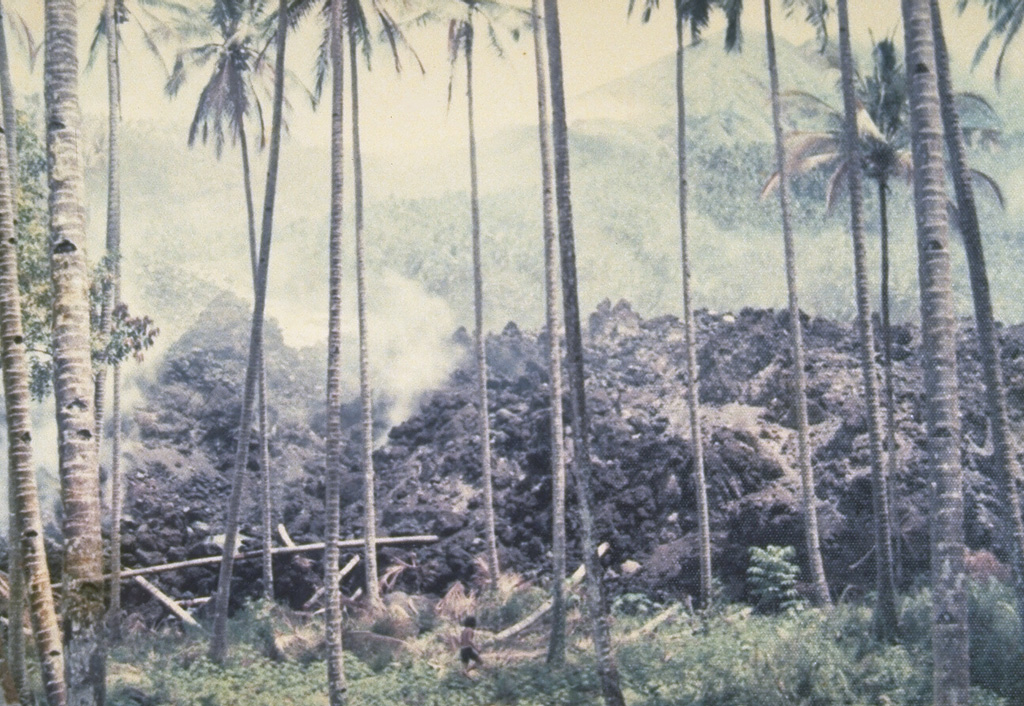
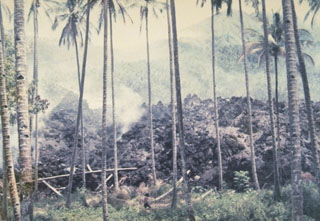
During 30 November to 2 December, incandescence was visible from lava in the upper flow field. Surface lava flows were not seen on the coastal flat or Pulama pali. At Kilauea, relatively strong shallow long-period seismicity at Halemaumau crater on 29 November decreased the following day. On these days a few deeper long-period earthquakes were recorded. On 29 November small amounts of inflation and deflation occurred, followed by very little deformation on 30 November.
Geological Summary. Kilauea overlaps the E flank of the massive Mauna Loa shield volcano in the island of Hawaii. Eruptions are prominent in Polynesian legends; written documentation since 1820 records frequent summit and flank lava flow eruptions interspersed with periods of long-term lava lake activity at Halemaumau crater in the summit caldera until 1924. The 3 x 5 km caldera was formed in several stages about 1,500 years ago and during the 18th century; eruptions have also originated from the lengthy East and Southwest rift zones, which extend to the ocean in both directions. About 90% of the surface of the basaltic shield volcano is formed of lava flows less than about 1,100 years old; 70% of the surface is younger than 600 years. The long-term eruption from the East rift zone between 1983 and 2018 produced lava flows covering more than 100 km2, destroyed hundreds of houses, and added new coastline.
Source: US Geological Survey Hawaiian Volcano Observatory (HVO)