Logo link to homepage

Report on Kilauea (United States) — 7 January-13 January 2004


Kilauea

Smithsonian Institution / US Geological Survey
Weekly Volcanic Activity Report, 7 January-13 January 2004
Managing Editor: Gari Mayberry.

Please cite this report as:

Global Volcanism Program, 2004. Report on Kilauea (United States) (Mayberry, G, ed.). Weekly Volcanic Activity Report, 7 January-13 January 2004. Smithsonian Institution and US Geological Survey.

Weekly Report (7 January-13 January 2004)

Kilauea

United States

19.421°N, 155.287°W; summit elev. 1222 m

All times are local (unless otherwise noted)


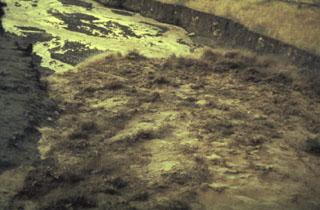
Volcanic activity continued at Kilauea's Pu`u `O`o crater during 8-12 January. Observers confirmed that most of the cones in the crater grew during the previous week and most cones were incandescent. Some days much lava was emitted from the West Gap vent, and the West Gap lava shield (a pile of lava flows built over a lava tube rather than over a conduit feeding magma) continued to expand. At Kilauea's summit few earthquakes and little, if any, volcanic tremor occurred. Volcanic tremor at Pu`u `O`o was continuous and at moderate levels. During the report period, small episodes of inflation and deflation occurred.

Geological Summary. Kilauea overlaps the E flank of the massive Mauna Loa shield volcano in the island of Hawaii. Eruptions are prominent in Polynesian legends; written documentation since 1820 records frequent summit and flank lava flow eruptions interspersed with periods of long-term lava lake activity at Halemaumau crater in the summit caldera until 1924. The 3 x 5 km caldera was formed in several stages about 1,500 years ago and during the 18th century; eruptions have also originated from the lengthy East and Southwest rift zones, which extend to the ocean in both directions. About 90% of the surface of the basaltic shield volcano is formed of lava flows less than about 1,100 years old; 70% of the surface is younger than 600 years. The long-term eruption from the East rift zone between 1983 and 2018 produced lava flows covering more than 100 km2, destroyed hundreds of houses, and added new coastline.

Source: US Geological Survey Hawaiian Volcano Observatory (HVO)